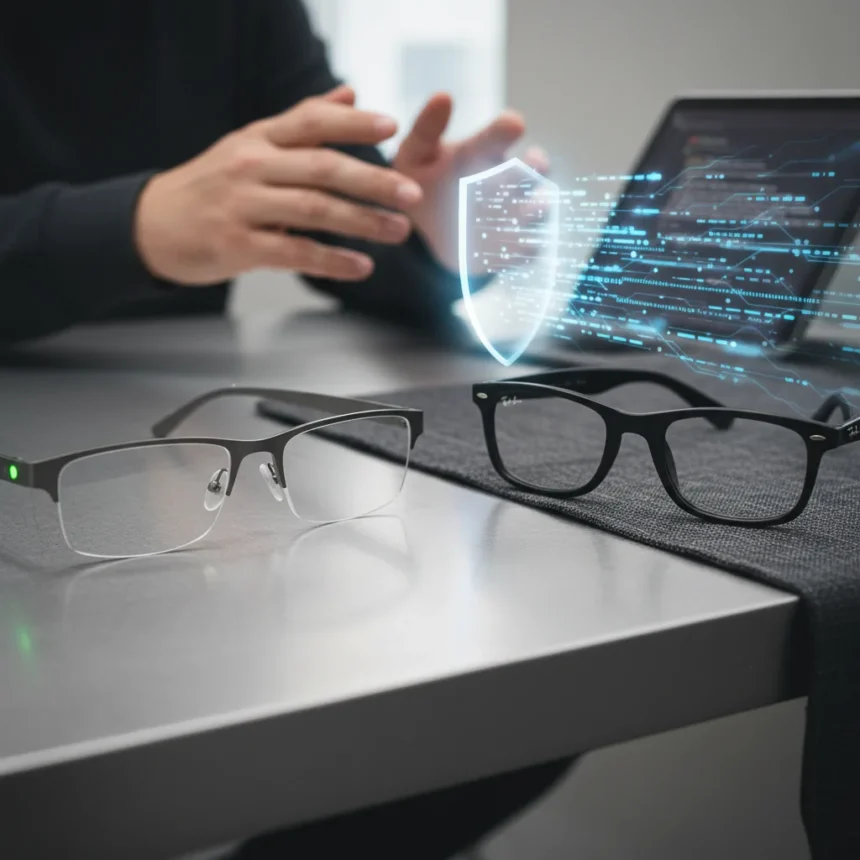
Apple smart glasses privacy is shaping up to be the defining competitive advantage that could lure even loyal Meta Ray-Bans users to switch when Apple’s rumored device launches in 2027. A smart glasses expert who has tested both ecosystems admits the privacy-first philosophy alone might be enough to justify abandoning Meta’s current market leader, despite Meta’s stronger sales momentum and more advanced AI capabilities.
Key Takeaways
- Apple’s smart glasses prioritize privacy through display-less design and on-device processing, differing fundamentally from Meta’s approach.
- Meta Ray-Bans have sold over 700,000 pairs at $299, with demand outpacing supply according to CEO Mark Zuckerberg.
- Apple’s glasses will feature integrated cameras, microphones, and sensors for photos, videos, calls, and hands-free AI via upgraded Siri.
- Apple plans late 2026 or early 2027 launch, with retail availability by 2027, as part of a broader three-device AI wearable strategy.
- Meta’s newer Ray-Ban Display model offers a small wearable screen and neural band controls, but lacks Apple’s ecosystem integration advantage.
Why Privacy Is Becoming the Deciding Factor
The smart glasses market has reached an inflection point where raw feature count no longer determines winner-take-all dominance. Apple smart glasses privacy approach represents a fundamental philosophical shift: data stays on the device, processed locally by Apple’s silicon, rather than streaming to cloud servers for analysis. This matters because smart glasses sit inches from your eyes, recording your visual perspective constantly. Meta Ray-Bans already capture photos and video; adding a display transforms them into always-on surveillance devices from the wearer’s perspective. Apple’s display-less design eliminates that psychological barrier while still delivering core functionality through audio feedback and haptic responses.
For a privacy-conscious user who has grown uncomfortable with Meta’s data collection practices, Apple smart glasses privacy positioning is not just a feature—it is a philosophical alignment. The expert quoted in the source material acknowledges this tension directly: Meta has built an enviable product with genuine demand, yet the privacy trade-off gnaws at them. Apple’s approach, by contrast, leverages its existing ecosystem of Watch, AirPods, and iPhone to create a closed loop where visual intelligence stays local. Competitors like RayNeo Air 4 Pro offer displays, but they lack Apple’s integration depth.
How Apple Smart Glasses Privacy Stacks Against Meta’s Current Offerings
Meta Ray-Bans dominate the current market with over 700,000 units sold and demand still outpacing supply, according to Meta CEO Mark Zuckerberg. At $299, they offer genuine utility: camera, Meta AI assistant, audio, and call functionality. Yet they represent a data-forward model where every interaction feeds Meta’s AI training pipeline. The newer Meta Ray-Ban Display glasses push this further with live preview, real-time translation, and navigation—features that require constant cloud processing. Meta’s AI is demonstrably smarter than Siri today, but that intelligence comes at a privacy cost.


Apple smart glasses privacy strategy flips this equation. The device will include cameras, microphones, and sensors for the same core tasks—photos, videos, calls, notifications—but with visual intelligence processed on-device through upgraded Siri and Apple Intelligence. This means fewer requests leaving your device, less behavioral data flowing to Apple’s servers, and no third-party training on your visual context. For users who have watched Meta expand its data collection across Ray-Bans into a broader ecosystem, Apple’s privacy-first positioning reads as a genuine alternative rather than a rebranded competitor.
The Ecosystem Advantage That Privacy Alone Cannot Explain
Privacy is the headline, but Apple smart glasses privacy appeal is amplified by ecosystem lock-in that Meta simply cannot replicate. Meta lacks a flagship smartphone or smartwatch; it relies on neural band gestures and voice commands for control. Apple owns the entire stack: iPhone for contextual notifications, Watch for fitness data, AirPods for audio, and now glasses for visual processing. This integration means Apple smart glasses can trigger contextual Siri responses based on what you are looking at, offer directions without pulling out your phone, and send visual reminders without a screen. Meta Ray-Bans cannot do this because Meta does not own the phone in your pocket.



The expert acknowledges this advantage explicitly: switching from Meta Ray-Bans would not be a lateral move but a commitment to the broader Apple ecosystem. For existing iPhone and Watch users, Apple smart glasses privacy benefits compound with convenience gains. For Android users or those invested in Meta’s ecosystem, the privacy advantage alone might not be enough to justify ecosystem switching. This is where Meta’s current lead remains defensible—they have shipped a product, proven demand, and built momentum. Apple has not yet launched, only conducted internal user studies via its Product Systems Quality Team (code-named Atlas) and planned focus groups to assess existing smart glasses.
When Will Apple Smart Glasses Privacy Leadership Actually Matter?
Apple’s rumored smart glasses are on track for late 2026 or early 2027 debut, with retail availability in 2027. This timeline gives Meta another 18-24 months to entrench Ray-Bans as the category standard. The newer Ray-Ban Display model, with its small wearable screen and neural band controls, signals Meta is not resting on non-display success. Yet Meta faces a structural disadvantage: it cannot credibly claim privacy as a core value when its entire business model depends on data collection and ad targeting. Apple, by contrast, has spent years positioning privacy as a brand pillar, from on-device Face ID to encrypted iMessage.
The question is not whether Apple smart glasses privacy will appeal to privacy-conscious users—it will. The question is whether that appeal is strong enough to overcome Meta’s first-mover advantage, lower price point, and superior AI capabilities. The expert’s admission that privacy alone might tempt them to switch suggests the answer is yes, at least for a segment of users who have grown weary of data extraction. For Meta, this represents an existential threat to the smart glasses category itself. If Apple succeeds in making privacy the primary decision criterion, Meta’s sales advantage evaporates.
FAQ: Apple Smart Glasses Privacy and Competitive Positioning
How much will Apple smart glasses cost compared to Meta Ray-Bans?
Apple has not announced pricing for its smart glasses. Meta Ray-Bans are priced at $299, with over 700,000 units sold. Apple’s entry price is unknown, though the company’s track record suggests a premium positioning relative to Meta’s offering.



What makes Apple’s privacy approach different from Meta Ray-Bans?
Apple smart glasses process visual intelligence on-device through upgraded Siri and Apple Intelligence, keeping data local rather than streaming to cloud servers. Meta Ray-Bans rely on cloud processing for AI features like real-time translation and navigation, meaning more behavioral data flows to Meta’s servers.
Will Apple smart glasses have a display like the new Meta Ray-Ban Display model?
No. Apple’s rumored smart glasses are display-less, using cameras, microphones, and sensors with audio feedback and haptic responses for user interaction. The newer Meta Ray-Ban Display glasses include a small wearable screen and neural band controls, but lack Apple’s ecosystem integration.
The smart glasses market is entering a critical phase where privacy and ecosystem integration are becoming as important as raw features and AI smarts. Apple smart glasses privacy positioning, combined with the company’s ability to leverage iPhone, Watch, and AirPods, could genuinely reshape the category—but only if Apple executes flawlessly at launch and prices competitively enough to justify ecosystem switching. For now, Meta’s lead is real, but it is not insurmountable.
Where to Buy
Apple iPhone 17 Pro | Apple iPhone 17e | Apple iPhone 17 Pro Max
Edited by the All Things Geek team.
Source: TechRadar