






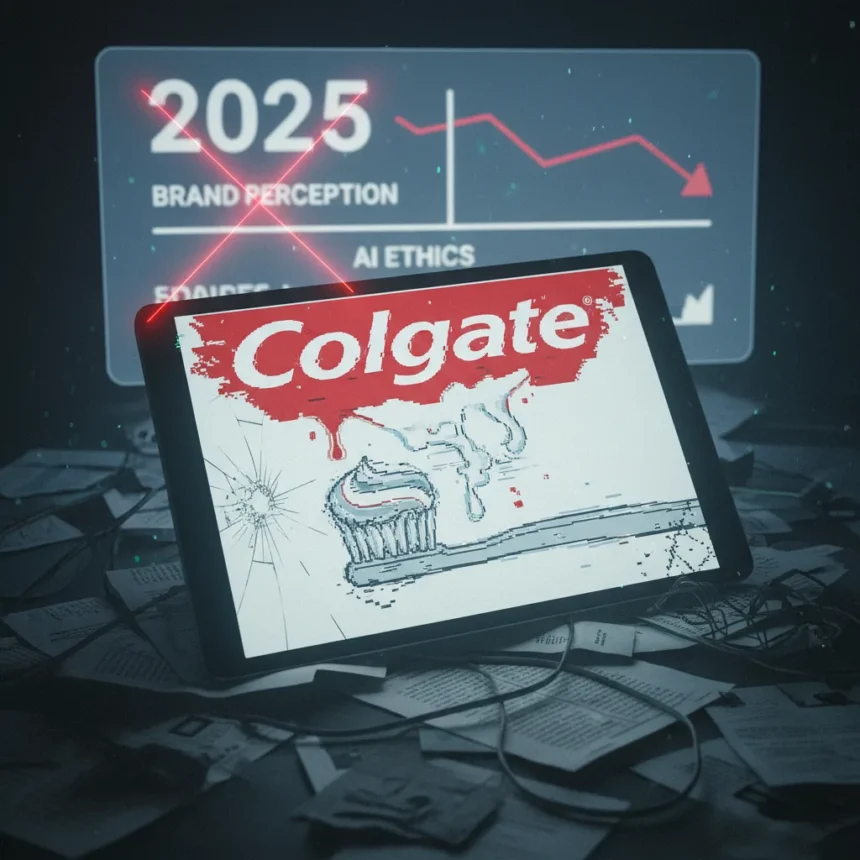
AI slop marketing has become a visible liability for major brands. Colgate recently posted low-quality AI-generated imagery on social media that was quickly flagged by designers and the public, prompting comments like “Please hire new graphic designers.” The incident highlights a broader 2025 trend: as awareness of AI-generated content spreads, audiences are becoming ruthlessly efficient at spotting low-effort output.
Key Takeaways
- Colgate posted AI-generated imagery criticized as low-effort, sparking designer backlash on social media.
- AI slop term usage surged 9x in 2025 compared to 2024, indicating mainstream consumer awareness.
- Coca-Cola and McDonald’s faced similar backlash for AI ads lacking emotional authenticity in 2024.
- Brands using AI slop marketing risk credibility damage when audiences detect minimal creative effort.
- Colgate-Palmolive’s stated AI policy prioritizes human augmentation and transparency, yet the post suggests execution gaps.
What is AI slop marketing?
AI slop refers to low-quality media—writing, images, video—generated by AI systems with minimal human refinement, effort, or purpose. The term emerged in the 2020s as a pejorative descriptor, similar to “spam” or “digital clutter.” In marketing, AI slop manifests as visuals with awkward anatomy, nonsensical text, or hollow emotional resonance. Unlike thoughtfully augmented AI content, which enhances human creativity, AI slop reads as a shortcut—a brand choosing efficiency over craft.
The term exploded into mainstream consciousness during 2025. Social listening analysis tracked a 9x surge in “AI slop” mentions between January 1 and November 20, 2025, compared to the same period in 2024. The phrase now appears routinely on Facebook, Pinterest, and design-focused forums. Colgate’s post arrived into an environment where audiences are primed to recognize and publicly call out lazy AI use.
Why Colgate’s timing made it worse
Colgate-Palmolive officially positions itself as leveraging AI for business processes, creativity, efficiency, and innovation across oral care and home care categories, with stated commitments to human augmentation and transparency. That policy framing makes the social media post a credibility gap—a gap audiences immediately spotted. The company claims to prioritize thoughtful AI integration, yet the imagery suggested minimal human oversight or quality control.



The backlash reflects a pattern. Coca-Cola faced similar criticism in 2024 for an AI-remade “Holidays Are Coming” advertisement created using multiple AI models via agencies. Critics called the result “soulless” and “creepy,” citing artificial character rendering and absence of emotional warmth. McDonald’s recent AI holiday ads also stumbled on the same problem: they lacked the authenticity and human judgment that audiences expect from established brands. Each incident teaches the same lesson—audiences detect when a brand has outsourced creative judgment to an AI system without meaningful human curation.
The 2025 AI slop reckoning
What separates 2025 from 2024 is scale of awareness. When the “AI slop” term usage jumped 9x year-over-year, it signaled that consumer detection of low-effort AI content moved from niche designer complaint to mainstream expectation. Ordinary social media users now possess a vocabulary and framework for identifying and criticizing AI-generated marketing. A brand cannot assume invisibility anymore.



Colgate’s post became a case study in that shift. No independent verification confirms the AI origin of the imagery, and Colgate has not publicly responded to the accusations. However, the speed and volume of public criticism—and the designer-led framing—suggest that audiences are now actively auditing brand content for authenticity markers. A post that might have scrolled past unnoticed two years ago now triggers immediate scrutiny.
What Coca-Cola and McDonald’s teach us
Coca-Cola’s 2024 AI Christmas ad remake and McDonald’s AI holiday campaigns both demonstrated that high-profile brands are experimenting with AI-generated advertising. Both experiments failed not because AI was involved, but because the execution prioritized speed over craft. The characters felt artificial. The emotional beats missed. The result read as a brand cutting corners rather than a brand exploring new creative tools.
Brands that successfully integrate AI tend to use it as augmentation—a tool that amplifies human creativity rather than replacing it. The inverse, which Colgate appears to have stumbled into, treats AI as a cost-cutting shortcut. Audiences detect the difference instantly. In 2025, that detection is no longer silent criticism from a niche audience—it becomes public social media commentary that damages brand perception.
Does Colgate-Palmolive’s AI policy address this?
Colgate-Palmolive’s official artificial intelligence policy states a commitment to human augmentation, transparency, and responsible AI use across business processes and creative work. The policy framework exists. The Colgate post suggests either a gap between policy and execution, or a failure of oversight in social media operations. Either scenario is damaging—it signals that stated principles do not translate into consistent practice.



Why this matters beyond Colgate
The Colgate incident is not an isolated misstep. It is a signal that 2025 is the year audiences stopped tolerating low-effort AI marketing. The 9x surge in “AI slop” terminology reflects a cultural shift: consumers now have language for what they are detecting, and they are willing to voice it publicly. Brands that treat AI as a replacement for human creativity will face the same backlash. Brands that treat it as a tool to enhance human judgment may avoid it.
For marketers, the lesson is straightforward. AI tools are powerful. But power without judgment reads as laziness. Colgate’s social media post cost the brand credibility not because AI was involved, but because the output suggested minimal human curation. In 2025, that is no longer invisible.
Should brands avoid AI in marketing entirely?
No. The issue is not AI itself but AI slop—low-quality output presented without refinement. Brands can use generative AI to accelerate ideation, create multiple design variations for human review, or augment existing creative work. The failure occurs when a brand skips the human judgment phase and publishes raw AI output. Coca-Cola’s mistake was not using AI; it was presenting AI output as a finished creative product.
How do audiences identify AI slop in marketing?
Audiences now recognize visual and textual tells: anatomical inconsistencies, nonsensical text, flat emotional resonance, and a general sense of “off-ness” that signals minimal human oversight. Designers and creative professionals are particularly attuned to these markers. Social media amplifies their observations instantly. A post flagged by design professionals often triggers broader public agreement within hours.
What should Colgate do next?
Acknowledge the gap between stated AI policy and execution, remove the problematic imagery, and recommit publicly to human-led creative review before publication. Silence or defensiveness will only deepen the credibility damage. Brands that acknowledge missteps and demonstrate corrective action often recover faster than those that ignore public feedback. The 2025 audience is watching—and they are equipped with language to describe what they see.
Colgate’s post is not unique. It is a preview of 2025’s brand reckoning with AI. As the “AI slop” term enters mainstream usage and audience detection sharpens, brands that skip the human judgment phase will face public criticism. The ones that treat AI as a tool requiring thoughtful human curation will move forward without incident. The choice, and the consequence, now rest entirely with the brand.
This article was written with AI assistance and editorially reviewed.
Source: Creativebloq