





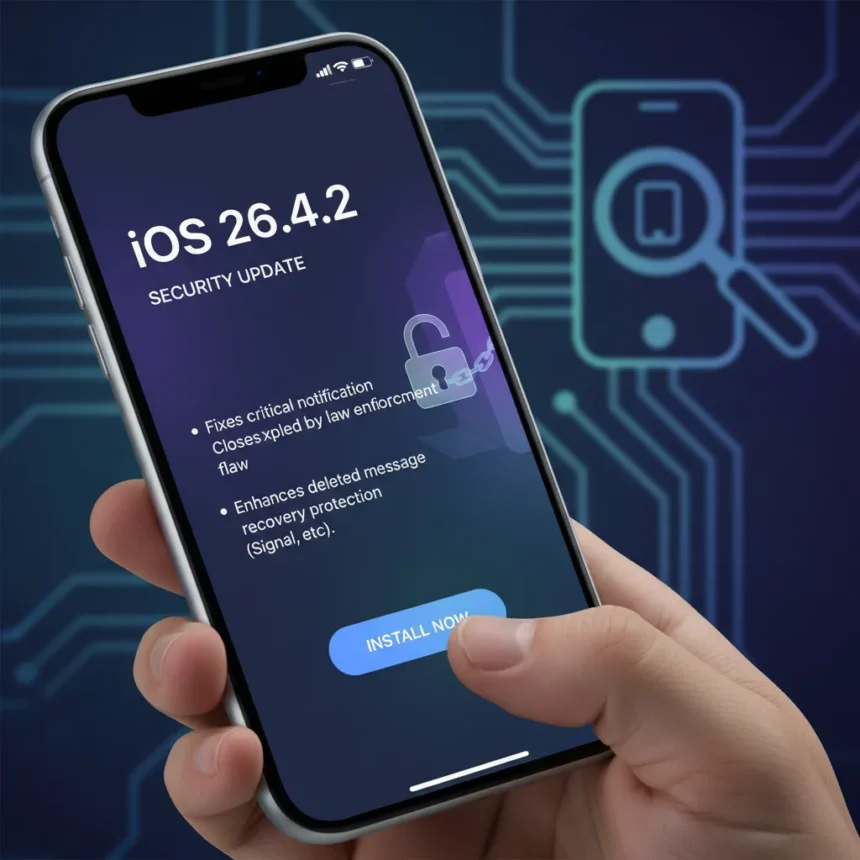
iOS 26.4.2 notification privacy represents a significant security win for iPhone users, closing a loophole that law enforcement agencies actively exploited to access supposedly deleted private messages. The update patches a critical flaw in how iOS handles notification logs, preventing forensic extraction of deleted Signal chats even after users removed the app entirely.
Key Takeaways
- iOS 26.4.2 patches a notification privacy flaw that let the FBI extract deleted Signal messages from iPhones
- The exploit worked by accessing notification database logs rather than the Signal app itself
- Free update available now for iPhone 11 and later via Settings
- Apple does not explicitly mention the FBI connection in official release notes
- Related updates include iPadOS 26.4.2 and iOS 18.7.8 for older devices
How the FBI exploited iOS 26.4.1 notification logs
The flaw allowed federal agents to recover deleted Signal conversations by directly accessing an iPhone’s notification database, bypassing the app itself entirely. Even after users deleted Signal, the notification system retained cached message previews and chat fragments in its logs. This meant law enforcement could reconstruct entire conversations without ever needing Signal’s encryption keys or the user’s password.
The technique surfaced publicly in connection with a case involving anti-ICE protests in Texas, where the FBI used this method to extract evidence from a suspect’s device. Apple became aware of the issue and moved quickly to patch it, though the company avoided naming the FBI or law enforcement in its official security documentation. Secondary sources like MacRumors and 404 Media connected the dots between the notification flaw and the law enforcement use case.
What iOS 26.4.2 notification privacy actually fixes
The patch prevents extraction of deleted messages from notification logs, fundamentally closing the forensic pathway that made the exploit possible. Apple’s fix ensures that once a notification is cleared, it cannot be recovered through database access. This is different from encrypting notifications themselves—it’s about preventing the OS from retaining recoverable traces of deleted content.


This distinction matters because it shows Apple is not just adding encryption layers but actually removing the ability to preserve deleted data in the first place. Compared to messaging apps like Signal, which rely on client-side encryption, iOS 26.4.2 notification privacy takes a system-level approach to preventing law enforcement access. The update also includes unrelated fixes for keyboard lag, CarPlay changes, and Apple Watch alarm functionality.
Should you update to iOS 26.4.2?
Yes. This is a security patch addressing a real-world exploit, not a cosmetic update. If you use Signal or any messaging app with notification previews, the notification privacy flaw could expose your deleted conversations to forensic extraction. The update is free and available immediately for iPhone 11 and later through Settings > General > Software Update.



Users still running iOS 18 should update to iOS 18.7.8, which includes the same notification privacy patch. The rollout is straightforward—no complications, no performance trade-offs. There is no reason to delay.
Does iOS 26.4.2 notification privacy affect other apps?
The flaw and its patch apply to any app that sends notifications with message previews, not just Signal. Any messaging platform—Telegram, WhatsApp, iMessage—could theoretically have had its deleted notifications extracted through the same database access method. iOS 26.4.2 notification privacy closes this vector for all apps simultaneously.
Why didn’t Apple mention the FBI in the release notes?
Apple’s official security documentation rarely names law enforcement agencies or specific real-world exploits by name. The company prefers describing vulnerabilities in technical terms—CVE numbers, affected components, patched functions—rather than contextualizing them with operational use cases. This approach keeps the focus on the technical fix rather than the political implications of law enforcement using the exploit.
How does iOS 26.4.2 compare to Android’s notification handling?
Android’s notification system works differently—it does not cache deleted message previews in the same persistent database format that iOS does. This architectural difference meant Android users were not vulnerable to the same forensic extraction technique. However, this does not mean Android is inherently more private; it simply means law enforcement would need to use different methods to access deleted content on Android devices. iOS 26.4.2 notification privacy now brings Apple’s approach closer to Android’s baseline, though neither system is immune to forensic techniques entirely.



The real takeaway is that iOS 26.4.2 notification privacy matters because it closes a specific, documented, actively exploited vulnerability. Install it immediately if you have not already.
Where to Buy
Apple iPhone 17 Pro | Apple iPhone 17 Pro Max | Samsung Galaxy S26 | Samsung Galaxy S26 Plus | Samsung Galaxy S26 Ultra
Edited by the All Things Geek team.
Source: TechRadar




