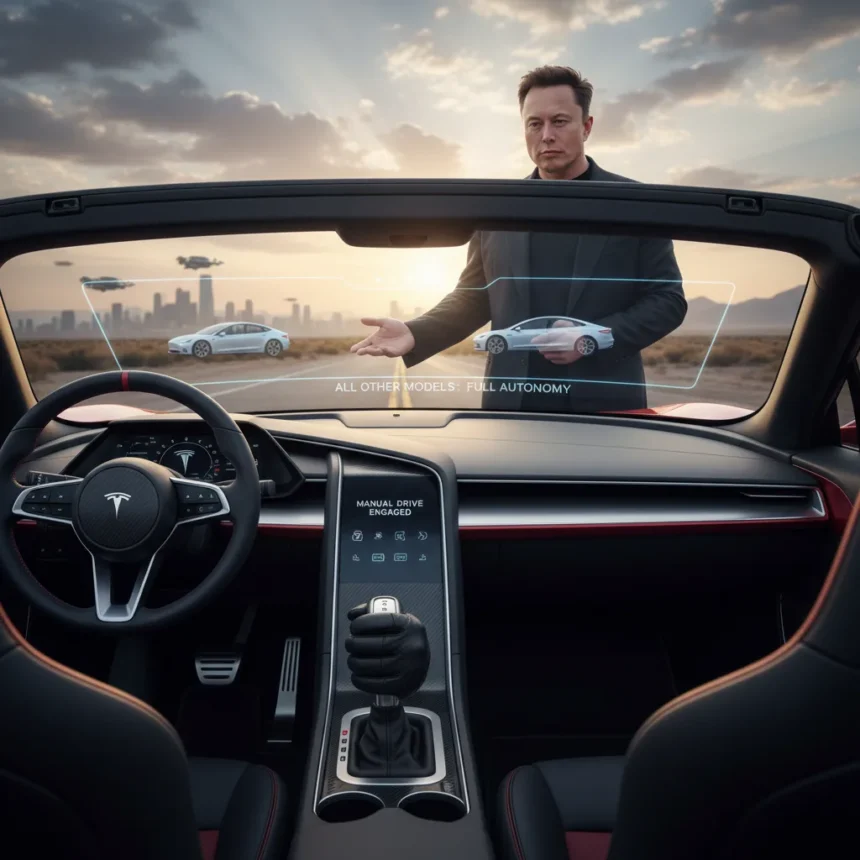
Elon Musk has declared that the Tesla Roadster will be the only manually driven car in Tesla’s future lineup, signaling the automaker’s aggressive pivot toward full autonomy across every other model. Musk described the Roadster as “the best of the last of the human-driven cars,” positioning it as a collector’s piece and historical milestone before autonomous transport dominates the road.
Key Takeaways
- Elon Musk stated the Tesla Roadster will be Tesla’s only manually driven car long-term
- The Roadster boasts sub-2-second 0–60 mph acceleration and 250+ mph top speed
- Tesla plans an April 1 Roadster unveiling with unconfirmed advanced features
- Musk indicated safety is secondary to performance for the Roadster
- Tesla is pursuing FSD and Cybercab robotaxis to remove humans from driving
The Tesla Roadster as the Final Driver’s Car
The Tesla Roadster manual car represents a deliberate strategic choice: while Tesla invests billions in autonomous driving, the Roadster will remain a pure driver’s machine. Musk’s framing of the vehicle as “the best of the last” acknowledges a fundamental shift in automotive philosophy. The Roadster will offer extreme performance—sub-2-second acceleration to 60 mph, a 250+ mph top speed, and a 620-mile range—designed to appeal to enthusiasts who value control and raw speed over convenience. This positions the Roadster as the apex predator of the human-driven era, a final celebration of mechanical mastery before robotaxis and autonomous fleets become the default.
Interestingly, the Tesla Roadster manual car will still offer Full Self-Driving (FSD) as an optional feature, though Musk’s comments suggest the focus is squarely on manual capability. This paradox—a manually driven car with autonomous technology available—underscores Tesla’s confidence in FSD while reserving the Roadster as a deliberate exception. For drivers who prioritize the tactile experience of controlling a high-performance vehicle, the Roadster becomes a rare commodity in a future dominated by autonomous systems.
Tesla’s Broader Shift to Autonomous Everything
Musk’s statement about the Tesla Roadster manual car must be understood within Tesla’s larger autonomy strategy. The company is aggressively pursuing FSD capabilities and developing the Cybercab, a robotaxi network designed to remove human drivers entirely from the equation. By reserving the Roadster as the sole manually driven model, Tesla is making a bold bet that autonomy will eventually replace human driving across all other segments—sedans, SUVs, trucks, and utility vehicles. The Roadster becomes the exception that proves the rule: in Tesla’s long-term vision, driving is optional, not essential.

This strategy contrasts sharply with competitors who continue to develop multiple manually driven models alongside autonomous research. Tesla is essentially saying: buy the Roadster if you want to drive; buy any other Tesla if you want autonomy to handle the road. It’s a clean narrative, though it remains to be seen whether consumers will accept such a binary choice or whether regulatory and safety concerns will force Tesla to maintain manual options across more of its lineup.
Speculation Around the Roadster’s Future Form
Musk has hinted that the Tesla Roadster manual car “might not even be a car anymore,” fueling speculation about flying capabilities or other radical features beyond traditional automotive design. In the same conversation, Musk predicted that flying cars will be available at scale within the next 15 years. While these remarks are speculative and unconfirmed, they suggest Musk views the Roadster as a boundary-pushing platform—potentially the last human-controlled vehicle before transportation becomes fully autonomous and possibly airborne.



The April 1 unveiling date adds uncertainty; whether this is a firm production timeline or another iteration in the Roadster’s notoriously delayed development cycle remains unclear. The original Roadster was revealed in 2017, and production timelines have shifted multiple times since then. Musk’s latest statements may signal a genuine commitment to bringing the vehicle to market, or they may reflect his characteristic optimism about timelines that often slip.
Is the Tesla Roadster worth waiting for if you want a manual car?
If Musk’s vision holds, the Tesla Roadster manual car will be one of the last high-performance vehicles you can actually drive yourself. For enthusiasts who value control and the tactile experience of driving, it represents a final opportunity to own a latest manual sports car before autonomy becomes ubiquitous. However, the repeated delays since 2017 suggest caution is warranted—the Roadster’s history is littered with missed timelines and shifted expectations.
Will all other Tesla models become fully autonomous?
According to Musk’s statements, yes. Tesla’s long-term strategy positions the Roadster as the sole exception, with all other models shifting to full autonomy through FSD and robotaxi networks. This represents a dramatic departure from the automotive industry’s current approach, where manual driving remains standard across most segments. Whether regulatory bodies will permit such a shift remains an open question.
Could Musk’s flying car prediction affect the Roadster’s design?
Musk’s hints that the Roadster “might not even be a car anymore” and his prediction of flying cars at scale within 15 years suggest the vehicle could incorporate features beyond traditional automotive design. However, these remarks are speculative. The actual capabilities and design of the final Roadster remain unconfirmed, and past statements from Musk about ambitious features have not always materialized as promised.



Elon Musk’s vision of the Tesla Roadster as the final manually driven car in Tesla’s lineup is bold, if audacious. It reflects a company betting entirely on autonomy while carving out one last space for human control—a strategic concession to driving enthusiasts in an otherwise autonomous future. Whether the Roadster lives up to the hype, arrives on schedule, or incorporates the speculated flying features remains to be seen. What is clear is that if Musk’s vision prevails, owning a Tesla Roadster manual car will become a historical artifact, a collector’s piece from the era when humans still steered their own vehicles.
Edited by the All Things Geek team.
Source: TechRadar