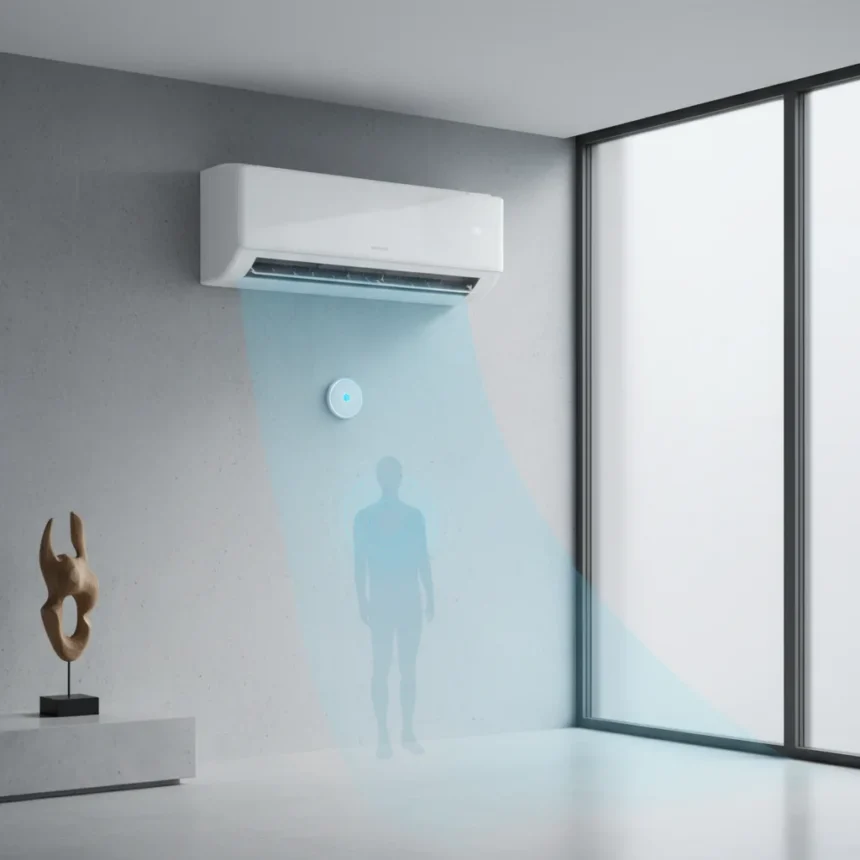
Xiaomi’s smart air conditioner motion sensor technology represents a shift toward adaptive climate control that responds to actual room occupancy rather than fixed schedules. The company has launched multiple models equipped with built-in mmWave radar sensors that detect human presence and adjust cooling intensity accordingly, addressing a fundamental inefficiency in traditional air conditioning: running at full capacity in empty rooms.
Key Takeaways
- Xiaomi air conditioners use mmWave radar sensors to detect occupancy and adjust airflow automatically.
- The smart air conditioner motion sensor reduces energy consumption when rooms are unoccupied.
- Models include directional cooling that focuses airflow where people are detected.
- Integration with the Mi Home app allows remote monitoring and manual override.
- Presence-sensing technology eliminates wasted cooling cycles in empty spaces.
How Xiaomi’s Smart Air Conditioner Motion Sensor Works
The smart air conditioner motion sensor relies on mmWave radar technology embedded in the unit itself. This radar continuously scans the room for human presence without requiring wearable devices or manual input. When the sensor detects occupancy, the air conditioner operates at normal cooling capacity. When it determines the room is empty, the system enters an energy-saving mode that reduces power consumption while maintaining the space at a preset temperature. This approach eliminates the guesswork of timer-based schedules and responds to actual usage patterns rather than assumptions about when people will be present.
The directional cooling feature works in tandem with occupancy detection. Once the smart air conditioner motion sensor identifies where people are located within the room, it directs airflow toward occupied zones. This prevents the inefficiency of cooling the entire space uniformly and reduces the temperature gradient that typically occurs in larger rooms. The result is faster cooling where it matters and lower overall energy expenditure.
Energy Savings and Smart Home Integration
Energy efficiency is the primary advantage of Xiaomi’s smart air conditioner motion sensor approach. Traditional units cool continuously regardless of whether anyone is in the room, wasting significant power during work hours or when occupants leave. By automatically reducing output when spaces are empty, these models cut idle-state energy consumption substantially. The system maintains comfort during occupied periods while preventing unnecessary cooling cycles.


The smart air conditioner motion sensor integrates with the Mi Home app, allowing users to monitor and control the unit remotely. This connectivity enables manual overrides when automated behavior does not match user preferences, though most users will find the automatic detection sufficient for daily operation. The app provides visibility into energy consumption patterns, helping occupants understand their cooling habits and identify further optimization opportunities.
Smart Air Conditioner Motion Sensor vs. Traditional Climate Control
Traditional air conditioners operate on fixed schedules or constant thermostat settings. They have no awareness of occupancy and waste energy cooling empty spaces. Xiaomi’s smart air conditioner motion sensor eliminates this inefficiency by introducing situational awareness to the cooling process. The mmWave radar approach differs from simpler motion detection methods because it operates continuously without line-of-sight requirements and detects subtle movements rather than just major motion events, making false positives rare.



Competing smart air conditioners may offer WiFi connectivity and app control, but fewer models integrate occupancy detection directly into the unit. Most require separate sensors or rely on smartphone location as a proxy for presence, which introduces delays and false negatives. Xiaomi’s integrated approach simplifies installation and improves reliability by eliminating dependency on external devices or network connectivity for the core occupancy-detection function.
Is Xiaomi’s Smart Air Conditioner Motion Sensor Worth the Premium?
The smart air conditioner motion sensor adds cost to the unit, but the energy savings justify the investment for most users. In climates with extended cooling seasons or in commercial spaces where occupancy is irregular, payback periods are typically 1-2 years. Residential users who work outside the home benefit most from automatic energy-saving modes that prevent cooling empty houses during business hours.
The convenience factor also matters. No scheduling, no manual adjustments, no guilt about forgetting to turn off the air conditioner when leaving a room. The system handles these decisions automatically and learns to adapt to your patterns over time. For anyone tired of managing thermostats or paying inflated cooling bills, the smart air conditioner motion sensor offers genuine practical value.
Does the Xiaomi smart air conditioner motion sensor work in all room sizes?
Yes, the mmWave radar sensor functions in rooms of various sizes, though larger spaces may benefit more from directional cooling features that focus airflow on occupied zones. The sensor detects presence across the entire room and adjusts output accordingly. In very large open-plan spaces, directional cooling ensures efficient coverage without cooling unused areas.



Can you disable the motion sensor if you prefer manual control?
The Mi Home app allows users to override automatic occupancy detection and set fixed cooling schedules or manual operation modes. This flexibility ensures the smart air conditioner motion sensor adapts to different preferences and use cases, from fully automatic operation to traditional scheduled cooling.
How does the smart air conditioner motion sensor affect noise levels?
The mmWave radar operates silently and does not introduce additional noise to the unit. Energy-saving modes may actually reduce noise because the compressor runs at lower capacity when the room is unoccupied, resulting in quieter overall operation compared to traditional units running continuously.
Xiaomi’s smart air conditioner motion sensor represents practical innovation in home climate control. It solves a real problem—wasted energy in empty rooms—with a simple, integrated solution that requires no additional hardware or complex setup. For anyone seeking to reduce cooling costs without sacrificing comfort, this technology delivers measurable value.
Where to Buy
Edited by the All Things Geek team.
Source: T3