




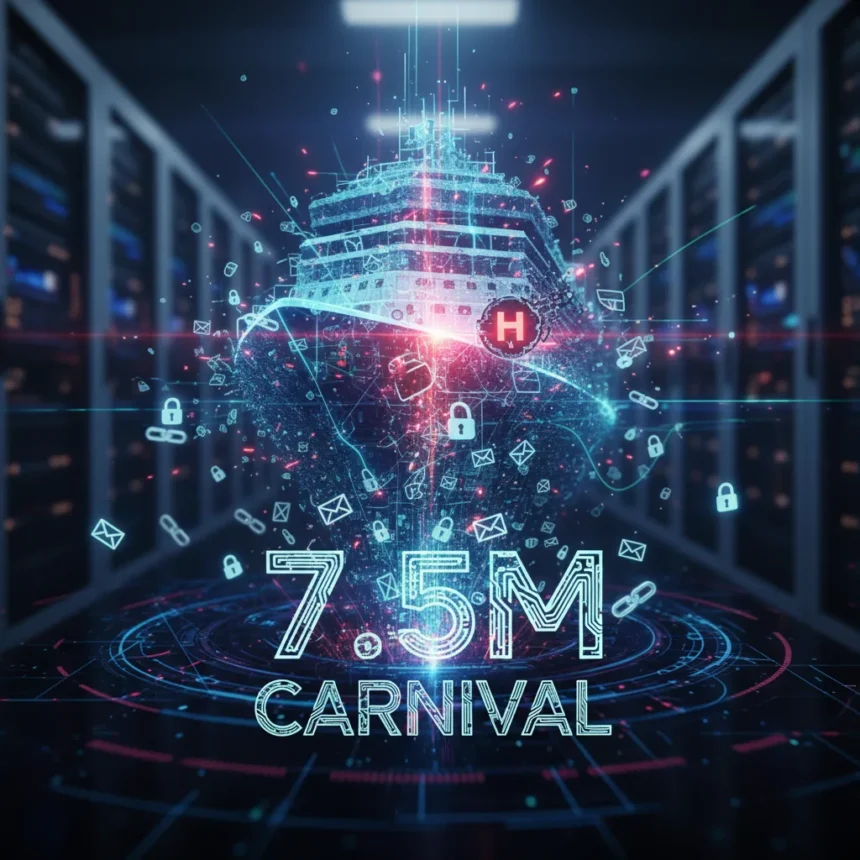
The ShinyHunters data breach has claimed another major victim. In April 2026, the notorious hacking collective publicly leaked 7.5 million email addresses and personal records stolen from Carnival Corporation, the world’s largest cruise company, after the firm refused to meet their extortion demands. The breach represents one of the largest loyalty program compromises in recent memory and signals an escalating threat to travel and hospitality firms worldwide.
Key Takeaways
- ShinyHunters leaked 8.7 million records including 7.5 million unique email addresses from Carnival’s Mariner Society loyalty program.
- The hacking collective targeted Carnival’s Holland America Line subsidiary via a phishing attack on a single user account.
- ShinyHunters demanded payment by April 21, 2026, then published the data publicly after Carnival refused negotiation.
- The breach is part of a coordinated campaign hitting over 40 organizations including Zara, 7-Eleven, and Medtronic.
- Exposed data includes names, dates of birth, genders, and membership status usable for fraud and targeted phishing attacks.
What Happened in the ShinyHunters Data Breach
ShinyHunters claimed to have obtained 8.7 million records from Carnival Corporation through what they described as a supply chain attack targeting Holland America Line, a subsidiary of the cruise giant. The stolen data specifically relates to the Mariner Society loyalty program and includes names, dates of birth, genders, membership status, and other personal information that criminals can weaponize for identity theft and phishing campaigns. Carnival acknowledged the incident but characterized it differently: the company stated that unauthorized activity involved a single user account, which they quickly shut down and reported to law enforcement. The discrepancy between Carnival’s account of a isolated phishing incident and ShinyHunters’ claim of a broader supply chain compromise remains unresolved, with the true scope of the breach still under investigation.
Have I Been Pwned, the authoritative breach notification service, flagged the Carnival breach and added it to their public database, allowing millions of loyalty program members to check whether their personal information was exposed.
The Extortion Demand That Carnival Refused
ShinyHunters posted a message on their leak site that crystallized their frustration: “The company failed to reach an agreement with us despite our incredible patience… They don’t care”. The group set a deadline of April 21, 2026, for Carnival to meet their extortion demands, but the cruise operator refused to negotiate. When the deadline passed, ShinyHunters made good on their threat and released the stolen data publicly on criminal platforms, where it remains available indefinitely. This escalation reflects a pattern in which ransomware groups and data thieves are increasingly willing to burn bridges and publish stolen information when targets decline to pay, turning failed extortion into reputational damage and fraud risk for victims.


Carnival’s decision to refuse payment aligns with guidance from law enforcement and cybersecurity experts who discourage ransom payments, as they fund criminal operations and incentivize future attacks. However, the public release of millions of email addresses and personal data creates real downstream harm for loyalty program members, who now face increased phishing and social engineering targeting.
ShinyHunters’ Broader Campaign Targeting 40+ Organizations
The Carnival breach is not an isolated incident but part of a coordinated campaign by ShinyHunters against over 40 major organizations. The group has claimed breaches affecting Mytheresa, Zara, 7-Eleven, Pitney Bowes, Canada Life Assurance, Hallmark, Medtronic (9 million records), Aman Resorts, and Marcus & Millichap, among others. In total, the campaign involves millions of records and terabytes of internal data, all leaked indefinitely on criminal platforms where they can be purchased, analyzed, or weaponized by other threat actors. This scale suggests a coordinated, sustained operation rather than opportunistic attacks—ShinyHunters is systematically targeting major brands across retail, insurance, healthcare, and hospitality sectors.



The breadth of this campaign underscores a troubling reality: large organizations with mature security programs are still falling to phishing attacks and supply chain compromises. Carnival is not a small or unsophisticated target; it is a multinational corporation with significant resources. Yet a single compromised user account was enough to unlock millions of customer records, suggesting that phishing remains one of the most effective attack vectors even against well-resourced firms.
What Data Was Exposed and What Comes Next
The stolen Mariner Society data includes names, dates of birth, genders, membership status, and contact information—a complete profile usable for targeted fraud and phishing. Criminals can use this information to craft convincing messages impersonating Carnival or Holland America Line, tricking members into clicking malicious links or providing additional credentials. The exposure of dates of birth is particularly dangerous, as this information is often used as a security question for account recovery across multiple services.
Carnival has not disclosed whether payment card data or passport information was compromised, leaving members uncertain about the full extent of the exposure. The company is investigating the scope of the breach and has notified law enforcement, but the public release of data means that damage mitigation is now reactive rather than preventative. Members of the Mariner Society should monitor their accounts for fraudulent activity, enable two-factor authentication wherever possible, and watch for phishing emails impersonating Carnival or its subsidiaries.
Carnival’s History of Cybersecurity Incidents
This is not Carnival’s first brush with serious cybersecurity failures. The company previously agreed to pay $6 million to US states following prior cyberattacks, signaling a pattern of security lapses. The repetition of major breaches raises questions about whether Carnival’s security investments and incident response capabilities are keeping pace with the threat landscape. Travel and hospitality companies are attractive targets because they hold sensitive personal data (passport numbers, payment methods, travel itineraries) and operate in a competitive industry where downtime is costly, making them more likely to negotiate with extortionists.



FAQ
How many Carnival customers were affected by the ShinyHunters data breach?
ShinyHunters claimed to have stolen 8.7 million records, including 7.5 million unique email addresses from Carnival’s Mariner Society loyalty program. The exact number of individual members affected depends on whether some email addresses belong to the same person across multiple accounts, but the exposure is massive and affects a significant portion of the loyalty program’s user base.
Should I change my password if I’m a Carnival Mariner Society member?
Yes. If you are a member of the Mariner Society loyalty program, change your password immediately and enable two-factor authentication if available. Monitor your email and payment methods for fraudulent activity, and consider placing a fraud alert with credit bureaus. You can check whether your email was in the breach using Have I Been Pwned.
Is the ShinyHunters data breach still ongoing?
The Carnival breach itself is not ongoing—the stolen data has already been published—but ShinyHunters continues to target other organizations as part of their broader 40-company campaign. The group remains active and shows no signs of slowing down, making this a persistent threat to major firms across multiple industries.
The ShinyHunters data breach exposes a critical vulnerability in how large organizations handle phishing attacks and supply chain security. Carnival’s refusal to pay extortion may have been principled, but it left millions of loyalty program members vulnerable to downstream fraud and identity theft. For travelers and cruise passengers, the lesson is clear: monitor your accounts closely, use strong unique passwords, and assume that your personal data may already be in the hands of criminals. For enterprises, the message is equally stark: a single compromised user account can unlock millions of customer records, and no company—no matter how large—is immune to phishing attacks.
This article was written with AI assistance and editorially reviewed.
Source: TechRadar