






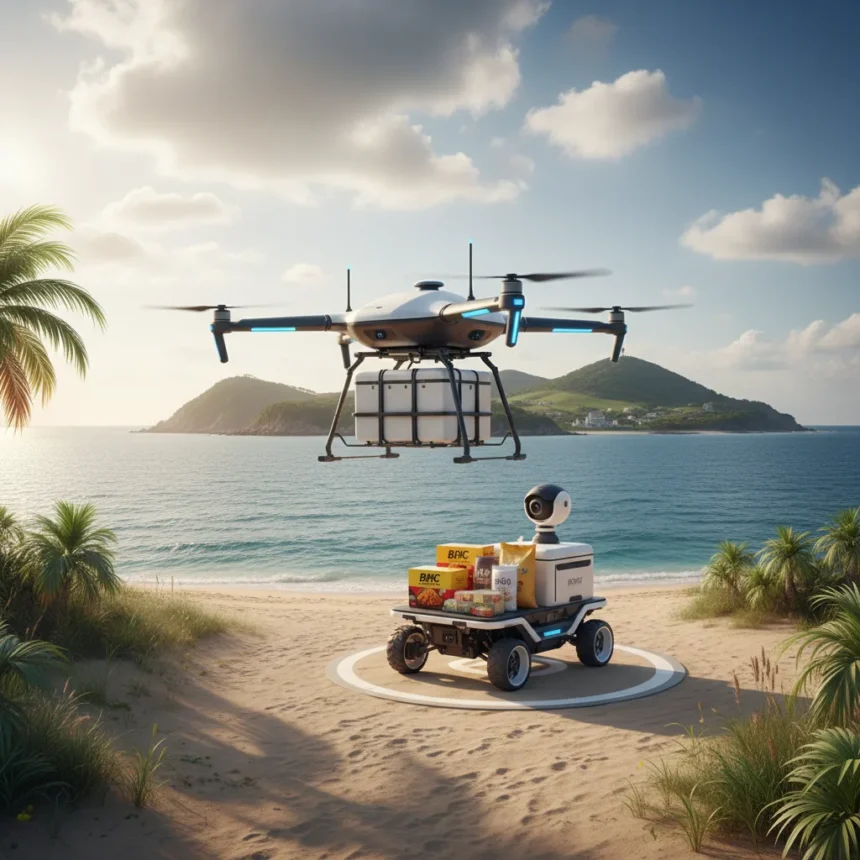
South Korea’s drone-to-robot delivery system just proved it can handle one of logistics’ toughest challenges: getting hot fried chicken to people living on remote islands without roads. The Korea Aerospace Administration (KASA) and Electronics and Telecommunications Research Institute (ETRI) conducted a monthlong trial starting March 26, 2026, on Biyang Island off Jeju, demonstrating that the combination of heavy-lift drones and autonomous ground robots could reshape how remote communities receive goods.
Key Takeaways
- South Korea completed approximately 80 drone delivery trials over one month on Biyang Island
- Heavy-lift drones carried payloads up to 40 kilograms across 3 kilometers of ocean, compared to standard commercial drones carrying about 3 kilograms
- An autonomous robot navigated narrow alleys at walking pace to deliver packages to 56 locations, including private homes and restaurants
- KASA plans to launch nationwide drone delivery by 2031 as part of a five-year development roadmap
- Items delivered included 10-kilogram bags of rice, dumbbells, food, and household goods, proving the system handles diverse cargo types
How the drone-to-robot delivery system works
The process strips away the romance of delivery drones and replaces it with practical engineering. A heavy-lift drone departs from Geumneung Port carrying a package, crosses approximately 3 kilometers of open ocean, and lands safely in an empty lot near the dock on Biyang Island. An autonomous rectangular robot then approaches, retrieves the package, and navigates the island’s narrow alleys at walking pace. When the robot reaches its destination, it sounds an alert to notify the local resident, who retrieves their order. This handoff between drone and ground robot solves the last-mile problem that has frustrated autonomous delivery companies worldwide—getting packages from a landing zone to someone’s door in spaces too cramped for vehicles.
The trial reached 56 locations across Biyang Island, including private homes and restaurants, proving the system can serve diverse end-points rather than just centralized pickup points. Items delivered included 10-kilogram bags of rice, dumbbells, food, and household goods, demonstrating that the system handles weight and variety that standard commercial drones cannot manage. Most , the payload capacity—up to 40 kilograms per flight—dwarfs the roughly 3-kilogram limit of typical commercial drones, a crucial advantage for serving remote populations that rely on bulk deliveries of essentials.
Why remote islands matter for drone logistics
Biyang Island represents an ideal testing ground because it exposes every weakness in current delivery infrastructure. No roads connect the island to the mainland. Ferries run on schedules that don’t align with urgent needs. Residents who want fried chicken, groceries, or household supplies face delays measured in hours or days. A drone-to-robot system bypasses these constraints entirely, moving goods across water faster than any conventional transport and then completing the final stretch autonomously.


This trial also sidesteps regulatory complexity that plagues drone delivery in dense urban areas. Remote islands have fewer residents, clearer airspace, and fewer obstacles—making them safer testing grounds for autonomous systems. South Korea’s government recognized this advantage and invested accordingly. The monthlong trial generated operational data that will inform nationwide rollout plans. KASA intends to launch nationwide drone delivery by 2031, a timeline that reflects confidence in the technology but also the engineering work still required.
Drone-to-robot delivery versus global competitors
Most drone delivery trials worldwide stop at the drone. Wing, Amazon’s delivery unit, Zipline, and other companies have focused on autonomous flight and landing, leaving the final delivery to human couriers or static pickup points. South Korea’s approach is different—it treats the last mile as an equally important engineering problem. By pairing drones with autonomous ground robots, KASA and ETRI created a system that requires no human intervention once the drone lands, a significant step toward fully autonomous delivery chains.



The 40-kilogram payload capacity also distinguishes South Korea’s heavy-lift drones from most commercial competitors. Standard delivery drones carry small packages—a meal, a parcel, a prescription. South Korea’s system moves bulk goods: rice, dumbbells, multiple meals, household items. For remote populations, bulk capacity matters more than speed. A resident on Biyang Island cares more about receiving a month’s worth of staples in one delivery than about receiving a single item in 30 minutes.
What happens next in the five-year roadmap
The trial’s success doesn’t mean the system is ready for everyday use. KASA and ETRI have set an ambitious five-year goal to build a drone-robot delivery system for everyday use by 2031. That timeline implies significant work ahead: refining autonomous navigation in varied terrain, improving battery life for longer ocean crossings, hardening the system against weather, and establishing regulatory frameworks that allow autonomous drones to operate at scale without constant human oversight.
The monthlong trial generated approximately 80 completed deliveries—a solid proof of concept but not a large sample for statistical reliability. Scaling to nationwide operation means handling thousands of deliveries daily, managing fleet maintenance, and ensuring the system performs in typhoon season, when Jeju’s weather turns hostile. South Korea’s commitment to a 2031 launch date suggests confidence, but also signals that this technology is years away from routine use.
Will drone-to-robot delivery reach your island?
The trial focused on remote islands because they present the clearest business case: high delivery costs, limited alternatives, and willing residents. Urban areas will likely follow later, after the technology matures and regulatory frameworks solidify. If KASA’s timeline holds, South Korea could become the first country to operate a nationwide autonomous drone-to-robot delivery network, a milestone that would reshape logistics globally.



What payload can the drones carry on these deliveries?
South Korea’s heavy-lift drones can transport up to 40 kilograms per flight, compared to standard commercial drones that typically carry around 3 kilograms. During the trial, deliveries included 10-kilogram bags of rice, dumbbells, food, and household goods, demonstrating the system’s ability to handle bulk items that remote populations actually need.
How many deliveries did the trial complete?
The monthlong trial completed approximately 80 drone delivery flights over the trial period, reaching 56 locations across Biyang Island. This included private homes and restaurants, proving the system could serve diverse endpoints beyond centralized pickup points.
When will South Korea launch nationwide drone delivery?
KASA plans to launch nationwide drone delivery by 2031 as part of a five-year development roadmap. The current trial represents an early phase of that rollout strategy, focused on proving the technology works before scaling to broader service areas.
South Korea’s drone-to-robot delivery trial succeeded because it solved a real problem for real people on a real island. No hype, no vaporware—just drones crossing ocean, robots navigating alleys, and residents getting their fried chicken. If the five-year roadmap holds, this model could become the blueprint for how remote communities worldwide receive goods when roads don’t exist and ferries run too slowly.
Where to Buy
This article was written with AI assistance and editorially reviewed.
Source: TechRadar