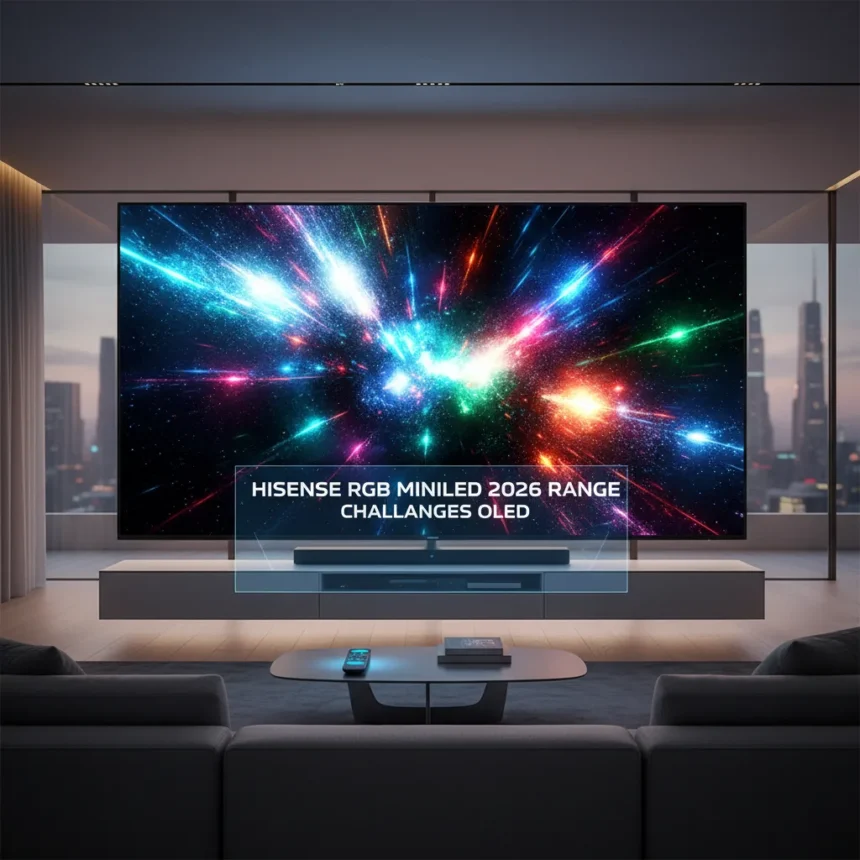
Hisense RGB MiniLED TVs represent a significant shift in how the company approaches premium display technology. Rather than chasing Micro LED or relying on conventional Mini LED backlights, Hisense is doubling down on RGB Mini LED for its confirmed 2026 TV range, positioning itself as the technology leader in this specific approach.
Key Takeaways
- Hisense RGB MiniLED TVs use individual red, green, and blue LEDs for full-colour local dimming at the pixel level.
- The 2026 lineup promises brighter panels and more precise backlighting than conventional Mini LED alternatives.
- Hisense U8Q (2025 model) features 2048 local dimming zones and claimed 5000 nits peak brightness as a preview of RGB Mini LED capabilities.
- RGB Mini LED differs from competitors’ Micro LED and SQD Mini LED approaches, offering a distinct contrast and colour accuracy path.
- VIDAA OS improvements strengthen Hisense’s smart TV ecosystem alongside hardware upgrades.
What Makes Hisense RGB MiniLED TVs Different
RGB Mini LED technology uses individual red, green, and blue LEDs for full-colour local dimming, enabling granular control per pixel for improved contrast, colour accuracy, and picture performance. This architectural approach differs fundamentally from conventional Mini LED backlights, which rely on white LEDs and quantum dot filtering. Hisense’s strategy positions RGB Mini LED as a middle ground between the cost and complexity of Micro LED and the limitations of standard Mini LED.
The key advantage lies in colour precision. By controlling red, green, and blue light independently at the backlight level, RGB Mini LED achieves more accurate colour reproduction and reduces crosstalk—a problem that plagues SQD Mini LED implementations used by competitors like TCL. When TCL added Super Quantum Dots to refine colour filtering in its X11H, it acknowledged the inherent weakness in white-LED-based Mini LED. Hisense’s approach attacks the problem at its source.
Hisense RGB MiniLED TVs vs. the Competition
Samsung and TCL are pursuing different paths. Samsung’s RGB MICRO LED TV, unveiled at CES 2025, uses a similar RGB backlight on VA LCD for full-colour dimming—a more ambitious but costlier approach than Mini LED. TCL’s SQD Mini LED strategy refines white LED output through quantum dot filtering, a less expensive but less precise alternative. Hisense’s RGB Mini LED sits between these two worlds: more precise than SQD, potentially more affordable than Micro LED.


The Hisense U8Q (2025 model) offers a real-world preview of what RGB Mini LED performance looks like. With 2048 local dimming zones and claimed 5000 nits peak brightness, the U8Q demonstrates the brightness ceiling Hisense is targeting. Compared to Samsung’s QN90F, the U8Q delivers superior zone count and peak output, though Samsung’s superior processing delivers more consistent performance across varied content without requiring the tweaking Hisense demands. For viewers willing to calibrate their display, Hisense wins on specifications and value. For those prioritising plug-and-play consistency, Samsung remains the safer bet.
OLED remains the contrast king—perfect blacks are impossible for any backlit technology. However, Mini LED’s brightness advantage means Hisense RGB MiniLED TVs can deliver superior HDR impact in bright rooms, a real-world advantage OLED cannot match.



The 2026 Lineup and What to Expect
Hisense’s dazzling flagship TV shown at a luxury event during CES 2026 signals the company’s confidence in RGB Mini LED as a premium positioning. The broader 2026 lineup promises brighter panels and new RGB Mini LED backlights across multiple tiers, with units starting to appear in shops post-CES. This is not a niche experiment—Hisense is betting the farm on RGB Mini LED as its answer to OLED’s dominance.
VIDAA OS improvements accompany the hardware push, strengthening Hisense’s smart TV ecosystem. A sluggish interface would undermine even brilliant picture quality, so the OS enhancements matter as much as the RGB backlighting itself.
Should You Wait for Hisense RGB MiniLED TVs?
If you prioritise brightness, colour accuracy, and value over absolute contrast, Hisense RGB MiniLED TVs represent a genuine alternative to OLED. The technology requires more calibration than Samsung’s offerings but rewards those willing to spend time optimising settings. Early adopters of the 2026 range should expect a learning curve—Hisense’s approach demands more user engagement than plug-and-play competitors.
How do Hisense RGB MiniLED TVs achieve better colour accuracy than standard Mini LED?
RGB Mini LED uses independent red, green, and blue LEDs at the backlight layer, controlling colour output directly rather than filtering white light through quantum dots. This eliminates crosstalk and delivers pixel-level colour precision, a fundamental advantage over SQD Mini LED approaches that refine white LED output after the fact.



Is Hisense RGB MiniLED better than OLED?
Not universally. OLED delivers superior contrast and perfect blacks—no backlit technology matches that. Hisense RGB MiniLED TVs excel in brightness, HDR impact, and value, making them better for bright rooms and budget-conscious buyers. OLED remains the premium choice for contrast perfectionists.
When will Hisense RGB MiniLED TVs be available for purchase?
The 2026 Hisense lineup is starting to appear in shops post-CES January 2026. Specific model availability and regional rollout timelines have not been announced, so check with local retailers for confirmed launch dates in your market.
Hisense RGB MiniLED TVs represent a calculated bet that precision and brightness matter more to most buyers than the perfect blacks OLED delivers. For anyone tired of OLED’s price tag or brightness limitations, the 2026 range offers a compelling alternative—assuming Hisense can deliver on the promise its CES showcase suggested.
Edited by the All Things Geek team.
Source: What Hi-Fi?