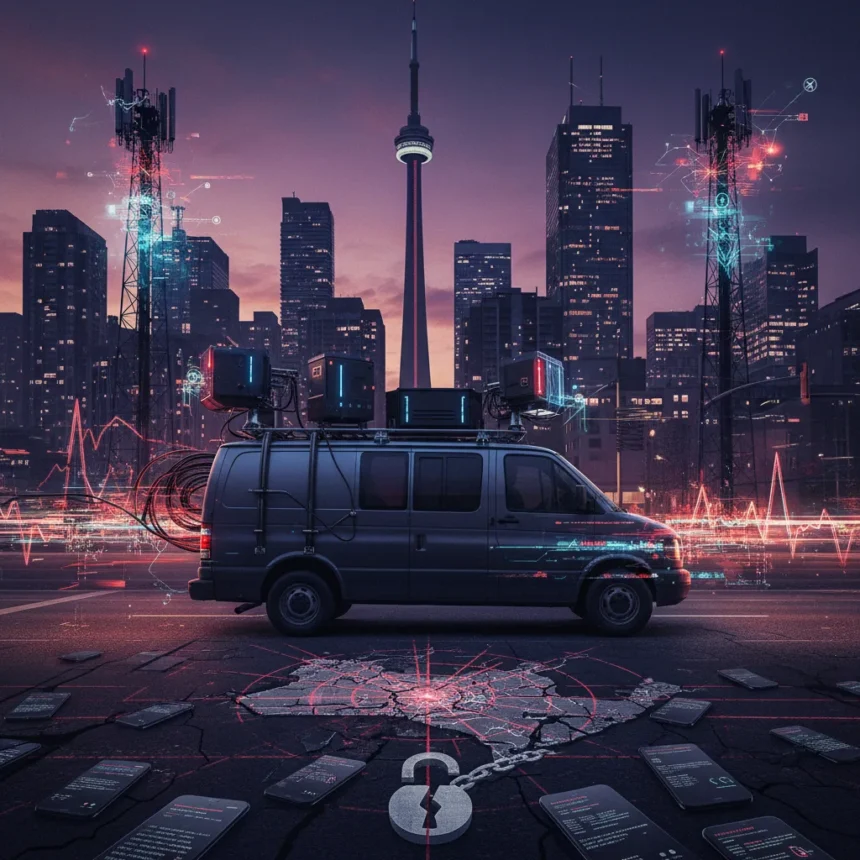
SMS blaster attacks represent a new frontier in mobile network exploitation, and Canada just became ground zero for demonstrating just how vulnerable even advanced cellular infrastructure can be. Hackers drove vehicles equipped with SMS blasters—devices that impersonate legitimate cellular networks—through Toronto streets, forcing thousands of devices to connect to fake base stations and resulting in 13 million network disruptions across affected areas. The incident, reported in 2025, reveals that 4G and 5G networks remain dangerously exposed to false base station attacks, even as carriers worldwide invest billions in infrastructure upgrades.
Key Takeaways
- SMS blasters (IMSI catchers) mounted on vehicles successfully impersonated cellular networks in Toronto, targeting every visible cell phone and IoT device in range.
- The attack caused 13 million network disruptions and successfully compromised thousands of devices through unauthorized connections.
- Devices automatically connect to stronger signals without authentication, a core vulnerability in current 4G and 5G architecture.
- Public safety risks extend beyond financial losses to emergency services disruption, vehicle-to-everything communications, and critical infrastructure like traffic systems.
- SMS blasters cost $1,000–$10,000 on black markets, with vehicle-mounted kits available for approximately $5,000 or more.
How SMS Blaster Attacks Work
SMS blaster attacks exploit a fundamental weakness in how mobile devices select networks. When a phone searches for a cellular connection, it automatically connects to the strongest signal it detects—without verifying whether that signal comes from a legitimate carrier tower or a fake one. Attackers mounted SMS blasters on vehicles and broadcast stronger fake network signals than the legitimate towers nearby, forcing devices to disconnect from real networks and connect instead to the blaster’s false base station. Once connected, the attacker can capture device identifiers (IMSI and IMEI numbers), intercept SMS traffic, and exploit unencrypted connections to inject malware or enable surveillance.
The Toronto incident demonstrates the scalability of this attack vector. By driving through populated streets, the attackers could target every visible cell phone and IoT device in range without needing to compromise a single carrier’s infrastructure or steal credentials. The attack succeeded because devices lack the authentication mechanisms needed to verify a network’s legitimacy before connecting. This is not a flaw unique to one carrier or one region—it is a structural vulnerability baked into how 4G and 5G networks operate globally.
The Public Safety Crisis Beyond Financial Loss
While data theft and malware injection represent serious threats, the real danger lies in disruption of critical services that depend on reliable cellular connectivity. Emergency services rely on 911 calls transmitted over cellular networks; vehicle-to-everything (V2X) communications that coordinate traffic and prevent collisions depend on uninterrupted connections; and smart city infrastructure including traffic lights, power grids, and water systems increasingly use cellular networks for remote management. When SMS blaster attacks force 13 million devices offline simultaneously, they create cascading failures across systems designed to protect public safety.


A single SMS blaster attack in a major city could prevent ambulances from receiving GPS directions, disable traffic signals during rush hour, or prevent drivers from calling for help during emergencies. The fact that attackers successfully compromised thousands of devices suggests they could have injected malware into critical infrastructure systems, emergency response vehicles, or hospital networks had they chosen to do so. The Toronto incident occurred in 2025, a period of heightened geopolitical tension and rising concerns about potential wartime disruption of civilian infrastructure. Whether the attack was perpetrated by criminal groups testing capabilities or state-sponsored actors conducting reconnaissance, the implications are identical: North American cellular networks are vulnerable to large-scale disruption.
Why Current 5G Defenses Fall Short
The telecommunications industry has known about false base station attacks for years. Law enforcement agencies use devices similar to SMS blasters—known as Stingrays—to locate suspects, though these deployments require warrants and operate under legal restrictions. The difference is that Stingrays are deployed by authorized agents in controlled circumstances, whereas the Toronto attackers operated freely on public streets with no oversight. Commercial versions of SMS blasters are available on dark web marketplaces for $1,000–$10,000, with vehicle-mounted kits costing approximately $5,000 or more, making them accessible to sophisticated criminal groups and well-funded threat actors.


5G networks were designed with improved security compared to 4G, including stronger encryption and better device authentication mechanisms. However, the Toronto incident suggests that these improvements either have not been universally deployed or contain gaps that attackers can exploit. Network operators have been urged to implement authentication upgrades like SUCI (Subscription Concealed Identifier) in 5G, which would prevent devices from broadcasting identifiable information to unauthorized networks. Yet adoption remains incomplete, leaving millions of devices vulnerable to the same attack vector that succeeded in Toronto. The gap between theoretical 5G security and real-world deployment is where attackers are operating.
What Comes Next for Carriers and Regulators
The Toronto SMS blaster attack will likely force carriers to accelerate deployment of authentication upgrades and implement stricter monitoring for false base stations within their coverage areas. Some carriers may deploy sensors capable of detecting unauthorized transmitters and alerting security teams to suspicious network activity. However, these defenses are reactive—they address symptoms rather than the root cause, which is that devices lack reliable mechanisms to verify network legitimacy before connecting.
Regulators face pressure to address the supply side of the problem as well. SMS blasters remain widely available on black markets and are technically legal in some jurisdictions when used for authorized purposes (such as security research or law enforcement). However, the Toronto incident demonstrates that availability on black markets enables criminal and potentially state-sponsored actors to acquire these tools. Stricter controls on the export and sale of IMSI catchers could slow proliferation, though determined actors will likely find ways to obtain or manufacture them.
Is SMS blaster vulnerability specific to Canada?
No. The vulnerability exploited in Toronto exists in every country where 4G and 5G networks operate. Canada was the location of this particular reported attack, but the underlying weakness—devices connecting to the strongest signal without authentication—affects cellular networks worldwide. Carriers in the US, Europe, Asia, and other regions face identical risks.



Can 5G networks prevent SMS blaster attacks?
Current 5G deployments can reduce but not eliminate SMS blaster attacks. Newer 5G security features like SUCI make it harder for attackers to capture device identifiers, but devices can still be forced to connect to false base stations. Complete prevention would require authentication mechanisms that verify network legitimacy before devices connect, a change that would require updating both network infrastructure and billions of mobile devices worldwide.
What should individuals do to protect against SMS blaster attacks?
Individual users have limited options. Disabling automatic network selection and manually connecting to known networks reduces risk, but this is impractical for most users. The real protection lies with carriers deploying detection systems and regulators enforcing stricter controls on IMSI catcher availability. Until carriers implement mandatory authentication upgrades, users remain vulnerable to attacks they cannot detect or prevent.
The Toronto SMS blaster attack is not a cautionary tale about a hypothetical future threat—it is evidence that the future has arrived. Hackers have demonstrated the ability to drive through city streets and compromise thousands of devices simultaneously, disrupting critical services and exposing the gap between 5G’s theoretical security and its real-world vulnerabilities. Carriers and regulators must move faster to close this gap, or similar attacks will become routine rather than exceptional.
Edited by the All Things Geek team.
Source: TechRadar