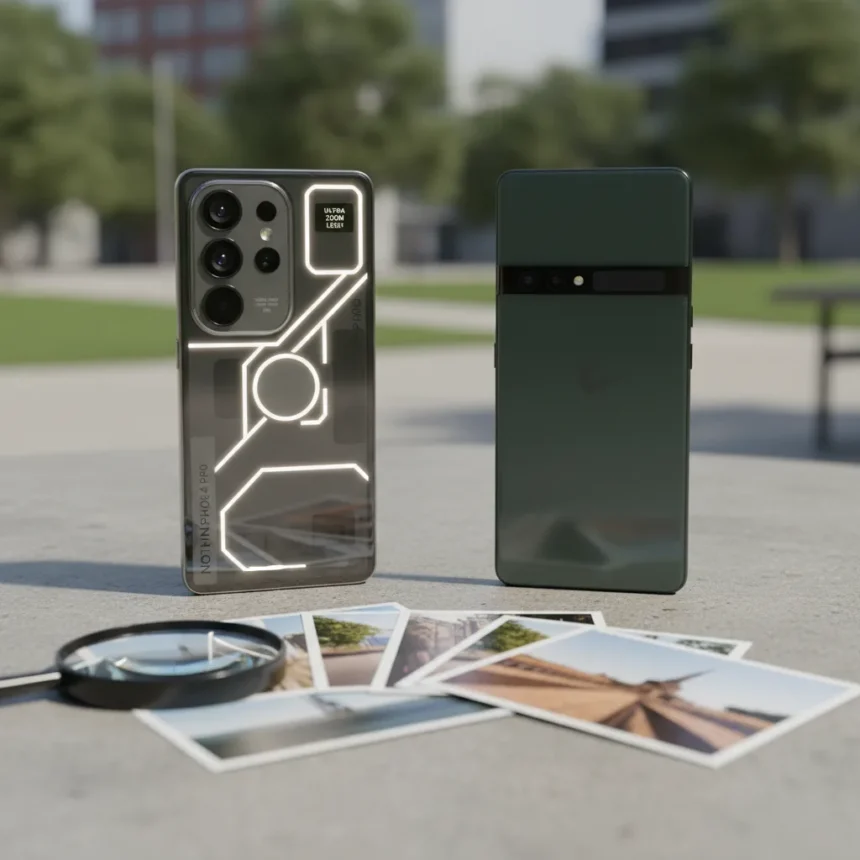
The Nothing Phone 4a Pro camera takes on the Google Pixel 10 flagship in a real-world shootout that challenges everything you think you know about budget phones versus expensive flagships. With over 100 photos captured across varied lighting and subjects, the results question whether processing power or raw hardware matters more when it comes to mobile photography.
Key Takeaways
- Nothing Phone 4a Pro features a 50MP main sensor with 3.5x periscope telephoto and 140x zoom capability.
- Google Pixel 10 includes a 48MP main sensor with 5x optical zoom but lacks Nothing’s hardware versatility.
- Nothing’s larger sensors and superior zoom range deliver competitive or superior photo quality at sub-$500 pricing.
- Pixel 10 edges ahead in video performance with 4K 60fps versus Nothing’s 4K 30fps.
- The shootout reveals hardware can outperform software processing in specific scenarios like telephoto and low-light photography.
Nothing Phone 4a Pro Camera Specs That Challenge the Flagship
The Nothing Phone 4a Pro camera setup is built on serious hardware. The main shooter uses a 50MP Sony LYT-710 sensor with an F1.9 aperture, 24mm focal length, and a 1/1.56-inch sensor size—larger than what many flagships offer. This is paired with optical image stabilization (OIS) and phase-detection autofocus (PDAF) for stabilized shots in challenging conditions. The ultra-wide camera delivers 8MP with a 15mm focal length and F2.2 aperture, covering 120 degrees of field of view.
Where Nothing Phone 4a Pro camera truly diverges from the Pixel 10 is the periscope telephoto. A 50MP sensor with 3.5x optical zoom and F2.9 aperture enables 140x total zoom—a capability that stretches far beyond the Pixel’s 5x optical reach. This telephoto lens also includes OIS and PDAF, meaning distant subjects stay sharp and steady. The device supports TrueLens Engine 4 processing with Ultra XDR photos and 4K Ultra XDR video, delivering HDR performance near Dolby Vision levels. Video recording spans 4K UHD at 30fps, 1080p at 120fps with HDR, and time-lapse modes.
The Google Pixel 10, by contrast, uses a 48MP main sensor with F1.7 aperture and a 1/2-inch sensor—competitive but not larger than Nothing’s. Its 10.8MP telephoto offers 5x optical zoom at F3.1, with PDAF and OIS for stabilization. The Pixel 10 records 4K UHD at 60fps, outpacing Nothing’s 30fps capability. For pure video performance, the Pixel wins. For photographic versatility and zoom range, Nothing’s hardware advantage is undeniable.


How Nothing Phone 4a Pro Camera Performs in Real-World Shooting
Over 100 photos reveal that Nothing Phone 4a Pro camera delivers competitive image quality despite the price gap [title]. In standard daylight scenes, both phones produce sharp, well-exposed images with accurate color rendering. Where the Nothing pulls ahead is in telephoto shots. The 3.5x periscope telephoto maintains detail and sharpness that the Pixel’s 5x lens cannot match at similar zoom levels, and at extreme zoom ranges—where the Pixel relies on digital interpolation—Nothing’s optical advantage becomes visually apparent.
Low-light photography shows another strength for the Nothing Phone 4a Pro camera. The larger main sensor (1/1.56-inch versus Pixel’s 1/2-inch) gathers more light, and the F1.9 aperture on Nothing’s primary lens is faster than the Pixel 10’s F1.7 advantage, compensating with sensor size. Night mode results from both phones are competent, but Nothing’s approach favors detail preservation over aggressive noise reduction, a trade-off some users prefer.



The Pixel 10’s processing engine remains a strength, particularly in computational photography and scene recognition. Google’s software algorithms excel at balancing highlights and shadows in complex lighting, and the Pixel’s video capabilities at 4K 60fps create smoother, more professional-looking video compared to Nothing’s 4K 30fps. However, the shootout demonstrates that hardware—specifically sensor size, aperture, and optical zoom—can outperform software in scenarios where physics and optics matter most.
Nothing Phone 4a Pro Camera vs Budget Alternatives
The Nothing Phone 4a Pro camera also outclasses the Google Pixel 10a, Google’s own budget offering. The Pixel 10a drops the telephoto lens entirely, relying on a 48MP main and 13MP ultra-wide with only 2x optical zoom and 8x digital zoom. This means users lose the telephoto versatility that Nothing provides. The Pixel 10a does include wireless charging at 10W, while Nothing Phone 4a Pro offers only 50W wired charging—a feature trade-off rather than a camera advantage. For photographers prioritizing zoom range and sensor quality, Nothing Phone 4a Pro camera delivers significantly more capability at comparable or lower pricing.
Frequently Asked Questions
Does the Nothing Phone 4a Pro camera truly outperform the Google Pixel 10?
In telephoto and low-light scenarios, the Nothing Phone 4a Pro camera’s larger sensors and superior zoom range deliver competitive or superior results. The Pixel 10 excels in video performance and computational processing, but the shootout reveals hardware advantage in specific photography contexts.
What is the main camera difference between Nothing Phone 4a Pro and Pixel 10?
The Nothing Phone 4a Pro camera includes a 50MP periscope telephoto with 3.5x optical zoom and 140x total zoom, while the Pixel 10’s 10.8MP telephoto maxes at 5x optical zoom. Nothing’s main sensor is also slightly larger (1/1.56-inch versus 1/2-inch), providing better low-light performance.



Is the Nothing Phone 4a Pro camera worth the sub-$500 price?
For photographers who prioritize zoom versatility and low-light detail, the Nothing Phone 4a Pro camera represents exceptional value. Video enthusiasts may prefer the Pixel 10’s 4K 60fps capability, but for pure photographic range and hardware quality, Nothing delivers flagship-level specs at budget pricing.
The Nothing Phone 4a Pro camera comparison against the Google Pixel 10 proves that flagship status and flagship price tags do not always align. Over 100 real-world photos reveal a budget phone with hardware that rivals and in some scenarios surpasses a flagship. For anyone skeptical that sub-$500 phones can challenge expensive flagships, this shootout offers compelling evidence that sensor size, aperture, and optical zoom still matter more than processing algorithms alone.
Where to Buy
Nothing Phone (4a) Pro | Google Pixel 10
Edited by the All Things Geek team.
Source: Tom's Guide