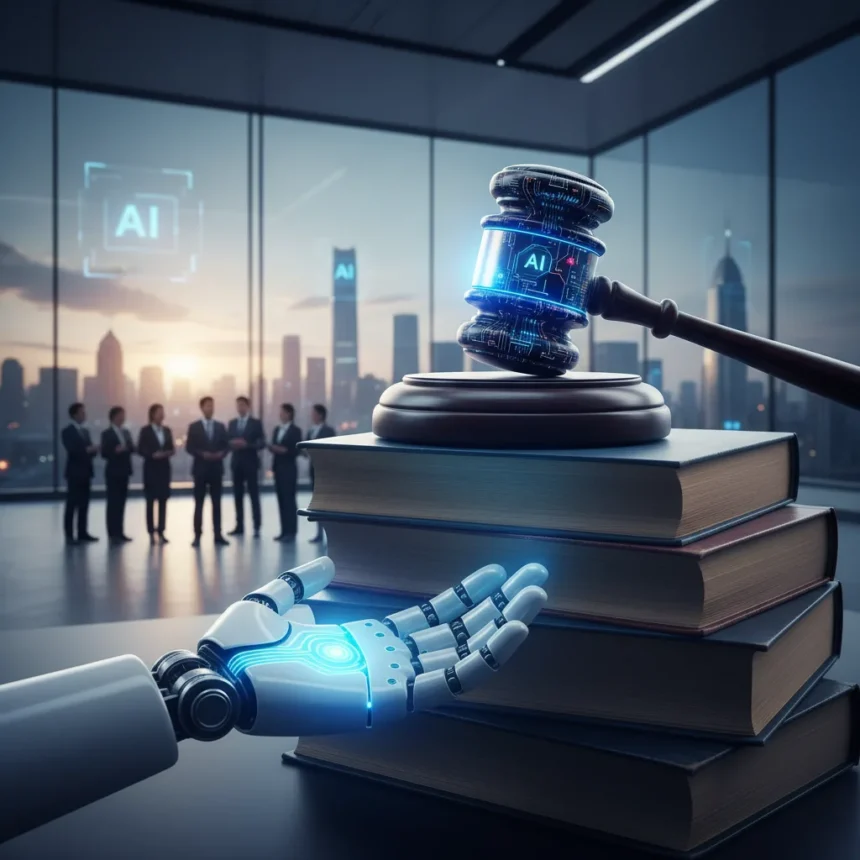
A Hangzhou Intermediate People’s Court has ruled that AI automation worker protections prevent companies from dismissing employees simply because large language models can do their jobs cheaper. The decision marks a significant boundary in how courts will treat automation-driven layoffs as AI adoption accelerates across the region.
Key Takeaways
- Hangzhou court ruled AI-driven replacement does not qualify as legal grounds for dismissal under China’s Labor Contract Law
- Companies cannot justify layoffs by claiming AI efficiency alone constitutes a major change in circumstances
- Offering substantially reduced pay as an alternative job is not considered reasonable reassignment
- Similar Beijing ruling found AI adoption is a voluntary company choice; employees should not bear all the risk
- China’s courts are treating these cases as typical examples to protect worker rights amid rapid AI adoption
What the Hangzhou Ruling Actually Says About AI Automation Worker Protections
The court found that an AI tech company acted unlawfully by dismissing a senior employee after his responsibilities were transferred to large language models. Under China’s Labor Contract Law, dismissal is only justified by a “major change in objective circumstances”—events like company mergers, relocations, or genuine business failure. AI-driven replacement does not meet this threshold. The ruling establishes that automation efficiency, no matter how substantial, cannot serve as the sole justification for termination.
The court also rejected the company’s attempt to reassign the employee to a different role at significantly lower pay. This detail matters: companies cannot circumvent worker protections by offering degraded positions as an alternative. The decision treats such reassignments as constructive dismissal rather than legitimate business adaptation.
How This Differs From Western Automation Precedent
In most Western jurisdictions, companies have broad latitude to restructure roles and eliminate positions due to technological change. The US and UK courts generally recognize “business necessity” as grounds for layoffs when automation reduces staffing needs. China’s approach is fundamentally different. By explicitly rejecting automation as a standalone justification, Chinese courts are asserting that companies benefiting from AI efficiency must still uphold social and legal responsibilities to their human workforce.



A parallel ruling in Beijing on December 26 reinforces this principle. When a map data collector was dismissed due to AI adoption, the court panel ruled that AI adoption is a voluntary competitive move by companies—and the risks of that choice should not be forced solely onto employees. This creates a legal framework where efficiency gains are not automatically treated as worker losses.
What Companies Face Now: The Broader Pattern
These cases are not isolated decisions. Chinese state media agency Xinhua highlighted them as “typical examples” to protect worker rights amid China’s accelerating AI adoption. This framing suggests courts will apply similar logic across future automation disputes. Companies cannot simply point to AI capability and declare positions redundant. They must demonstrate genuine business hardship, not just efficiency improvement.



For global tech companies operating in China, the ruling creates real constraints. A senior engineer or analyst cannot be terminated because an LLM can handle routine tasks faster and cheaper. The company would need to show that the role itself no longer exists—not that it can be performed by cheaper automation. Reassignment with pay cuts is off the table as a workaround.
Why This Matters Beyond China
As AI adoption spreads globally, labor courts worldwide will face similar questions. Should automation efficiency alone justify dismissal? Should workers bear the full cost of productivity gains? China’s courts have answered no. This creates a potential template for other jurisdictions considering AI automation worker protections in their own labor frameworks. The ruling suggests that legal systems can distinguish between technological necessity and technological choice.
Will Other Countries Follow This Model?
It is unclear whether Western courts will adopt similar AI automation worker protections. The US and EU have shown more deference to corporate restructuring, though the EU’s stricter employment protections could align with China’s approach. For now, China stands alone in explicitly rejecting automation-only layoffs. Workers in other regions have no equivalent legal shield.
What Happens If a Company Ignores the Ruling?
Enforcement matters. Chinese courts can order reinstatement and back pay if a company violates the decision. The ruling is binding on the defendant, though it does not automatically set precedent for all future cases—each dispute is evaluated independently. However, the court’s explicit reasoning and Xinhua’s promotion of the case as a typical example suggest future rulings will follow similar logic.


Does This mean AI can never replace workers in China?
No. The ruling does not ban automation or require companies to keep unnecessary positions. It simply requires that dismissals be justified by genuine business need, not automation capability alone. A company undergoing restructuring, facing bankruptcy, or closing an entire division could still reduce headcount. The difference is that efficiency improvements alone do not meet the legal bar for termination.
How do companies adapt their AI strategy under this ruling?
Rather than replacing workers outright, companies may need to redeploy them—retraining staff for higher-value tasks that AI cannot yet handle. This shifts the business case for automation: instead of headcount reduction, the ROI comes from productivity per worker and new capabilities. It also means companies adopting AI in China face higher labor costs than competitors in regions without similar protections.
The Hangzhou and Beijing rulings represent a deliberate choice by Chinese courts to treat workers as stakeholders in automation decisions, not merely costs to eliminate. Whether this model spreads or remains unique to China will shape how AI adoption unfolds globally. For now, it is a rare legal brake on the assumption that AI always justifies layoffs.
Edited by the All Things Geek team.
Source: Tom's Hardware