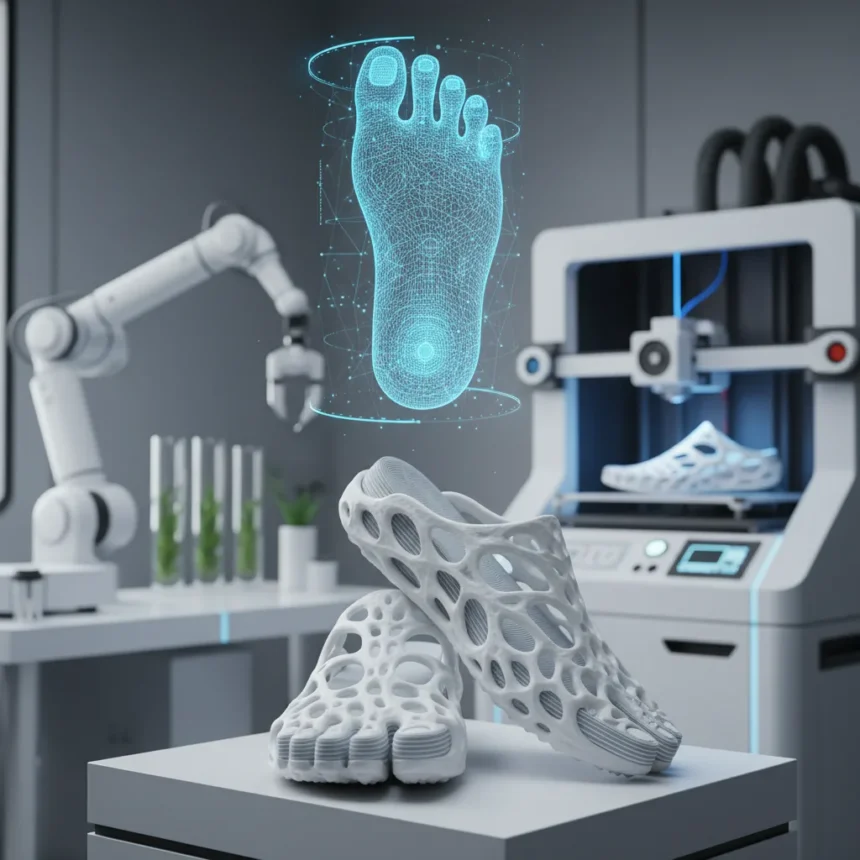
Vivobarefoot’s Tabi Gen 02 is a custom sandal built directly from 3D foot scans, using scan-to-print technology to match the anatomical form of individual feet. The sandal represents a shift in how minimalist footwear brands approach personalization—rather than offering one-size-fits-most, Vivobarefoot is scanning each customer’s feet and manufacturing a unique pair. This is not a gimmick. It’s a direct challenge to the assumption that all feet fit the same mold.
Key Takeaways
- Tabi Gen 02 uses 3D foot scans to create personalized barefoot sandals shaped to individual anatomy
- Walk-in foot scans available at Vivobarefoot stores in London and Bristol; virtual queue option for remote customers
- Tabi-style split-toe design inspired by 15th-century Japanese footwear, with grippy treaded outsole
- Crafted from low-impact materials emphasizing sustainability across the manufacturing process
- Gen 01 limited to 590 pairs; Gen 02 expands access through virtual scanning queue system
How 3D foot scans custom sandal technology actually works
The scan-to-print methodology captures the unique contours of each foot, then uses that data to fabricate a sandal that conforms to the wearer’s specific anatomy rather than forcing the foot into a pre-molded shape. Customers can visit Vivobarefoot’s London and Bristol stores for walk-in foot scans, or join a virtual queue for early access if they live outside those locations. The process removes the guesswork that plagues traditional sandal sizing—no more choosing between a size 9 or 10 and hoping it works.
This approach inverts the typical footwear manufacturing pipeline. Instead of designing a sandal and then asking feet to adapt, Vivobarefoot designs the sandal around the foot. For barefoot enthusiasts, this matters because minimalist footwear is only effective if it actually matches your foot’s natural shape. A poorly fitting barefoot sandal defeats the entire philosophy.
The Tabi Gen 02 design and materials
The sandal uses a tabi-style split-toe design, a silhouette rooted in 15th-century Japanese footwear tradition. The split-toe layout separates the big toe from the other four, mimicking the natural movement of the foot and improving balance and proprioception. The outsole is grippy and treaded, designed for outdoor usage rather than purely indoor wear.


Vivobarefoot emphasizes low-impact materials throughout the manufacturing process, aligning with the minimalist brand’s broader commitment to sustainability. The company, founded on technology invented by Tim Brennan and developed through Terra Plana, has long positioned itself as the intersection of barefoot philosophy and environmental responsibility. Gen 02 carries that ethos forward—the 3D-printing approach itself reduces material waste compared to traditional injection molding.
The inaugural Tabi Gen 01 came in four colorways: Obsidian Black, Mineral Grey, Forest Green, and Earth Brown. Whether Gen 02 expands the palette remains to be seen, but the color options reflect a design sensibility that leans understated rather than flashy.



Vivobarefoot’s competitive position in minimalist footwear
Vivobarefoot operates in the minimalist shoe space, a category that includes brands like Xero Shoes and Altra, but few competitors offer true customization at scale. Most minimalist brands still rely on standard sizing, meaning customers must order multiple sizes to find the right fit. The 3D-printing approach sidesteps that entirely. It’s a technology moat—competitors cannot easily replicate scan-to-print manufacturing without significant capital investment and supply chain restructuring.
The expansion from Gen 01 (limited to 590 pairs) to Gen 02 suggests Vivobarefoot believes the demand justifies scaling. The virtual queue system for remote customers indicates the brand is serious about reaching beyond London and Bristol. This is not a boutique experiment; it’s a path toward mainstream customization.
Is the Tabi Gen 02 worth the investment?
Custom footwear carries a premium price, and Vivobarefoot’s offering is no exception. The value proposition rests on two pillars: fit precision and philosophical alignment. If you believe barefoot footwear should match your foot’s actual shape, the scan-to-print approach delivers. If you view sandals as interchangeable commodities, the customization adds cost without perceived benefit.
For barefoot enthusiasts already committed to minimalist footwear, the Tabi Gen 02 eliminates a persistent pain point—the uncertainty of whether a given size will actually work for your feet. The sustainability angle appeals to environmentally conscious buyers who want their gear to reflect their values. The tabi design itself is a statement; it signals that you understand footwear history and are willing to embrace unconventional foot separation.


How do I get a Tabi Gen 02 sandal?
Visit Vivobarefoot’s London or Bristol stores for a walk-in foot scan, or join the virtual queue for early access if you are outside those locations. The virtual queue system allows remote customers to participate in the customization process without traveling to a physical store.
What makes the tabi split-toe design different from regular sandals?
The split-toe layout separates the big toe from the other four toes, mimicking natural foot movement and improving balance and proprioception. This design traces back to 15th-century Japanese footwear tradition and is rarely seen in modern Western sandals, making it a distinctive choice for barefoot advocates.
Are the Tabi Gen 02 sandals sustainable?
Vivobarefoot uses low-impact materials and emphasizes sustainability throughout the manufacturing process. The 3D-printing approach itself reduces material waste compared to traditional injection molding, aligning with the brand’s environmental commitments.
The Tabi Gen 02 represents a meaningful shift in how minimalist footwear brands can approach personalization. Rather than asking customers to adapt to standard sizing, Vivobarefoot is building sandals around individual feet. For barefoot enthusiasts tired of compromises, that’s a compelling proposition—if you can access the technology and justify the premium cost.
Where to Buy
Vivobarefoot Motus Flex | Vivobarefoot Tracker FG Women's | Vivobarefoot Gobi Hiber | Vivobarefoot Primus Lite III | VivoBarefoot Tracker Hi Boot
Edited by the All Things Geek team.
Source: T3