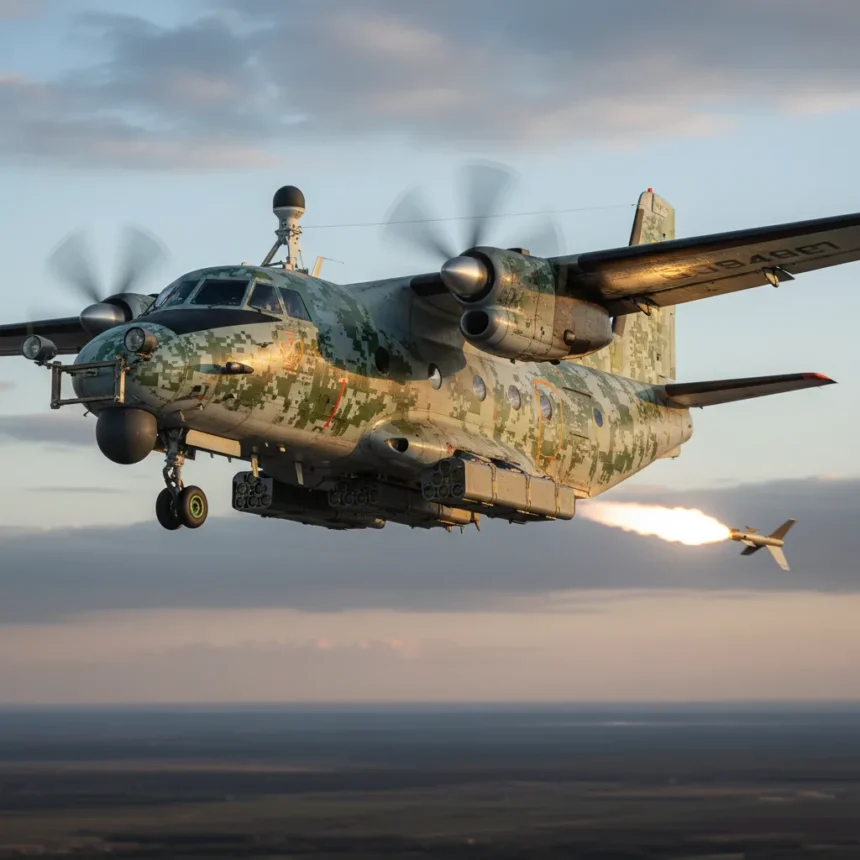
Ukraine An-28 drone hunter platforms represent a pragmatic shift in air defense strategy. Ukrainian forces have repurposed the Antonov An-28, a 55-year-old Russian-designed twin-turboprop transport aircraft, into an airborne interceptor platform capable of launching up to six drone interceptors per sortie against Russian Shahed attack drones. The adaptation emerged from necessity: traditional air defense systems like the MIM-104 Patriot cost millions per launch, while Shahed drones cost roughly $20,000 each. Ukraine needed a cost-asymmetric answer.
Key Takeaways
- Ukraine repurposed a vintage An-28 transport aircraft into an anti-drone platform equipped with interceptor drones and a Gatling-class minigun.
- The aircraft can carry up to six P1-SUN interceptor drones per sortie, each with a 15 km operational range and 15-17 minute endurance.
- An-28 crews have reportedly downed 222 Russian drones using gun armament since February 2026.
- The system costs a fraction of traditional air defense missiles, addressing Ukraine’s need for affordable, scalable drone defense.
- Russia is already discussing copying the concept using older An-2 aircraft or similar platforms.
How Ukraine converted the An-28 into a drone carrier
The An-28 modification centers on underwing hardpoints: the aircraft features at least three mounting points per wing, allowing deployment of multiple interceptor drones in a single mission. The primary interceptor is the P1-SUN, developed by Ukrainian company SkyFall, which features optical target detection and can operate at altitudes up to 5,000 meters with a maximum range of 15 kilometers. Ukrainian pilot Timur Fatkullin, who has flown these missions, described the system as a “cheap air-to-air missile” that has “already proven effective in real combat conditions”.
Beyond drone interceptors, the An-28 carries a Dillon Aero M134D Minigun mounted on a swivel support in the fuselage side door. This 7.62×51 mm Gatling-class weapon allows direct engagement of drone targets when interceptors are not deployed or when targets are within gun range. The combination of standoff interceptors and close-range firepower gives crews tactical flexibility that single-purpose systems lack.
Operational deployment follows a coordinated workflow. Ground controllers guide the An-28 into airspace where Russian drones have been detected. Crew members use the aircraft’s onboard electro-optical system to visually identify targets, often in nighttime conditions, then deploy P1-SUN interceptors from the underwing hardpoints or engage directly with the minigun. This layered approach—detection, identification, and multiple engagement options—reflects Ukraine’s evolution toward distributed, cost-effective air defense rather than reliance on expensive centralized systems.


Ukraine An-28 drone hunter performance in combat
First public reports of the An-28 in the anti-drone role emerged in February 2026, with video footage of P1-SUN deployment published on April 23, 2026, by pilot Fatkullin. According to Fatkullin, An-28 crews have downed 222 Russian drones using gun armament alone. Ukrainian forces have also tested additional interceptor options, including the Merops AS-3 Surveyor and U.S.-made Merops drones, evaluating which platforms perform most effectively in counter-drone roles.
The An-28’s short takeoff and landing (STOL) capability proves operationally significant. The aircraft can operate from austere airfields and unprepared strips, reducing dependence on fixed bases that Russian forces target. Some An-28 crews consist of civilian volunteers, according to observations by French journalists embedded with Ukrainian units, reflecting the broader mobilization of Ukraine’s air defense effort.



Why Russia is already copying Ukraine’s concept
The success of Ukraine’s An-28 platform has not gone unnoticed in Moscow. Russian military analysts are proposing their own versions using older Soviet aircraft. Russia is discussing restoration of the An-2, a single-engine biplane, at a cost of roughly $430,000 per aircraft, compared to the $5 million replacement cost of modern systems like the LMS-901. Alternative platforms under consideration include the Ilyushin Il-114 and Lavochkin L-410.
This replication attempt highlights a pattern in modern warfare: Ukraine develops a low-cost workaround, and Russia attempts to copy it. The timeframe for such replication typically spans approximately one year. However, Russia faces constraints that may slow implementation. Sourcing enough serviceable An-2 aircraft, retrofitting them with modern avionics and weapons systems, and training crews to operate them effectively requires resources Ukraine has already committed. Russia’s version, even if deployed, would likely enter service well behind Ukraine’s operational advantage.
The broader context: Cost-asymmetric air defense
Ukraine An-28 drone hunter systems exemplify a strategic principle: when facing numerically superior drone swarms, expensive point-defense solutions become unsustainable. A single Patriot missile costs millions and addresses one target. The An-28 platform, modified from a legacy airframe, costs far less to operate and can engage multiple targets per sortie. The interceptor drones themselves—the P1-SUN and Merops variants—represent additional cost savings compared to traditional air-to-air missiles.
This approach extends Ukraine’s broader air defense evolution. Systems like OCTOPUS, developed in partnership with the United Kingdom, and light trainer aircraft adapted for interception missions, all follow the same principle: maximize defensive capability within severe budget constraints. As Russian Shahed attacks continue, Ukraine cannot afford to trade expensive missiles for cheap drones indefinitely. The An-28 platform addresses this imbalance by offering a reusable platform that can engage multiple targets across multiple sorties.



What makes the An-28 suitable for this role?
The Antonov An-28, despite its age, possesses characteristics that make it adaptable for anti-drone operations. The twin-turboprop design provides reliable power and sufficient payload capacity for hardpoints and minigun armament. The aircraft’s modest speed—typical of transport aircraft—actually suits drone interception, allowing crews time to identify and engage targets without overshooting them. Faster jets designed for air-to-air combat become liabilities when the enemy operates at lower speeds and altitudes.
The An-28’s fuselage provides mounting points for both underwing ordnance and side-firing weapons. Crew size and cockpit layout allow for dedicated operators to manage targeting systems and weapons deployment while pilots focus on navigation and positioning. This division of labor, even in a small aircraft, proves essential for effective drone interception.
Are other countries copying Ukraine’s approach?
No equivalent programs have been publicly reported in NATO or allied nations. The United States, with access to advanced jet fighters and drone interceptors, has not pursued similar adaptations of legacy transport aircraft. European allies have focused on missile-based air defense rather than drone-launched interceptors from modified platforms. Ukraine’s solution emerged from necessity—the absence of sufficient advanced air defense systems and the need to counter a specific threat (Shahed drones) with available resources. Other nations face different constraints and have pursued different solutions.
Will the An-28 platform scale to larger operations?
Ukraine’s current An-28 drone hunter deployments remain relatively limited in scope. The platform requires trained crews, available aircraft, and reliable interceptor drones. Scaling to dozens or hundreds of such aircraft would strain Ukraine’s resources and require sustained production of P1-SUN or similar interceptors. However, the concept’s success may drive increased investment in interceptor drone production and recruitment of additional crews, potentially expanding the fleet over time.
FAQ
How many interceptor drones can the An-28 carry per mission?
The An-28 can carry up to six interceptor drones per sortie, with at least three mounting points per wing. The exact number deployed depends on crew decisions regarding fuel reserves, weather, and expected threat density in the operational area.
What is the operational range of the P1-SUN interceptor drone?
The P1-SUN, developed by Ukrainian company SkyFall, has a maximum operational range of 15 kilometers and can operate at altitudes up to 5,000 meters with an endurance of 15-17 minutes. These specifications allow the interceptor to engage Russian Shahed drones at significant standoff distances from the An-28.
How much does a Shahed drone cost compared to air defense missiles?
Russian Shahed drones cost approximately $20,000 each, while traditional air defense missiles like the MIM-104 Patriot cost millions per launch. This cost disparity is precisely why Ukraine developed the An-28 platform—to defend against cheap drones using affordable, reusable systems rather than expensive one-shot missiles.
Ukraine An-28 drone hunter platforms represent a template for resource-constrained air defense: repurpose available assets, combine standoff and close-range weapons, and prioritize cost-effectiveness over technological sophistication. As Russian drone attacks intensify, this pragmatic approach may influence how other nations design their own air defense strategies.
Edited by the All Things Geek team.
Source: TechRadar