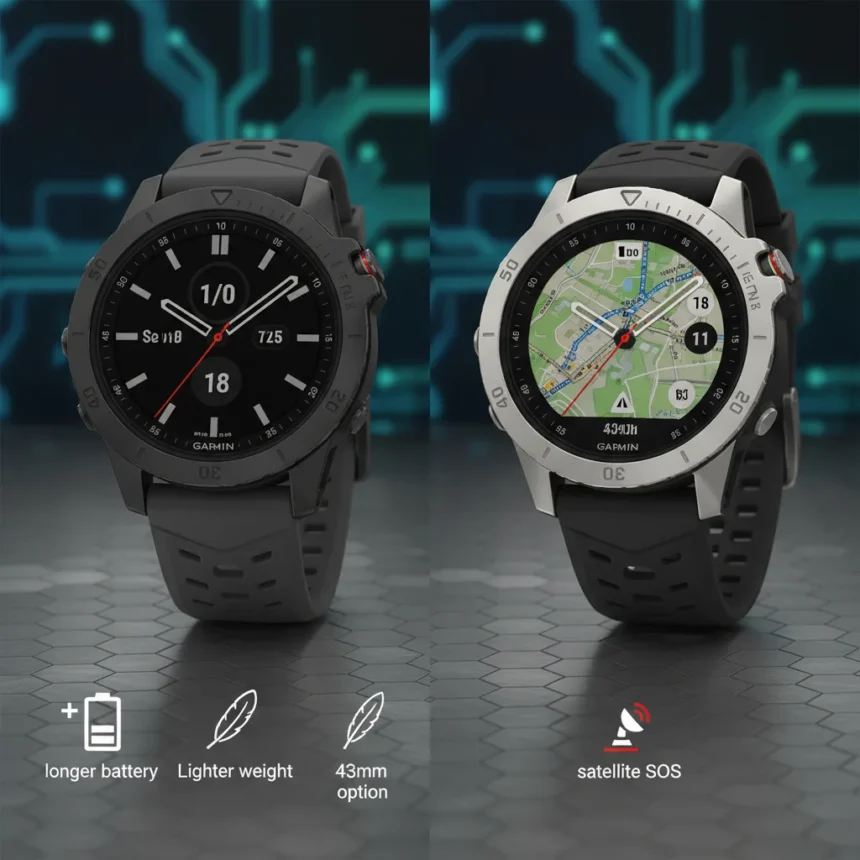
The Garmin Fenix 8 vs Fenix 8 Pro showdown reveals a clear winner for different users. Both flagships just dropped $250, making this the moment to decide whether you need independent satellite connectivity or if a lighter, longer-lasting watch serves you better.
Key Takeaways
- Fenix 8 outlasts Fenix 8 Pro by 1–3 days in smartwatch mode across most sizes.
- Fenix 8 Pro adds LTE calling, texting, and satellite SOS—useful only for remote expeditions.
- Fenix 8 offers 43mm size and MIP Solar displays; Pro only comes in 47mm and 51mm.
- Fenix 8 Pro weighs 16–17g more due to LTE and satellite antennas.
- Both watches now cost $250 less, making Fenix 8 the smarter choice for everyday athletes.
Garmin Fenix 8 vs Fenix 8 Pro: The Core Difference
The Garmin Fenix 8 vs Fenix 8 Pro comes down to one question: do you need to send messages and trigger emergency SOS when your phone has no signal? The Pro answers yes with built-in LTE for phone-free calls, texting, and real-time LiveTrack sharing over LTE-M networks. It also packs Skylo satellite connectivity for check-in messages and interactive SOS to Garmin’s emergency response team—available across America, southern Canada, and most of Europe. The standard Fenix 8 requires a connected smartphone for LiveTrack, weather, and any communication. For 95% of users, that trade-off is a non-issue.
The Pro’s independent connectivity justifies its premium only if you regularly venture into terrain where cellular coverage vanishes and satellite messaging becomes a lifeline. For everyone else—trail runners, weekend hikers, gym enthusiasts, casual multisport athletes—the Fenix 8 delivers identical fitness tracking, navigation, and durability without the weight penalty or the price tag.
Battery Life: Where Fenix 8 Pulls Ahead
Testing revealed the Fenix 8 outlasts the Fenix 8 Pro in nearly every battery mode. In smartwatch mode, the 47mm Fenix 8 AMOLED lasts 16 days versus the Pro’s 15 days; the 51mm gap widens to 29 days versus 27. In GPS-only mode, the difference grows more pronounced: 47mm Fenix 8 delivers 47 hours against the Pro’s 48, but the 51mm Fenix 8 achieves 84 hours compared to the Pro’s 78. During a 10-day real-world test, the Fenix 8 retained 14% battery when the Pro hit zero—a meaningful advantage for multi-week expeditions.


The Pro’s heavier LTE and satellite antennas drain power faster, even in modes that do not use those radios. If battery anxiety keeps you tethered to chargers, the Fenix 8 solves that problem. The 51mm Fenix 8 with MIP Solar display stretches smartwatch mode to 30 days with solar charging, or 48 days in optimal sunlight—performance the Pro cannot match because it lacks MIP options entirely.
Size, Weight, and Display Options
The Garmin Fenix 8 vs Fenix 8 Pro diverges sharply on sizing flexibility. The Fenix 8 comes in 43mm, 47mm, and 51mm; the Pro only in 47mm and 51mm. For athletes with smaller wrists—runners, cyclists, female users—the 43mm Fenix 8 is the only option between these two flagships. The Pro weighs 77–93g across its sizes; the Fenix 8 ranges 60–95g. The 43mm Fenix 8 tips the scales at just 60g, a featherweight advantage for endurance sports.



Display technology splits the lineup. The Pro offers AMOLED on 47mm and 51mm models, with a MicroLED option exclusive to 51mm. The Fenix 8 pairs AMOLED with MIP Solar options on 47mm and 51mm sizes. MIP Solar extends battery life dramatically—the 47mm MIP Solar achieves 21 days in smartwatch mode, or 28 days with solar charging. The Pro’s MicroLED 51mm, by contrast, lasts only 10 days in smartwatch mode, making it the least efficient option in either lineup. If you prioritize battery longevity, the Fenix 8’s MIP Solar is a significant shift.
Build Quality and Materials
The Pro justifies its premium with titanium construction: all Fenix 8 Pro models feature titanium bezels, case backs, and sapphire crystal screens. The standard Fenix 8 uses stainless steel or polymer construction depending on the model. For everyday wear, the Fenix 8’s durability is more than adequate. For expeditions into extreme terrain where weight savings matter and you are willing to accept slightly softer bezels, the Fenix 8 remains a capable choice. The Pro’s titanium is luxury, not necessity, for most use cases.
Connectivity and Real-World Use Cases
The Fenix 8 Pro’s LTE and satellite features sound compelling until you examine real-world scenarios. Spectator Messaging lets race organizers send real-time updates during events—useful for organized competitions but rare for solo training. Satellite check-ins work in dead zones, but they require a Skylo subscription and coverage in your region. Interactive SOS is genuinely valuable for remote mountaineering or backcountry skiing, but casual athletes rarely face situations where a smartphone cannot reach emergency services.
The Fenix 8 handles 99% of fitness use cases without independent connectivity. You sync workouts, receive notifications, and access weather via your phone—the same workflow millions of runners and cyclists already use. Unless your sport regularly takes you into areas where your phone has no signal and satellite messaging is a safety necessity, the Pro’s connectivity is an expensive insurance policy you will never claim.



Price and Value After the $250 Drop
Both watches received $250 price cuts, reshaping the value equation. The Pro’s baseline cost remains higher due to LTE, satellite, and titanium construction. The Fenix 8’s lower starting price, combined with its lighter weight, longer battery in most modes, and 43mm option, makes it the smarter purchase for athletes who do not rely on independent communication. If you are torn between the two, ask yourself: have I ever needed to send a message when my phone had no signal? If the answer is no, buy the Fenix 8 and pocket the savings.
Which Watch Should You Buy?
Choose the Fenix 8 if you are a runner, triathlete, weekend hiker, or gym enthusiast who trains within cellular coverage. Its lighter weight, superior battery life, and size flexibility make it the everyday winner. Choose the Fenix 8 Pro only if you undertake regular expeditions into remote terrain where satellite SOS or LTE messaging is a genuine safety requirement—mountaineering, backcountry skiing, or solo wilderness expeditions. For everyone else, the Fenix 8 is the better value.
Is the Fenix 8 really lighter than the Pro?
Yes. The 43mm Fenix 8 weighs 60g, the 47mm Fenix 8 ranges 60–95g depending on band, and the 51mm reaches 95g. The Fenix 8 Pro weighs 77–93g across its two sizes. The Pro’s LTE and satellite antennas add 16–17g of weight, a noticeable difference during long training sessions.
Does the Fenix 8 Pro have a brighter display?
The Fenix 8 Pro’s AMOLED display is brighter than the standard Fenix 8’s AMOLED, and the MicroLED option on the 51mm Pro is brighter still. However, the Fenix 8’s MIP Solar display is nearly as readable outdoors and lasts far longer on a single charge. Brightness matters less than battery life for most athletes.
Can the Fenix 8 send SOS messages?
No. The Fenix 8 requires a connected smartphone to send emergency contacts or access LiveTrack. The Fenix 8 Pro can send interactive SOS via Skylo satellite even without phone signal, but only in covered regions (America, southern Canada, most of Europe).
The Garmin Fenix 8 vs Fenix 8 Pro decision hinges on lifestyle, not specs. If you want the lightest, longest-lasting watch for everyday training and recreation, the Fenix 8 wins. If you need satellite SOS and LTE independence for remote expeditions, the Pro justifies its cost. For most athletes, the Fenix 8’s $250 discount makes it the obvious choice.
Where to Buy
Garmin Fenix 8 for $749 at Amazon, | Garmin Fenix 8 Pro AMOLED for $949 | Garmin Fenix 8: | Garmin Fenix 8 Pro AMOLED:
Edited by the All Things Geek team.
Source: Tom's Guide