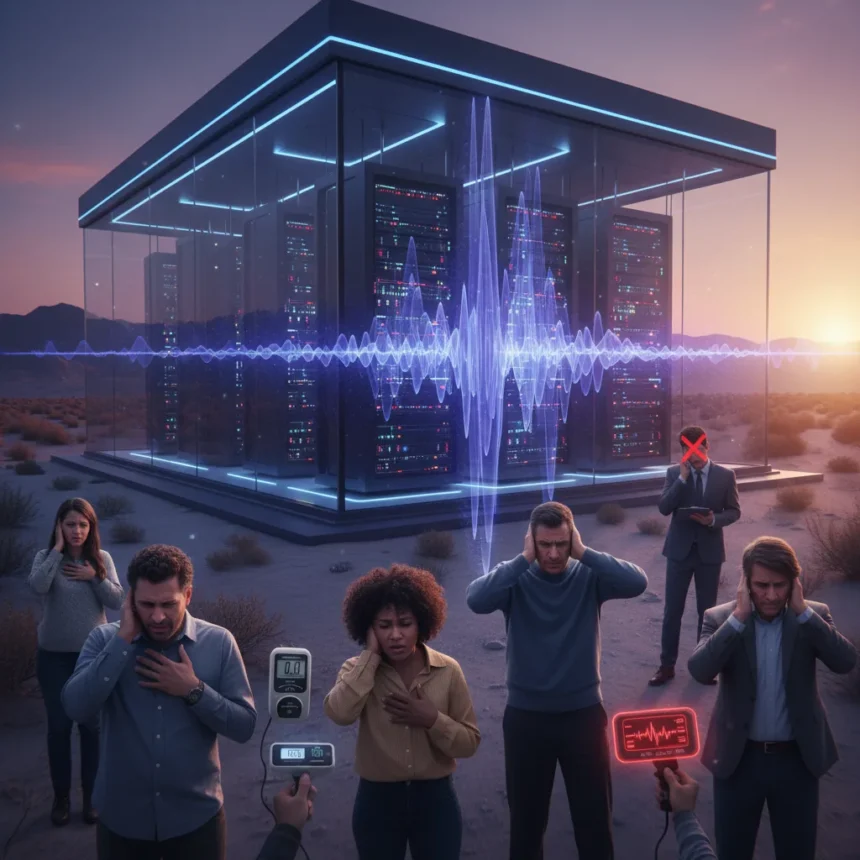
AI data centers infrasound is becoming a silent crisis for communities living near these facilities. Residents report persistent low-frequency and high-frequency sounds that standard decibel meters fail to capture, yet cause measurable physical discomfort including sleep disruption, headaches, dizziness, and nausea. The problem exposes a fundamental gap between how regulators measure noise and what people actually experience when living adjacent to always-on industrial infrastructure.
Key Takeaways
- Standard A-weighted decibel meters filter out infrasound and near-inaudible frequencies, showing compliant noise levels when residents report severe discomfort.
- AI data centers operate 24/7 with cooling systems, backup generators, and transformers that emit continuous low-frequency noise.
- Residents describe symptoms that worsen near the facilities and improve when they leave the area, suggesting direct exposure causation.
- Current noise-ordinance enforcement relies on measurement tools inadequate for the acoustic signature of modern data centers.
- Similar complaints are emerging across multiple U.S. and European data-center clusters, indicating a widespread pattern rather than isolated incidents.
Why Standard Noise Meters Miss the Problem
The core issue is acoustic measurement mismatch. A-weighted decibel meters, the standard tool for noise-ordinance enforcement, are designed to approximate human hearing sensitivity across frequencies. They deliberately filter out very low-frequency and infrasonic components because traditional understanding held that humans cannot hear these sounds. But infrasound—sound below the human hearing threshold of roughly 20 hertz—can still be felt as vibration and pressure in the body. When residents near AI data centers report continuous humming, pressure in the head, and sleep disruption, conventional decibel readings often show the facility is operating well within regulatory limits. The meters are working as designed. The problem is the design itself no longer matches the reality of how modern data-center infrastructure affects nearby populations.
This measurement gap creates a credibility trap for residents. Health department officials and local authorities receive complaints about noise-related symptoms but see decibel readings that suggest no violation. The resident is dismissed as oversensitive or imagining the problem, while the data center operates under the assumption that compliance with dBA standards equals community safety. Neither assumption is correct.
AI Data Centers Infrasound Sources and 24/7 Operation
AI data centers are not typical office buildings. They run continuously, without pause, to serve global computing demands. The acoustic footprint comes from multiple industrial components: massive cooling systems that move air constantly, backup diesel generators ready to fire on demand, electrical transformers stepping voltage up and down, and HVAC equipment cycling relentlessly. Each component produces vibration and noise across a broad frequency spectrum. The cooling systems in particular generate low-frequency rumble that penetrates walls and travels through soil. Unlike a factory that shuts down at night, an AI data center produces this acoustic environment every hour of every day.



Residents living within a half-mile or more report the same symptoms: sleep fragmentation, morning fatigue, difficulty concentrating, irritability, and a sense of pressure or vibration that they cannot escape indoors. Some describe the sensation as a constant presence, a low-level assault on their nervous system that builds over weeks and months. The symptoms often improve dramatically when residents leave the area for vacation or spend time elsewhere, then return when they come back—a pattern that strongly suggests location-linked exposure rather than psychological complaint or coincidence.
The Regulatory Framework Is Broken for This Problem
Current noise-ordinance frameworks were built for different industrial scenarios: factories with defined working hours, transportation noise that peaks at certain times, construction that is temporary. They assume that noise is intermittent and that people can find quiet refuge at night. AI data centers violate every one of these assumptions. They operate around the clock. They produce noise signatures that standard measurement tools cannot quantify. And they are being built in or near residential areas because land is cheaper and grid capacity is available there.



The result is regulatory paralysis. When a resident files a noise complaint, inspectors arrive with A-weighted decibel meters, take readings, and find no violation. The complaint is closed. The resident is left with no recourse and the impression that authorities do not believe them. Meanwhile, the data center continues operating under the legal fiction that it is compliant. This cycle repeats across multiple communities, and the pattern is becoming visible: similar complaints are emerging around data-center clusters in the U.S. and Europe, suggesting this is not a local anomaly but a systemic problem.
Health Effects Without Clinical Consensus
Residents report a consistent cluster of symptoms: sleep disruption is nearly universal, followed by headaches, dizziness, nausea, and general malaise. Some describe pressure sensations in the head or chest. Others report irritability and difficulty concentrating. These are not rare or exotic complaints—they are the symptoms typically associated with chronic noise exposure and infrasound sensitivity. But because the noise is not registering on standard meters, medical professionals and public-health officials often struggle to validate the connection. Without a measurable acoustic exposure that regulators recognize, the symptoms can be dismissed as stress-related, psychosomatic, or unrelated to the data center. This absence of official recognition does not mean the symptoms are not real. It means the measurement system is failing to capture the exposure.
What Happens When Communities Push Back
Some residents have begun documenting their experiences and organizing collectively. They report that leaving the area for a few days relieves symptoms, then the symptoms return within hours of coming back. This temporal pattern is difficult to dismiss as coincidence or psychological. Yet without regulatory tools to measure the infrasound and without health authorities willing to investigate without measurable data, residents are left in a position of having to prove their own suffering against institutional skepticism.
The tension is sharpening as AI data-center construction accelerates. Developers have strong economic incentives to build where land is cheap and grid capacity exists. Communities have equally strong incentives to avoid hosting industrial infrastructure that disrupts sleep and health. The current regulatory framework has no mechanism to resolve this conflict fairly because it cannot measure what residents are experiencing.


How This Compares to Other Industrial Noise Problems
Large power plants, manufacturing facilities, and refineries have generated low-frequency noise complaints for decades. But those facilities typically operate on defined schedules and are often zoned away from residential areas. AI data centers are different: they are newer, they operate 24/7, and they are often sited in areas where land-use zoning is ambiguous or where residential encroachment has occurred around an older facility. The acoustic problem is not entirely novel, but the scale and relentlessness of AI data-center noise is pushing existing measurement and regulatory frameworks to their breaking point.
Is infrasound from data centers proven to cause health problems?
Residents report consistent health symptoms including sleep disruption, headaches, and dizziness that improve when they leave the area. However, the article does not present peer-reviewed clinical studies establishing causation. The pattern of complaints is real and widespread, but the mechanism and severity remain contested because standard measurement tools cannot quantify the exposure.
Why don’t decibel meters detect data center infrasound?
A-weighted decibel meters are designed to approximate human hearing and deliberately filter out very low-frequency sounds below roughly 20 hertz. Data centers emit significant energy in these low-frequency ranges through cooling systems and transformers, but the meters are calibrated to ignore these frequencies. The result is readings that show compliance even when residents report intense discomfort.
Are these complaints happening in multiple locations?
Yes. Similar infrasound and low-frequency noise complaints have emerged around data-center clusters in multiple U.S. and European communities, indicating this is a pattern rather than isolated incidents. As AI data-center construction accelerates globally, the complaints are likely to increase unless measurement and regulatory frameworks are updated.
The core problem is not that residents are imagining things or that data centers are intentionally causing harm. The problem is that the tools regulators use to enforce noise ordinances were never designed to measure the specific acoustic signature of always-on industrial infrastructure operating in proximity to homes. Until measurement frameworks evolve and regulatory standards account for infrasound and continuous low-frequency noise, this conflict will persist and spread. Communities will continue reporting symptoms that regulators cannot measure, and data centers will continue operating under the assumption that dBA compliance equals safety. The gap between these two realities is where residents’ quality of life is disappearing.
Edited by the All Things Geek team.
Source: Tom's Hardware