







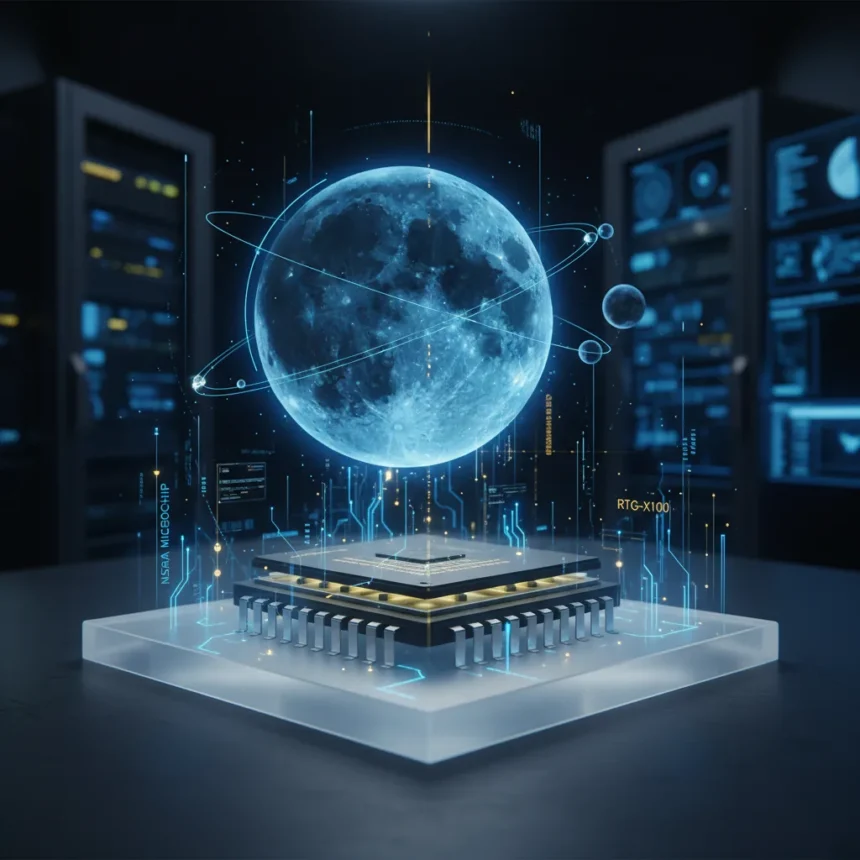
NASA and Microchip Technology have jointly developed the High Performance Spaceflight Computer (HPSC), a radiation-hardened spaceflight processor designed to deliver up to 100 times the performance of current space-qualified chips while surviving the intense radiation of deep space missions. This breakthrough marks a fundamental shift in how spacecraft will compute during extended lunar and Martian exploration, where autonomous decision-making and real-time data processing are no longer luxuries but necessities.
Key Takeaways
- HPSC is a 64-bit RISC-V multicore processor with radiation-hardened-by-design (RHBD) architecture for Moon and Mars missions.
- Targets 100x performance improvement over RAD750, the current baseline space-qualified processor.
- Two variants: Radiation-Hardened (HPSC-RH) for deep space and Radiation-Tolerant (HPSC-RT) for Low Earth Orbit constellations.
- Supports AI model portability from desktop computers to spacecraft, enabling autonomous deep space operations.
- Uses advanced FINFET materials and distributed radiation protection for energy-efficient computing despite hardening requirements.
Why the radiation-hardened spaceflight processor matters now
Current spacecraft rely on processors designed decades ago. The RAD750, the workhorse of space missions today, traces its lineage back roughly 15-20 years behind commercial silicon in architectural capability. As NASA prepares for sustained lunar habitation and eventual Mars missions under the Artemis program, this performance gap becomes untenable. Astronauts and rovers need processors that can handle real-time image processing, autonomous navigation, and complex decision-making without constant ground intervention. HPSC closes that gap by delivering orders of magnitude higher performance per watt while maintaining the radiation tolerance that keeps electronics functional in hostile space environments.
The challenge of building a radiation-hardened spaceflight processor lies in the physics. Space radiation—primarily high-energy protons and cosmic rays—flips bits in semiconductor logic, causing errors. Traditional approaches to radiation hardening sacrifice performance and efficiency. HPSC inverts that trade-off through radiation-hardened-by-design (RHBD) techniques that distribute protection across the chip according to functional criticality, power consumption, timing requirements, and physical area constraints. The result is a processor that survives where older designs would fail, yet runs faster and cooler.
The architecture: multicore design with always-on redundancy
HPSC is built on a 64-bit RISC-V instruction set with multiple processor cores, cache-coherent memory, integrated I/O, and a network-on-chip (NoC) fabric that ties everything together. What sets it apart is the always-on System Controller (SysC)—a dedicated RISC-V core that monitors the main processors and can take corrective action if radiation strikes corrupt data. This fault-tolerant design means the spacecraft doesn’t crash when a cosmic ray hits; it detects the error, corrects it, and continues operating.



The chip uses advanced FINFET transistor materials and radiation-hardened flip-flops and logic gates to resist Total Ionizing Dose (TID)—the cumulative radiation exposure that gradually degrades semiconductor performance. By hardening only the most critical logic paths and allowing less-critical circuits to use standard designs, engineers balance radiation immunity against power consumption and heat output. A processor that requires massive cooling systems is useless on a spacecraft with finite power budgets.
Two flavors for different mission profiles
NASA and Microchip are producing two variants of the radiation-hardened spaceflight processor. The HPSC-RH (Radiation-Hardened) targets deep space and planetary missions where radiation exposure is most intense—think Jupiter’s magnetosphere or the cosmic ray environment near Mars. The HPSC-RT (Radiation-Tolerant) is optimized for Low Earth Orbit constellations, where radiation levels are lower but missions still demand long operational lifespans. Both are pin and software compatible, meaning developers can write code once and deploy it across mission profiles without recompilation.


This flexibility addresses a real problem in space hardware. Historically, each mission required custom silicon tailored to its specific radiation environment, driving up costs and timelines. HPSC’s dual approach lets NASA and commercial space companies choose the right variant for their mission without rebuilding software ecosystems.
AI models now work in deep space
One of HPSC’s most significant capabilities is support for OpenXLA models—the same AI frameworks used in desktop computers and cloud datacenters. This means a machine learning model trained on Earth can be compiled for HPSC and deployed on a spacecraft with minimal modification. A rover on Mars could run a neural network trained on millions of Earth images to classify rocks, identify hazards, or plan routes autonomously. Previously, space missions relied on hand-coded decision trees and rule-based systems because the processors were too slow and power-hungry for real AI inference.
This shift unlocks new mission architectures. Instead of waiting hours for commands to travel from Earth (the signal delay to Mars is 3-22 minutes one way), rovers and landers can make decisions in real time using onboard AI. For long-duration missions, this autonomy is transformative.
Prototypes and timeline
Development of the radiation-hardened spaceflight processor is already advancing beyond theory. Researchers at the University of Texas have built a prototype Framework Laptop 16 mainboard using HPSC components to test the processor in a radiation-tolerant computing environment. This hands-on prototyping validates the design before flight hardware is manufactured. Microchip’s PIC64-HPSC series is announced for space missions, though engineering samples are expected in the mid-2020s. That timeline aligns with Artemis mission preparations, suggesting HPSC could fly on lunar spacecraft within the next few years.



Microchip’s experience with radiation-hardened FPGAs—including the PolarFire, which passed space radiation testing with a Single Event Latchup (SEL) threshold exceeding 80 MeV·cm²/mg—provides confidence that the company can deliver on HPSC’s promises. The partnership with NASA also ensures the design meets the rigorous qualification standards space missions demand.
How HPSC compares to current space processors
The RAD750, HPSC’s baseline for the 100x performance claim, has served NASA and commercial space companies reliably for two decades. But reliability and performance are not the same thing. The RAD750 operates at clock speeds and with memory bandwidth that feel antiquated by modern standards. HPSC achieves high clock rates despite radiation protection—a technical feat that earlier designs could not match. For missions that need to process gigabytes of sensor data daily, that performance gap translates directly into capability. A rover with HPSC can analyze images in minutes instead of hours, or a spacecraft can autonomously detect and avoid hazards without ground operator intervention.
Commercial silicon remains off-limits for space missions because radiation hardens it unpredictably. A processor designed for a smartphone may fail catastrophically in space. HPSC bridges that gap by adopting modern RISC-V architecture—open-source and widely supported—while adding the hardening layers space demands. Developers can leverage the same tools and libraries they use for terrestrial RISC-V systems, reducing the learning curve and accelerating time-to-flight.
Why this matters for space exploration
The radiation-hardened spaceflight processor represents a generational leap in space computing. It enables longer-duration missions, more autonomous operations, and faster decision-making in environments where human operators cannot intervene in real time. For Artemis missions to the Moon and eventual human exploration of Mars, that capability is foundational. Habitats need processors that can manage life support systems, communications, and scientific instruments without constant ground support. Rovers need the intelligence to explore rugged terrain and conduct science autonomously. HPSC makes both possible.
Beyond exploration, the technology has spillover benefits. Radiation-hardened processors are also valuable in terrestrial applications exposed to cosmic rays—high-altitude aircraft, medical devices, and automotive systems in extreme environments. The investment in space-grade silicon often finds commercial applications, making HPSC a rare example of space technology that benefits Earth-bound industries as well.
Is HPSC the final answer for space computing?
HPSC is a major step forward, but it is not the end of the story. As missions push deeper into space and demand even more autonomy, processors will need to evolve further. Quantum-resistant cryptography, advanced AI inference, and fault-tolerant architectures will become standard. HPSC’s modular design and support for emerging frameworks like OpenXLA position it as a platform that can adapt as space missions grow more ambitious. The partnership between NASA and Microchip also signals that space-grade computing will no longer lag commercial technology by decades—a shift that accelerates innovation across the entire industry.
When will HPSC actually fly?
Engineering samples of the radiation-hardened spaceflight processor are expected in the mid-2020s, with full flight qualification following. That timeline suggests HPSC could appear on Artemis lunar missions or deep space probes launching in the late 2020s. Microchip’s track record with radiation-hardened FPGAs and NASA’s rigorous qualification process give confidence that the processor will meet its performance and reliability targets.
What makes RHBD different from traditional radiation hardening?
Traditional radiation hardening uses thick shielding, redundant circuits, and conservative design margins—all of which consume power and limit performance. Radiation-hardened-by-design (RHBD) takes a smarter approach, protecting only the logic that matters most while allowing non-critical circuits to use standard designs. This surgical approach preserves performance and efficiency while maintaining radiation tolerance. HPSC’s use of advanced FINFET materials further enhances resistance to Total Ionizing Dose, the cumulative radiation damage that degrades semiconductors over years-long missions.
NASA and Microchip’s radiation-hardened spaceflight processor represents a watershed moment in space computing. It proves that high performance and radiation tolerance are not mutually exclusive. For the next generation of lunar habitats, Mars rovers, and deep space probes, that capability is not optional—it is essential. The 100x performance leap over current space processors is not just a number; it is the difference between tele-operated rovers and truly autonomous explorers, between ground-dependent spacecraft and independent deep space agents. As humanity pushes toward sustained lunar presence and eventual Mars settlement, HPSC will be the silicon beating at the heart of those missions.
Edited by the All Things Geek team.
Source: Tom's Hardware


