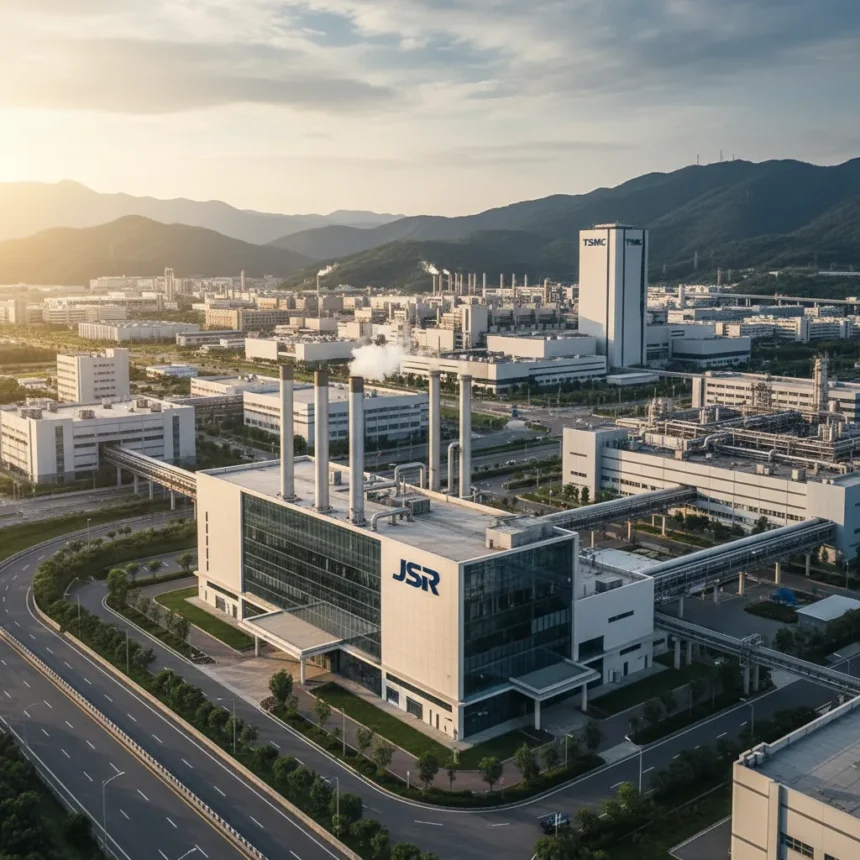
EUV photoresist production is moving closer to the world’s largest chip manufacturer. Japanese chemical giant JSR, which controls roughly one-fifth of the global photoresist market, established a joint venture in Taiwan in April 2026 to build its first dedicated production facility for advanced resist materials, positioning itself directly alongside TSMC for real-time co-development of next-generation lithography chemicals.
Key Takeaways
- JSR formed JSR Micro Advanced Manufacturing Taiwan Co., Ltd. in April 2026 with 51% ownership to produce EUV photoresists near TSMC.
- The Taiwan plant targets production startup as early as 2028, with investment in the tens of millions of dollars.
- Rivals Tokyo Ohka Kogyo and Shin-Etsu Chemical already operate Taiwan facilities, giving them direct TSMC access JSR previously lacked.
- JSR simultaneously builds the world’s first production-scale metal oxide resist facility in South Korea, targeting 2026 mass production for Samsung and SK hynix.
- Metal oxide resists absorb EUV photons more efficiently than traditional resist chemistries, enabling smaller chip features.
Why JSR needed to move production to Taiwan
JSR’s Taiwan expansion addresses a structural competitive disadvantage. Competitors Tokyo Ohka Kogyo and Shin-Etsu Chemical already operate production facilities in Taiwan, giving them the ability to collaborate directly with TSMC engineers on resist development and troubleshooting in real time. JSR’s existing Taiwan operation, established in 2007 in Hsinchu County, focused on research and development of EUV metal resist but lacked a production footprint. The new joint venture facility in Yunlin County closes that gap by embedding manufacturing capability directly in TSMC’s supply ecosystem.
This move reflects a broader shift in semiconductor materials strategy. As Chinese photoresist makers intensify competition at the commodity end of the market, Japanese suppliers like JSR are racing to deepen ties with leading-edge chipmakers and lock in their position in high-value materials. Without a Taiwan production plant, JSR risked becoming a secondary supplier rather than a co-developer of TSMC’s most advanced lithography processes.
EUV photoresist production and metal oxide resist innovation
The Taiwan facility will focus on co-developing advanced photoresists with TSMC, particularly metal oxide resists (MOR) designed for extreme ultraviolet lithography. Metal oxide resist absorbs EUV photons more efficiently than traditional resist chemistries, enabling finer feature resolution and supporting the industry’s push toward 3-nanometer nodes and beyond. JSR is simultaneously building the world’s first production-scale MOR facility in South Korea, where mass production is expected to begin in 2026, supplying tin-based MOR to Samsung Electronics and SK hynix.


The dual geographic strategy reveals JSR’s intent to become the primary MOR supplier across Asia’s two largest chipmakers. By establishing production capacity in both South Korea and Taiwan, JSR reduces supply-chain risk while positioning itself as indispensable to advanced node development. The Taiwan facility will also consider production of abrasives used to smooth semiconductor substrates, diversifying its materials portfolio beyond photoresists alone.
Timeline and investment scope
JSR’s Taiwan plant is targeted to come online as early as 2028, though this timeline remains subject to regulatory approval and construction milestones. The investment is valued in the tens of millions of dollars, though JSR has not disclosed an exact figure. The South Korea MOR facility is further along, with mass production expected to begin in 2026. This staggered rollout suggests JSR is prioritizing the higher-volume MOR technology first, then scaling photoresist production in Taiwan as TSMC’s demand for co-developed materials grows.



The timing is critical. Advanced node manufacturing requires materials suppliers to iterate alongside chipmakers, often involving TSMC engineers in early development stages to ensure resist performance meets lithography specifications. A Taiwan facility allows JSR to compress feedback loops and reduce time-to-market for new resist formulations, a capability its competitors already possess.
What does this mean for the photoresist market?
JSR’s Taiwan expansion signals continued Japanese dominance in high-value semiconductor materials despite competitive pressure from China. By embedding production next to TSMC, JSR is betting that proximity and co-development access will sustain its market position even as commodity resist suppliers proliferate globally. The move also underscores TSMC’s strategic preference for multi-vendor supply chains—TSMC works with JSR, Tokyo Ohka Kogyo, and Shin-Etsu Chemical, reducing dependency on any single supplier.
For JSR shareholders, the Taiwan facility represents a defensive but necessary investment. The company cannot afford to lose TSMC’s advanced node business to rivals with on-site production capacity. For TSMC, the arrival of another major photoresist supplier in Taiwan strengthens its negotiating position and ensures material supply security as EUV lithography becomes critical to sub-3-nanometer scaling.
Is JSR building production capacity in other regions?
Yes. JSR is simultaneously constructing the world’s first production-scale metal oxide resist facility in South Korea, where mass production is expected to begin in 2026. This facility supplies tin-based MOR to Samsung Electronics and SK hynix, Japan’s two major semiconductor competitors to TSMC. JSR’s dual-region strategy reflects the reality that advanced chipmakers demand local material suppliers to support rapid iteration and quality control.



What is metal oxide resist and why does it matter?
Metal oxide resist (MOR) is a photoresist chemistry designed specifically for extreme ultraviolet (EUV) lithography. Unlike traditional organic resists, MOR absorbs EUV photons more efficiently, enabling higher resolution and better pattern fidelity at smaller feature sizes. This efficiency gain is critical for chipmakers pushing toward 3-nanometer nodes and beyond, where traditional resist performance begins to degrade. JSR’s MOR technology is central to its strategy to remain indispensable to leading-edge chipmakers.
When will JSR’s Taiwan photoresist plant start production?
The Taiwan facility is targeted to come online as early as 2028, though this timeline is not guaranteed and may shift based on regulatory approvals, construction progress, and TSMC’s demand signals. The South Korea MOR facility is further advanced, with mass production expected to begin in 2026. JSR will likely prioritize the MOR facility first, given its strategic importance to Samsung and SK hynix.
JSR’s Taiwan move is a defensive play dressed up as expansion. The company is not entering a new market—it is finally catching up to rivals already embedded in TSMC’s supply chain. The real story is not JSR’s ambition but its necessity. Without a Taiwan production footprint, JSR risks becoming a secondary supplier of advanced photoresists to the world’s most important chipmaker. By establishing a joint venture with local partners, JSR is betting that proximity and co-development access will protect its market share against both established competitors and emerging Chinese challengers.
Edited by the All Things Geek team.
Source: Tom's Hardware