





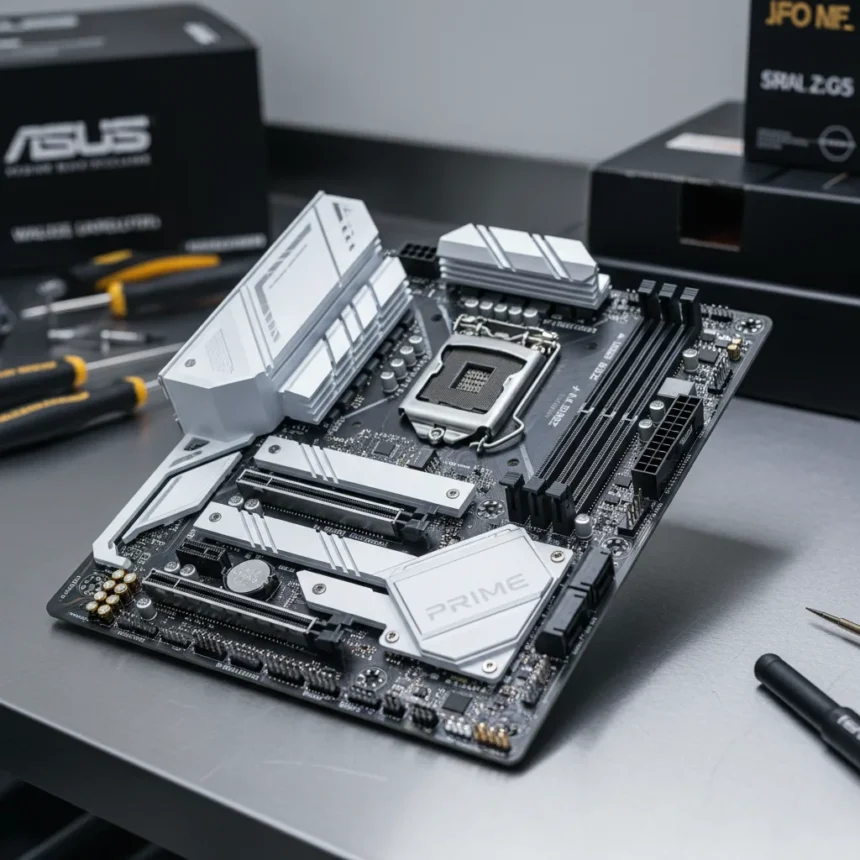
The Asus Prime Z890-P WiFi is a budget-class ATX motherboard for Intel’s Z890 chipset and LGA 1851 socket, designed for Core Ultra (Arrow Lake) processors launching October 24, 2024. Priced around $280–$300, it promises entry-level access to the new platform’s native Thunderbolt 4 and Wi-Fi 7 capabilities. But the real question is whether Asus’ cost-cutting actually delivers value, or simply delivers fewer features than competitors charging similar money.
Key Takeaways
- Asus Prime Z890-P WiFi costs $280–$300, positioning it as an entry-level Z890 board for budget builders.
- Supports DDR5 memory with 4 DIMM slots; Z890 platform enables speeds up to 9000MHz+ on higher-end models.
- Features Wi-Fi 7, 2.5GbE LAN, Thunderbolt 4, and one PCIe 5.0 x16 slot for GPU expansion.
- Typically includes 4x M.2 slots (one PCIe 5.0, others Gen4) plus SATA ports for legacy storage.
- Competitors like ASRock Z890 Pro-A offer similar specs at lower prices; Asus ROG Strix Z890-A adds features at $400.
Where the Asus Prime Z890-P WiFi Actually Competes
At $280–$300, the Asus Prime Z890-P WiFi sits in a crowded segment where value matters more than brand loyalty. The board delivers what you’d expect from an entry-level Z890: DDR5 support with 4 DIMM slots, Wi-Fi 7 connectivity, and enough USB ports to keep modern peripherals happy. The inclusion of Thunderbolt 4 is a genuine platform advantage—Intel’s Z890 chipset enables this natively, giving even budget boards a feature that was rare on previous-generation platforms.
The storage situation is functional but uninspired. Four M.2 slots sound adequate until you compare them to boards at the same price. One slot runs PCIe 5.0, delivering blazing-fast NVMe speeds for your boot drive or games. The remaining three are PCIe Gen4, which is still fast enough for most workloads but less future-proof. SATA ports remain for older drives, though fewer builders care about those anymore.
Asus has equipped the Prime Z890-P WiFi with its AI tools for overclocking, cooling, and networking optimization. These features appeal to enthusiasts who want automated tuning without manual BIOS tweaking. The design includes DIY-friendly elements like Q-Release mechanisms, making component swaps easier. It’s the kind of thoughtful engineering that separates Asus from cheaper competitors—but only if you actually use those features.


Why the Asus Prime Z890-P WiFi Stumbles Against Alternatives
The real problem isn’t what the Asus Prime Z890-P WiFi includes—it’s what it omits relative to competing boards at the same price. ASRock’s Z890 Pro-A undercuts it at $189–$199, delivering identical DDR5 support, Thunderbolt 4, and nearly the same storage layout. For builders on the tightest budgets, ASRock’s board is the obvious choice. Gigabyte’s PRO Z890-A WIFI sits around $240 with comparable USB and Thunderbolt connectivity, leaving the Asus option looking overpriced by comparison.
The real danger comes from looking just slightly upmarket. The Asus TUF Gaming Z890-Plus WiFi costs $356.81—only $76 more than the Prime—but brings superior build quality and a reputation for stability under heavy loads. For an extra $100, the Asus ROG Strix Z890-A Gaming WiFi ($399.99) adds five M.2 slots instead of four, better audio components, and a more robust VRM designed for serious overclocking. That’s where the Prime Z890-P WiFi loses the argument: it’s positioned as a stepping stone to better boards, not as a destination.



The board’s VRM (voltage regulator module) is competent but not exceptional. It delivers stable power to your CPU, but lacks the phase count and cooling of midrange alternatives. For users pushing Core Ultra chips to their limits, this is a limitation worth knowing about. MSI’s MEG Z890 ACE, at the premium end, features a 24-phase VRM with 110A MOSFETs that crushes the Prime’s architecture. Even if you’re not overclocking, a stronger VRM means lower heat and longer component lifespan—things that matter over a 5-year ownership cycle.
Asus Prime Z890-P WiFi vs. the Platform It Represents
The Z890 platform itself is the real story here. Native Thunderbolt 4, DDR5 at speeds up to 9000MHz+, and Wi-Fi 7 represent genuine leaps forward from Z790. The Asus Prime Z890-P WiFi inherits these advantages simply by existing on the platform. But it doesn’t innovate within that framework—it merely checks boxes.
This is Asus’ strategy for the budget segment: give customers the platform benefits at an accessible price, then upsell them to ROG boards if they want more personality or performance headroom. It’s a sensible business model, but it leaves the Prime Z890-P WiFi feeling like a foundation rather than a finished product. Builders buying this board should know they’re getting the bare minimum of Z890 goodness, not the full experience.
Should You Buy the Asus Prime Z890-P WiFi?
The Asus Prime Z890-P WiFi is the right choice only if you have specific constraints: you want Z890 platform features, you have a tight budget, and you don’t plan to push the system hard. If any of those conditions change, a competitor board becomes the smarter buy. ASRock’s Z890 Pro-A is cheaper and nearly identical. The TUF Gaming Z890-Plus WiFi offers better build quality for $76 more. The ROG Strix Z890-A adds features and cooling for $100 more. The Prime Z890-P WiFi occupies an awkward middle ground where it’s neither the cheapest nor the best value—just adequate.



For Core Ultra builders who prioritize stability and want to upgrade their system in 2–3 years, the Prime Z890-P WiFi will get the job done. For enthusiasts or anyone planning a longer ownership cycle, the extra investment in a better board pays dividends in reliability and upgrade flexibility. The platform is excellent. This particular board is just fine.
What are the storage specs for the Asus Prime Z890-P WiFi?
The board includes four M.2 slots, with one supporting PCIe 5.0 and three running PCIe Gen4. Most users will populate the PCIe 5.0 slot with their primary NVMe drive for fastest boot and game loading times. SATA ports remain for legacy storage, though they’re becoming less common in new builds.
Does the Asus Prime Z890-P WiFi support overclocking?
Yes. The board includes Asus AI overclocking tools and a capable BIOS for manual tuning. However, its VRM is entry-level, so sustained overclocking under heavy loads may generate more heat than midrange alternatives. Budget builders should keep expectations realistic—this board is stable, not exceptional, for extreme overclocking.
How does the Asus Prime Z890-P WiFi compare to Z790 boards?
The Prime Z890-P WiFi costs roughly $100 more than its Z790-P predecessor, but gains native Thunderbolt 4, Wi-Fi 7 options, and support for faster DDR5 speeds. If you’re upgrading from an older platform, these advantages justify the cost. If you already own a Z790 board, the gains are incremental unless you need Thunderbolt 4 specifically.
The Asus Prime Z890-P WiFi is a competent entry point to Intel’s newest platform, but it’s not a compelling product on its own merits. It exists to serve builders who prioritize budget over features—a legitimate audience, but one with better options nearby. Spend $20 less on ASRock, or $100 more on Asus ROG, and you’ll feel better about your choice.
Where to Buy
Edited by the All Things Geek team.
Source: Tom's Hardware




