






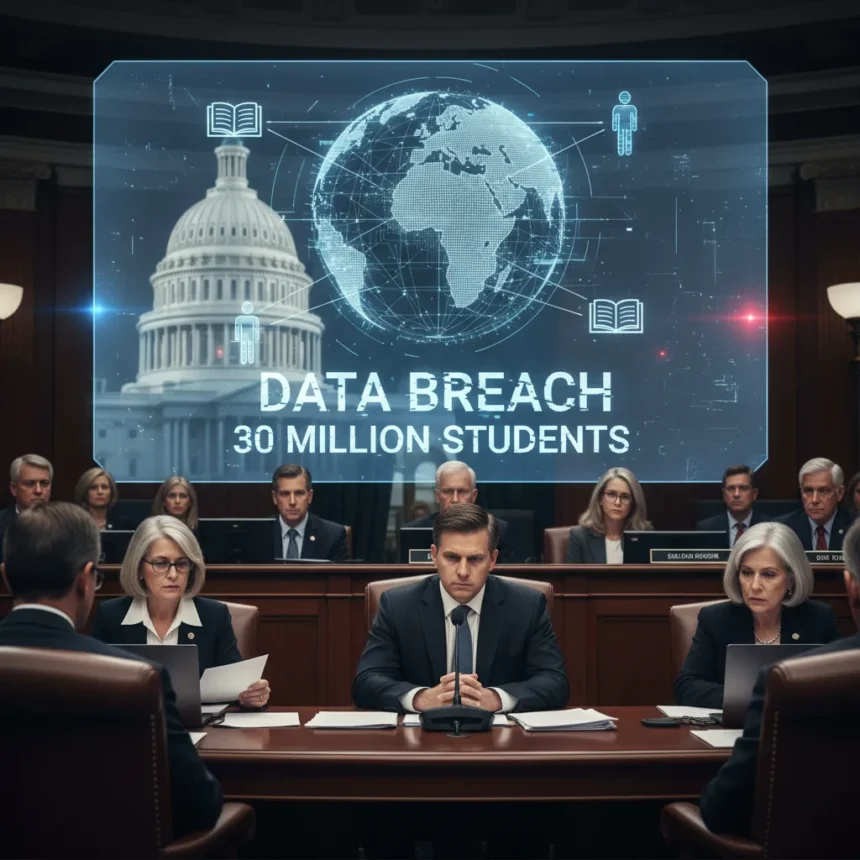
The Canvas data breach has triggered the first congressional summoning of an education technology CEO, signaling how seriously lawmakers now view security failures in schools. Instructure CEO Steve Daly faces a House Committee on Education and the Workforce hearing scheduled for May 20, 2026, in Washington, D.C., to answer for two major breaches by the ShinyHunters hacking group that compromised Canvas, the learning management system serving over 30 million users globally, including 90% of US higher education institutions.
Key Takeaways
- Instructure CEO Steve Daly summoned to testify before Congress on May 20, 2026, regarding Canvas data breaches.
- ShinyHunters hacking group conducted two breaches: December 2023 (6TB of user data claimed) and April 2024 (96,000 support tickets with PII stolen).
- Canvas serves over 30 million users globally and dominates US higher education with roughly 45% market share.
- April 2024 breach exposed customer support tickets containing names, emails, phone numbers, and sensitive student records.
- Instructure enhanced security post-breach with multi-factor authentication and endpoint detection; no ransom paid.
Why Congress Is Investigating the Canvas Data Breach
The Canvas data breach represents a watershed moment for education technology oversight. When a single platform serving 90% of US higher education institutions falls to hackers twice in five months, the ripple effects extend far beyond technical inconvenience. Students lost access to coursework, grades, and institutional communications during outages. Rep. Burgess Owens, a committee member, framed the stakes bluntly: students were left stranded without access to critical learning tools, and Congress demanded answers on how this happened and what prevents repetition.
The breaches occurred in a climate of rising cyber threats targeting education. ShinyHunters, an Indian hacking group, first struck in December 2023, claiming access to 6TB of Canvas user data. Instructure disputed the severity, confirming only unauthorized access to the Canvas Preview environment while claiming no evidence of student data theft. Months later, in April 2024, the group proved that claim incomplete by stealing 96,000 customer support tickets from Instructure’s Help Center. Those tickets contained personally identifiable information—names, emails, phone numbers—and in many cases, sensitive student records. ShinyHunters posted samples on BreachForums, offering the full dataset for sale. Instructure refused to pay ransom.
Canvas Data Breach Scope and Student Impact
The April 2024 breach exposed the depth of Canvas’s centralized architecture. Unlike decentralized platforms such as Moodle, which runs on individual institution servers, Canvas concentrates user data in Instructure’s infrastructure. That design choice accelerates deployment and reduces administrative burden for schools, but it also creates a single point of catastrophic failure. When ShinyHunters breached the Help Center, they accessed not just support metadata but transcripts of interactions between Instructure staff and thousands of institutions, many discussing security issues, integration problems, and student data concerns. Some tickets contained student names, ID numbers, and academic standing information.
Canvas dominates the US education technology market with approximately 45% market share, making breaches uniquely disruptive compared to smaller competitors like Moodle or Brightspace. A Canvas outage affects millions of students simultaneously across hundreds of institutions. During the breaches, students at universities and K-12 districts nationwide reported inability to submit assignments, view grades, or access course materials for extended periods. The disruption was not merely inconvenient—it interrupted instruction and assessment during critical academic windows.
Instructure’s Response and Security Measures
After the April 2024 breach, Instructure announced enhanced security measures, including mandatory multi-factor authentication and endpoint detection and response tools. The company stated that data security was a priority and that robust measures would protect users going forward. However, Congress will press Daly on why these protections were not in place before the breaches and whether independent audits have verified the effectiveness of new controls.



The Canvas data breach also raises questions about Instructure’s disclosure practices. The company’s initial statement following the December 2023 breach downplayed the incident, claiming no student data was compromised. That narrative collapsed when ShinyHunters released proof of access to student records. For the April 2024 breach, Instructure again faced criticism for slow disclosure and incomplete initial communications about what data was stolen. Congress will likely explore whether institutions and affected individuals were notified promptly and comprehensively.
What This Means for Education Technology Going Forward
The Canvas data breach hearing reflects a broader shift in how Congress views education technology security. Education is no longer treated as a peripheral sector in cybersecurity policy—it is now a critical infrastructure concern. Schools depend on platforms like Canvas to deliver instruction, assess learning, and manage institutional records. When those platforms fail, the impact cascades across millions of students and hundreds of institutions.
The hearing also signals that education technology companies can no longer rely on obscurity or regulatory inattention. Instructure is one of the largest edtech vendors in the world, and its security failures now trigger congressional scrutiny. Smaller competitors and newer entrants should expect similar oversight if they suffer breaches affecting student data at scale.
For institutions using Canvas, the hearing may accelerate conversations about diversification. While Canvas’s market dominance makes switching impractical for most schools, some may explore hybrid approaches, integrating alternative tools for sensitive functions like student records or financial data. Others may demand stronger contractual guarantees around security audits and breach notification from Instructure.



How Does Canvas Compare to Other Learning Management Systems?
Canvas faces competition from Blackboard (owned by Anthology), Moodle, Schoology (owned by PowerSchool), and Brightspace (owned by D2L). Moodle, an open-source platform, distributes data across individual institution servers rather than centralizing it in a vendor-managed cloud. That architecture reduces the blast radius of a breach—compromising Moodle at one university does not automatically expose data from hundreds of others. However, Moodle requires institutions to manage their own security infrastructure, which many schools lack the expertise to do well. Canvas offers simplicity and integration at the cost of centralized risk. The congressional hearing will likely intensify debate over which trade-off serves students better.
What will happen at Daly’s congressional testimony?
Daly will face questions on the timeline of the Canvas data breach discovery, why preventive controls were inadequate, and what independent verification exists for Instructure’s post-breach security enhancements. Expect detailed questioning on the April 2024 breach of the Help Center, the types of student data exposed in support tickets, and which institutions were affected. Congress will also press on communication—when did Instructure notify affected customers, how did it reach students directly, and what remediation or credit was offered.
Could Canvas breaches have been prevented?
Both the December 2023 and April 2024 Canvas data breaches likely exploited known vulnerabilities or weak access controls rather than zero-day exploits. The Help Center breach, in particular, suggests that Instructure failed to segregate customer support systems from production databases or to restrict employee access to sensitive data. Standard security practices—network segmentation, least-privilege access, multi-factor authentication, and regular penetration testing—should have prevented or detected these breaches. Instructure’s post-breach security announcements suggest these controls were not in place beforehand, raising questions about the company’s security maturity before the incidents.
The Canvas data breach hearing on May 20, 2026, will set a precedent for how Congress treats education technology security. If Daly’s testimony fails to satisfy lawmakers, expect legislative proposals mandating security standards, breach notification timelines, and liability frameworks for edtech vendors. For Instructure and its competitors, the hearing is a warning: student data breaches are no longer a private matter between a vendor and its customers. They are now a matter of national education policy.
Edited by the All Things Geek team.
Source: TechRadar