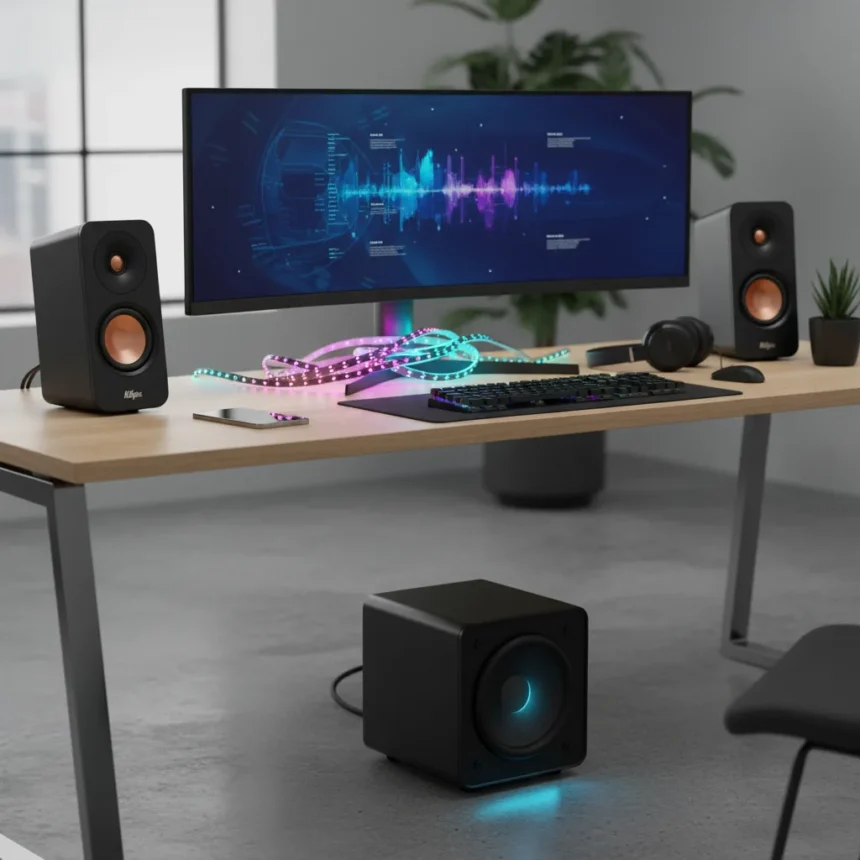
The Klipsch ProMedia Lumina is a redesigned 2.1 speaker system for PC and desktop use, made by Klipsch, launched in September 2024, priced at $299 MSRP, available globally through Klipsch.com, Amazon, Best Buy, and regional distributors in Europe, the UK, and Australia. It marks the first major refresh of Klipsch’s iconic ProMedia line since 2006, adding Bluetooth 5.3 connectivity, app-controlled RGB LEDs, and a significantly more compact subwoofer. Yet the pursuit of a slimmer footprint comes at a cost: measurably weaker bass response than the original ProMedia 2.1.
Key Takeaways
- Klipsch ProMedia Lumina satellites are 20% smaller than predecessors; subwoofer measures 9.1 x 9.1 x 9.8 inches.
- Bluetooth 5.3 and customizable RGB LEDs via Klipsch Connect app add modern features the original lacked.
- Bass response drops 6dB at 40Hz compared to ProMedia 2.1 THX; frequency response spec of 35Hz unverified in testing.
- System delivers 240W total power with 3-inch midrange drivers and 0.75-inch titanium-dome tweeters in horn-loaded design.
- Priced at $299, it undercuts gaming-focused competitors like Razer Nommo Chroma ($250) but loses raw bass extension.
Design That Prioritizes Space Over Sound
The Klipsch ProMedia Lumina shrinks to fit modern desks, but that compromise shows in the numbers. The subwoofer—9.1 x 9.1 x 9.8 inches and weighing 11.7 pounds—is genuinely compact, using a front-firing 6.5-inch woofer with a rear slot-port design. The satellites follow suit: each measures 8.5 x 5.7 x 6.5 inches, making them 20% smaller than the original ProMedia 2.1. Both are magnetically shielded and include rubber feet, with optional wall-mount brackets for further space savings.
The trade-off is immediate. Testing reveals the Lumina’s bass response at 40Hz sits 6dB lower than the ProMedia 2.1 THX, a perceptible loss in low-end presence. The subwoofer’s frequency response spec claims 35Hz, but actual measurements show the -10dB point closer to 45Hz. That gap matters if you value bass extension for movies or games. For casual music listening on a desk, the compact size may justify the trade. For anything else, you’re buying convenience at the cost of performance.
Modern Connectivity and Customization
Where the Klipsch ProMedia Lumina improves is in features the 2006 original never had. Bluetooth 5.3 with support for SBC, AAC, and aptX HD codecs means wireless pairing from phones, tablets, or laptops. The right satellite includes a 3.5mm analog stereo input for wired sources, and the Klipsch Connect app (iOS/Android) unlocks customizable RGB LEDs with seven static colors or animated patterns like breathing and music sync modes. Brightness is adjustable from off to high.


The app also houses EQ presets—Music, Movie, Voice, Flat, and Custom—plus a 5-band equalizer for fine-tuning. Firmware updates roll out through the app, keeping the system current. The volume knob on the right satellite features a multi-color LED ring that responds to your selections. Setup is straightforward: connect the subwoofer’s fixed 10-foot cable to the right satellite, link the left satellite via a second 10-foot cable, plug in power, and pair via Bluetooth or 3.5mm input. For a system that started in 2006, these additions feel genuinely modern.
Klipsch ProMedia Lumina vs. Competitors
The Klipsch ProMedia Lumina sits in a crowded segment. Compared to its own predecessor, the original ProMedia 2.1 offers superior bass extension and a bulkier form factor, though it lacks Bluetooth, LEDs, and app control. The Logitech Z407 ($120) delivers wireless functionality and DSP, but its horn-loaded highs cannot match the Lumina’s clarity. The Razer Nommo Chroma ($250) leans bass-heavy for gaming, sacrificing midrange and treble accuracy. The Creative Pebble Plus ($60) is more compact but inferior in sound quality and power output. The Lumina’s 240W total system power and MicroTractrix horn design on the tweeters position it as the more refined choice for accuracy-focused listeners, even if its bass doesn’t dig as deep as gaming-centric alternatives.


Who Should Buy the Klipsch ProMedia Lumina?
The Klipsch ProMedia Lumina makes sense for desk-bound users who value aesthetics and modern connectivity over bass extension. If your desk space is tight, the compact subwoofer and 20% smaller satellites are genuine advantages. Bluetooth pairing simplifies switching between a PC and phone. RGB LED customization appeals to streamers and content creators. The 2-year warranty and Klipsch’s heritage in horn-loaded speaker design provide confidence in build quality.
Skip it if deep bass matters. Movie enthusiasts, bass-heavy music listeners, and gamers will feel the 6dB loss at 40Hz. The unverified frequency response spec and actual -10dB point at 45Hz signal that Klipsch prioritized compact dimensions over low-end authority. At $299, it is not the cheapest option, and it does not deliver the bass performance to justify the premium over the original ProMedia 2.1 ($199) or the more bass-forward Razer Nommo Chroma ($250).
FAQ: Common Questions About the Klipsch ProMedia Lumina
Does the Klipsch ProMedia Lumina work with wireless sources?
Yes. Bluetooth 5.3 with aptX HD support allows wireless pairing from phones, tablets, and laptops. Hold the Bluetooth button on the right satellite for 5 seconds to pair. Wired connection via 3.5mm input on the right satellite is also supported.
Can you customize the RGB LEDs on the Klipsch ProMedia Lumina?
Yes, via the Klipsch Connect app. Choose from seven static colors (red, green, blue, cyan, magenta, yellow, white), animated modes like breathing and music sync, and adjust brightness from off to high. The app also houses EQ presets and firmware updates.



How does bass performance compare to the original ProMedia 2.1?
The Lumina’s bass is noticeably weaker. Testing shows it sits 6dB lower at 40Hz than the ProMedia 2.1 THX, and the actual -10dB point is closer to 45Hz rather than the claimed 35Hz specification. The compact subwoofer design sacrifices low-end extension for space savings.
The Klipsch ProMedia Lumina is a competent refresh that modernizes an aging product line with Bluetooth, app control, and RGB customization. But it commits a cardinal sin: it makes the system smaller and more convenient while making the bass worse. For desk-space-constrained users who stream music and video calls, that trade-off may be acceptable. For anyone who values bass extension or owns the original ProMedia 2.1 and expects an upgrade, the Lumina disappoints. Klipsch proved it could shrink the hardware. It should have worked harder to preserve the sound.
Where to Buy
Edited by the All Things Geek team.
Source: Tom's Hardware