






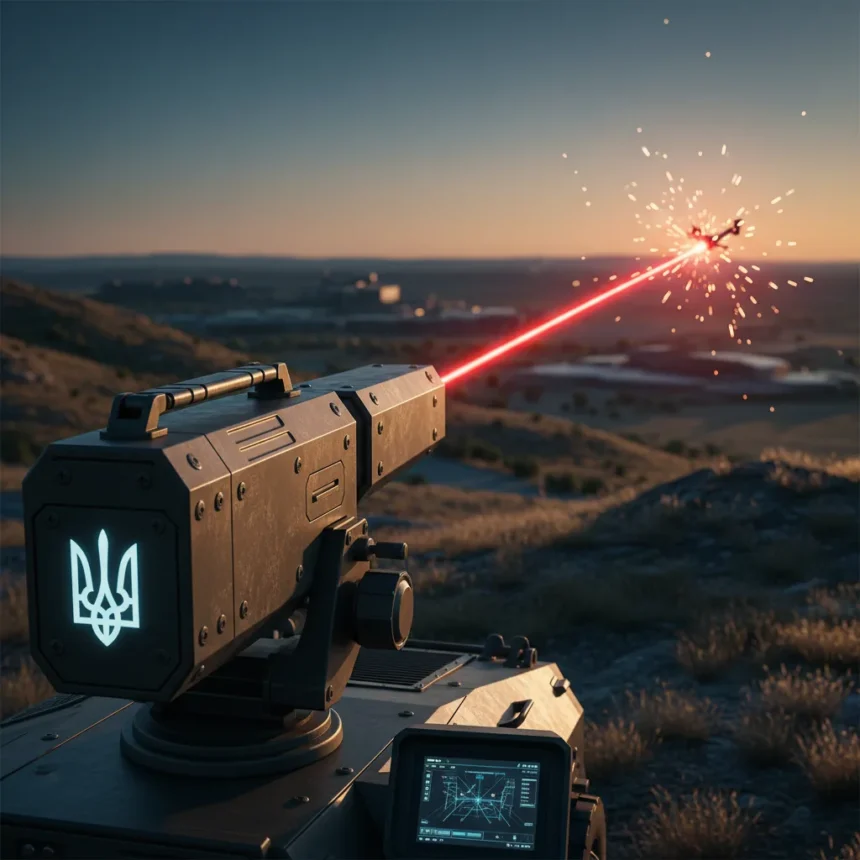
Ukraine’s Tryzub anti-drone laser system represents a fundamental challenge to how Western militaries price air defense. Developed by Ukrainian company Celebra Tech, the Tryzub anti-drone laser can destroy drones, helicopters, and surveillance systems at ranges up to 3 miles away—and costs a tiny fraction of what traditional missile-based Western systems charge.
Key Takeaways
- Tryzub anti-drone laser can engage targets at 3-mile range with dramatically lower operating costs than Western equivalents
- System is trailer-mounted and developed by Ukrainian company Celebra Tech for rapid deployment
- Designed to counter FPV drones and reconnaissance UAVs that have dominated recent conflict
- Represents shift from expensive missile-based air defense to laser-based alternatives
- System is in final testing stages and approaching battlefield deployment
How the Tryzub Anti-drone Laser Works
The Tryzub anti-drone laser is a trailer-mounted system that uses directed energy to destroy aerial targets. Unlike traditional air defense missiles that cost tens of thousands of dollars per shot, the laser operates at a fraction of the per-engagement cost, making it economically viable against the constant stream of cheap drones that Russian forces have been deploying. The system is designed to engage multiple target types—from small FPV quadcopters to larger reconnaissance platforms—across different engagement ranges.
The operational advantage lies in speed and persistence. A laser weapon does not require reloading between shots and can engage targets as quickly as they appear in its field of view. In a conflict where drone swarms have become standard tactics, the ability to fire repeatedly without logistical constraints represents a significant tactical shift. Ukrainian forces have demonstrated the system in action, showcasing its capability to track and engage moving targets.
Why Cost Matters More Than Range
The real story behind the Tryzub anti-drone laser is not just its 3-mile range—it is the economics of air defense itself. Western defense contractors have built their business models around expensive systems: a single air-to-air missile can cost between $40,000 and $100,000 or more, depending on the platform. When facing thousands of cheap drones worth $300 to $3,000 each, the math becomes absurd. Ukraine cannot afford to spend a quarter-million dollars in ammunition to destroy a single reconnaissance quadcopter.



The Tryzub anti-drone laser inverts this equation. Operating costs per engagement are negligible compared to missile systems. This cost advantage is not theoretical—it is driving procurement decisions right now. Ukrainian military officials have emphasized that the system’s affordability makes it practical for defending long front lines against the relentless drone attacks that have characterized the war. The system can be deployed at multiple points without bankrupting the defense budget, a luxury traditional air defense cannot offer.
Tryzub Anti-drone Laser vs. Western Air Defense
The comparison between the Tryzub anti-drone laser and Western systems reveals a fundamental gap in military procurement philosophy. Western platforms like the Patriot or IRIS-T systems are designed for high-value targets and peer conflict scenarios. They excel at engaging manned aircraft and cruise missiles. But they are overkill—and financially ruinous—when the threat is a constant stream of unmanned quadcopters and small surveillance drones.



The Tryzub anti-drone laser fills a different niche. It is purpose-built for the current conflict’s actual threat profile. While Western systems are still in development or undergoing testing (the UK’s DragonFire laser, for example, is not expected to deploy until 2027), Ukraine is already fielding working laser systems. This is not because Ukrainian engineering is superior—it is because the system was designed for immediate battlefield need rather than abstract future scenarios. The contrast highlights how traditional defense procurement has lagged behind the realities of modern drone warfare.
What Happens When Cheap Beats Expensive
The Tryzub anti-drone laser represents a potential disruption to the defense industry’s traditional model. Military-industrial economics have long depended on expensive solutions to military problems. Contractors lobby for complex, costly systems because they generate larger contracts and higher profit margins. A cheap, effective laser weapon that any nation can manufacture threatens that model.
This is why TechRadar framed the system as a “military-industrial complex nightmare.” If Ukraine can field an effective air defense laser for a fraction of Western costs, other nations will follow. Smaller militaries with limited budgets will choose the Tryzub anti-drone laser over expensive Western alternatives. Production will scale. Competitors will emerge. The entire air defense market could shift toward cheaper, laser-based solutions designed for drone threats rather than traditional aircraft.
The system’s approaching deployment is significant. It is not a prototype or a concept—it is entering final testing stages and moving toward operational use. This is not a promise of future capability; it is an imminent reality.



Can Lasers Actually Replace Missiles?
The Tryzub anti-drone laser will not replace all air defense systems. Missiles excel at engaging targets beyond visual range and at extreme altitudes. Lasers are line-of-sight weapons and can be degraded by weather and atmospheric conditions. But for the specific threat of low-altitude drones operating over contested territory, the laser’s advantages are overwhelming: instant engagement, no ammunition logistics, minimal collateral damage, and near-zero per-shot cost.
The real question is not whether lasers will replace all missiles, but whether they will capture the growing segment of air defense devoted to drone defense. That segment barely existed five years ago. Today it dominates procurement discussions. The Tryzub anti-drone laser is positioned to own that market because it solves the actual problem—cheap, fast engagement of cheap targets—rather than trying to adapt expensive legacy systems to a new threat.
Is the Tryzub anti-drone laser actually effective in combat?
Ukraine has demonstrated the Tryzub anti-drone laser in action, with footage showing the system engaging targets. However, the provided sources do not contain independently verified combat performance data or casualty figures. Manufacturer demonstrations and military claims are not the same as third-party verification. The system’s real-world effectiveness will become clear only after extended operational deployment.
How does the Tryzub anti-drone laser compare to the UK’s DragonFire?
Both are laser-based air defense systems, but they are on different timelines. The UK’s DragonFire is still in testing and is not expected to deploy until 2027. The Tryzub anti-drone laser is in final testing stages and approaching deployment now. Additionally, the Tryzub was designed specifically for the current threat environment in Ukraine, while DragonFire is a broader military platform still undergoing development.
What targets can the Tryzub anti-drone laser destroy?
The system is designed to engage drones, helicopters, and surveillance platforms. It is particularly suited for countering FPV drones and reconnaissance UAVs, which have become the dominant aerial threat in the current conflict. The 3-mile range allows engagement of these targets at distances that give defenders reaction time.
The Tryzub anti-drone laser matters because it proves that expensive does not mean effective. Ukraine has built a weapon that solves today’s actual problem—defending against cheap drones—rather than preparing for yesterday’s wars. As drone warfare spreads beyond Ukraine, other militaries will face the same economic pressure. The system’s approaching deployment could mark the beginning of a fundamental shift in how air defense is purchased, designed, and deployed worldwide.
Edited by the All Things Geek team.
Source: TechRadar




