





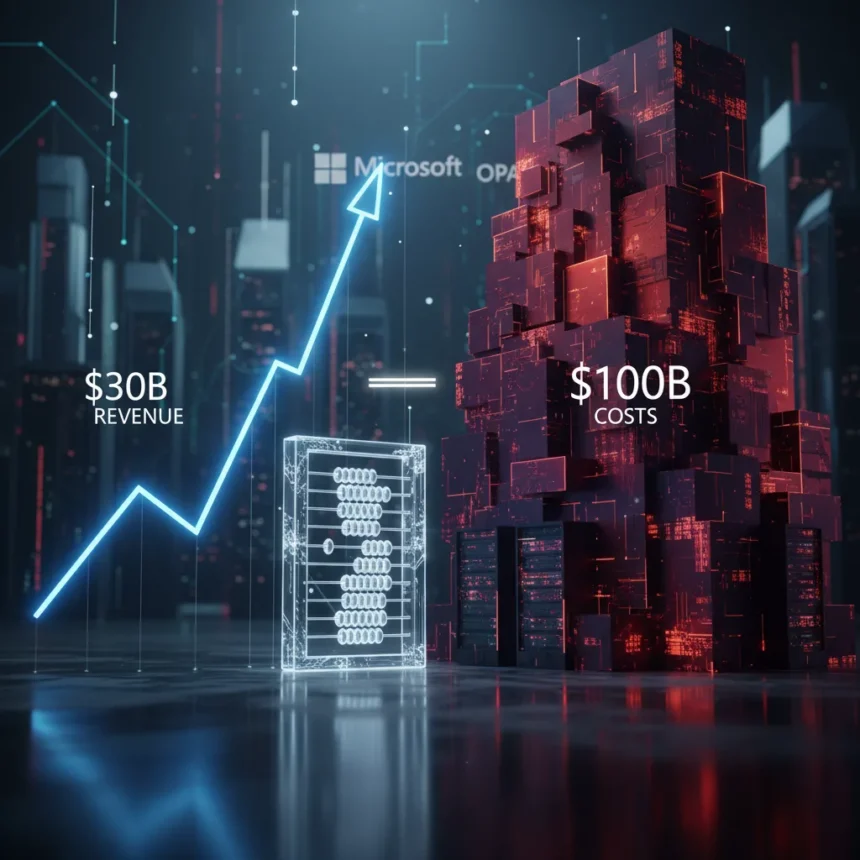
Microsoft’s OpenAI partnership has generated approximately $30 billion in revenue over two years, yet the company burned through roughly $100 billion in costs to achieve that figure. This gap between revenue and expenditure reveals the staggering financial reality behind AI dominance—a reality that forced Microsoft and OpenAI to renegotiate their deal structure entirely.
Key Takeaways
- Microsoft earned $30 billion from OpenAI in two years while spending approximately $100 billion on infrastructure and development costs.
- The original deal structure capped Microsoft’s revenue share at $38 billion through 2030, down from a potential $135 billion under the previous 20% revenue-sharing model.
- The renegotiated agreement saves OpenAI roughly $97 billion through 2030 by restructuring how Microsoft captures returns.
- The new deal allows OpenAI to sell on competing cloud platforms, reducing Microsoft’s exclusive revenue advantage.
- The financial pressure reveals why even trillion-dollar tech companies struggle to monetize AI infrastructure investments profitably.
How Microsoft’s OpenAI Revenue Collapsed
Microsoft’s original deal with OpenAI promised substantial returns on its massive infrastructure investment. The partnership was structured around a 20% revenue share, which could have totaled approximately $135 billion through 2030. That math looked compelling on paper. In reality, the arrangement became unsustainable almost immediately. The gap between what Microsoft spent building the infrastructure and what it could actually extract from OpenAI’s revenue stream became impossible to ignore. Microsoft needed a restructured deal or faced years of negative returns on its AI bet.
The renegotiated agreement caps Microsoft’s revenue share at $38 billion through 2030. That is a reduction of roughly $97 billion from the original projection. For context, this restructuring saves OpenAI nearly $100 billion—money that would have otherwise flowed directly to Microsoft’s balance sheet. The move signals that neither company could sustain the original financial arrangement. Microsoft’s leverage as the primary cloud infrastructure provider proved weaker than expected when OpenAI gained leverage from competing offers.
Why Infrastructure Costs Dwarf Revenue
The $100 billion Microsoft spent to support OpenAI’s operations covers far more than servers and electricity. This includes the custom chips, data center buildouts, redundancy systems, and engineering talent required to run world-scale AI models. Every query Claude or ChatGPT processes demands computational resources that cost money to provision, maintain, and upgrade. Microsoft cannot simply flip a switch and reduce these expenses—they are structural costs baked into the infrastructure.



Compare this dynamic to traditional software licensing. When Microsoft sells Office 365 subscriptions, the marginal cost of adding one more customer is negligible—the software already exists. AI infrastructure is inverted: the costs are front-loaded and enormous, while revenue generation depends entirely on adoption and usage patterns that remain unpredictable. Microsoft bet billions that OpenAI’s growth would justify these expenses. The renegotiated deal suggests that growth is real but slower than the original financial model assumed.
What the Restructured Deal Actually Changes
The new agreement fundamentally shifts how OpenAI and Microsoft share risk and reward. Most critically, the restructured deal allows OpenAI to sell its services on competing cloud platforms, not exclusively through Microsoft Azure. This flexibility reduces Microsoft’s ability to capture value through infrastructure lock-in. OpenAI can now negotiate with Google Cloud, Amazon Web Services, or other providers without violating its agreement with Microsoft.



This concession reveals OpenAI’s negotiating position. The company was willing to accept lower revenue guarantees from Microsoft in exchange for operational independence. For Microsoft, the trade-off means accepting a smaller slice of a potentially larger pie—if OpenAI grows faster on multiple cloud platforms, Microsoft’s capped share might actually represent better economics than the original deal would have delivered. The restructuring is less about Microsoft losing leverage and more about both companies acknowledging that the original model did not reflect market reality.
The Broader Lesson for AI Investment
Microsoft’s situation illustrates a brutal truth: building AI infrastructure is phenomenally expensive, and monetizing it is far harder than the hype suggests. The company spent $100 billion to generate $30 billion in revenue over two years. That is a 3.3-to-1 cost-to-revenue ratio. Even accounting for the fact that some infrastructure costs are amortized over longer periods, this math is deeply unfavorable in the near term.
Other tech companies face the same pressure. Google, Amazon, and Meta are all spending tens of billions on AI infrastructure with uncertain returns. The difference is that Microsoft made its bet explicit through a partnership with OpenAI, making the financial gap visible. Companies that build AI in-house can obscure these costs across broader R&D budgets. Microsoft cannot hide the reality that its OpenAI investment is not yet profitable on a direct basis.
Is Microsoft’s OpenAI investment worth it long-term?
Yes, but not in the way the original deal suggested. Microsoft is not betting on short-term profitability from OpenAI’s revenue share. Instead, the company is building market position in enterprise AI, embedding OpenAI’s models into its own products, and positioning Azure as the default cloud for AI workloads. The $100 billion is a market-entry cost, not a profit center. If Microsoft can convert that infrastructure investment into sustained enterprise AI dominance, the long-term returns could justify the near-term losses.


Why did Microsoft and OpenAI renegotiate the deal?
The original 20% revenue-share structure was unsustainable for OpenAI. As the company’s revenue grew, Microsoft’s take would have eventually exceeded OpenAI’s own earnings, creating a perverse incentive structure. The renegotiated cap at $38 billion through 2030 gives OpenAI predictability and allows the company to pursue growth on multiple cloud platforms without hemorrhaging money to Microsoft. For Microsoft, the deal trade-off is worth it because it preserves the partnership and secures OpenAI as a strategic asset.
What happens if OpenAI’s growth slows?
If OpenAI’s revenue growth stalls, Microsoft’s capped $38 billion share through 2030 becomes even more valuable—it guarantees a floor regardless of performance. Conversely, if OpenAI explodes in growth, the cap limits Microsoft’s upside but the company still benefits from Azure consumption and market positioning. The restructured deal hedges both outcomes, which is why both parties accepted it.
Microsoft’s OpenAI partnership is a masterclass in the true cost of AI dominance. The company spent $100 billion to earn $30 billion, and then renegotiated to accept even lower returns. That is not a failure—it is the price of building infrastructure for a technology that barely existed two years ago. Whether that price was worth paying depends entirely on whether AI becomes as transformative as Microsoft believes. The renegotiated deal suggests the company is betting yes, but with far more caution than the original numbers implied.
Edited by the All Things Geek team.
Source: Windows Central




