






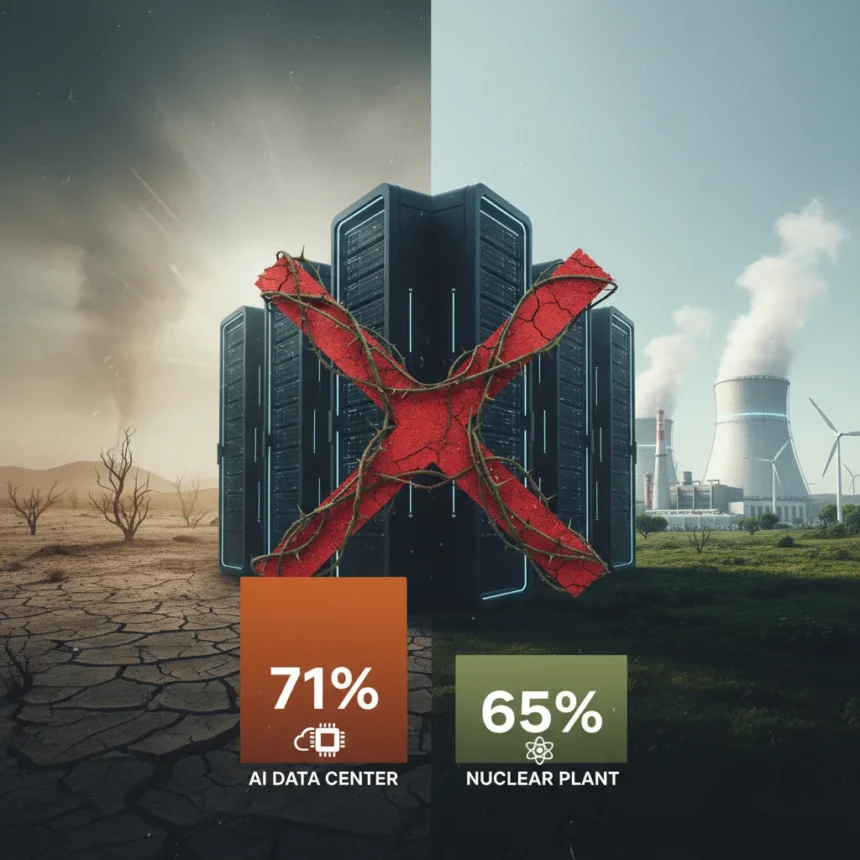
AI data center opposition has emerged as a surprising public relations crisis for the tech industry. A March 2026 Gallup survey reveals that 71% of Americans oppose building a data center in their neighborhood, making data centers more unpopular than nuclear power plants—a finding that should alarm Silicon Valley.
Key Takeaways
- 71% of Americans oppose data center construction in their area, compared to 53% opposing nuclear plants
- 48% of data center opponents express strong opposition, with Democrats at 56% strong opposition
- Resource consumption drives opposition: 50% cite excessive resource use, 18% specifically mention water
- Environmental worry spans the general population: 46% of all respondents worry greatly about data center environmental impact
- This marks Gallup’s first measurement of data center sentiment, establishing a baseline for tracking public resistance
The NIMBY Problem That Dwarfs Nuclear
For decades, nuclear power has symbolized the ultimate NIMBY (Not In My Backyard) infrastructure—something people support in theory but oppose locally. Data centers have now shattered that assumption. The 18-point gap between data center opposition (71%) and nuclear opposition (53%) represents a fundamental shift in how Americans view tech infrastructure. Nuclear plants have faced public resistance since Gallup began tracking the question in 2001, with opposition peaking at 63%. Yet data centers, barely measured before this survey, have already exceeded that historical high. This is not merely a preference difference—it reflects genuine anxiety about what AI infrastructure means for neighborhoods and resources.
The comparison itself tells a story about public perception. Americans have had two decades to process nuclear energy’s risks and benefits. They understand the safety protocols, the waste management debates, the regulatory oversight. Data centers, by contrast, remain mysterious to most people. Few understand what computing equipment actually requires or why AI training demands such extraordinary resources. That knowledge gap fuels fear.
Environmental Concerns Drive the Resistance
The April follow-up survey conducted by Gallup zeroed in on why Americans reject data centers so decisively. Environmental and resource concerns dominate the opposition: 50% of opponents cite excessive resource use as their primary concern. Water consumption emerges as a specific flashpoint, with 18% mentioning water use explicitly. Energy consumption follows closely at 18%, while 16% cite broader pollution concerns including noise, air quality, and water pollution. These are not abstract environmental anxieties—they are concrete, localized worries about what data centers consume and what they leave behind.


The water issue deserves particular attention. Data centers require vast quantities of water for cooling equipment, a reality that becomes politically explosive in water-stressed regions. As AI training scales globally, data center water demands will intensify precisely where water scarcity already threatens agriculture, drinking supplies, and ecosystems. Americans understand this intuitively, even if they cannot articulate the technical details. A data center in your region means competition for a finite resource.
Quality of Life and Economic Anxiety
Beyond environmental concerns, roughly 20% of opponents worry about impacts on local quality of life. These concerns include increased population pressure, heightened traffic, and preference for alternative land use. A data center does not bring jobs the way a factory does—it brings trucks, noise, and electricity demand without proportional employment. Communities see the costs but struggle to identify the benefits.



Economic anxiety compounds the resistance. Another 20% of opponents cite negative economic consequences, specifically higher utility bills, cost-of-living increases, and concerns about taxpayer funding for construction costs. The perception that data centers drive up local utility rates while enriching distant corporations fuels resentment. Communities fear becoming infrastructure colonies—places where their resources are extracted to power someone else’s AI ambitions.
The Political Divide That Unites
One striking finding: opposition to AI data center construction crosses party lines, though with different intensity. Democrats express the strongest opposition, with 56% strongly opposed. Independents follow at 48% strong opposition, while Republicans register 39% strong opposition. Despite this variation, the overall 71% opposition rate means substantial majorities in every political group reject local data center construction. This is not a partisan issue—it is a genuine consensus against having this infrastructure nearby, regardless of political identity.
The Anti-AI Sentiment Wildcard
A smaller but notable segment—10% of opponents—expresses outright dislike of AI technology itself. Another 4% cite distrust of AI specifically. Combined, roughly 14% of data center opposition stems from skepticism about the technology rather than the infrastructure. This matters because it suggests that even if data center developers solve the environmental and resource concerns, they will still face ideological resistance from people who question whether AI development should accelerate at all.
Why This Moment Matters
This survey arrives at a critical inflection point. AI companies are racing to build data centers globally, and they are encountering fierce local opposition in many regions. Until now, that opposition lacked quantification. The Gallup data transforms anecdotal complaints into measurable public consensus. Developers cannot dismiss community resistance as fringe activism when seven in ten Americans hold the same view.



The comparison to nuclear power is instructive in another way: it took decades for nuclear to become politically toxic. Data centers achieved that status in months. This reflects both the speed of AI’s expansion and the public’s rapid recognition that this infrastructure carries genuine costs. Unlike nuclear power, which generates electricity for broad consumption, data centers are perceived as serving corporate interests and AI development—causes with less universal buy-in.
Can Data Centers Rebuild Public Trust?
The opposition data reveals what would need to change: companies would need to demonstrate that data centers do not consume excessive resources, that they protect water supplies, that they generate local economic benefit beyond construction, and that they coexist with community priorities. The environmental concern metric—46% of all respondents worry greatly about data center environmental impact—suggests skepticism runs deep. Addressing it requires more than corporate PR. It requires genuine infrastructure redesign, transparent resource accounting, and community benefit agreements with teeth.
FAQ
Why do Americans oppose data centers more than nuclear plants?
Data centers are perceived as serving corporate AI interests rather than public benefit, and Americans lack understanding of what they actually do. Environmental and resource concerns dominate opposition, with water and energy consumption cited as primary worries. The novelty of data center infrastructure means communities have not yet developed trust or regulatory familiarity.
What specific resources concern Americans most about data centers?
Water consumption and energy use are the top cited concerns, each mentioned by 18% of opponents. Pollution—including noise, air quality, and water pollution—concerns 16%. The broader category of excessive resource use drives 50% of opposition overall.
Does opposition to data centers break down along political lines?
Yes, though the overall opposition is bipartisan. Democrats show the strongest resistance at 56% strongly opposed, followed by Independents at 48% and Republicans at 39%. However, substantial opposition exists across all political groups, indicating this is not a partisan divide but a genuine consensus issue.
The Gallup data establishes a clear baseline: Americans have made their position known. Data center developers now face a legitimacy crisis that mirrors nuclear power’s decades-long struggle. Whether the industry can rebuild trust depends on whether it addresses the specific concerns—water, energy, local impact, and genuine community benefit—that drive opposition. Without a credible plan to tackle these issues, the 71% opposition figure will likely harden as more communities face concrete development proposals. The window for changing public perception exists, but it is closing fast.
Edited by the All Things Geek team.
Source: TechRadar