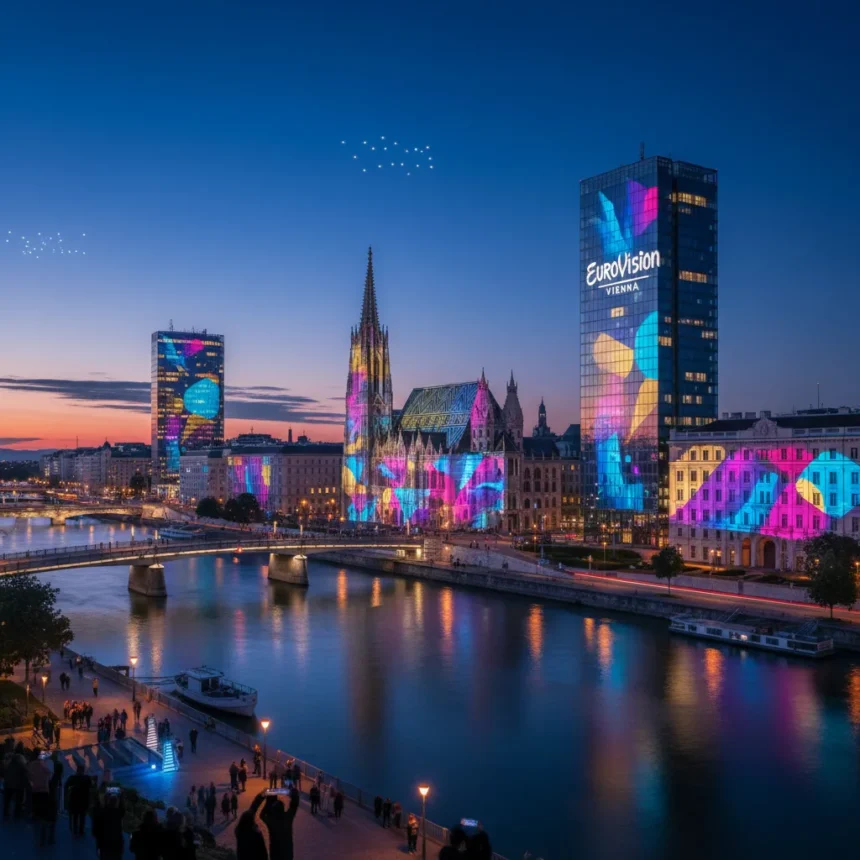
Eurovision branding transforms cities far beyond the song contest itself—it reshapes how the world perceives a host nation’s cultural relevance and modernity. When a city wins the right to host Eurovision, it gains a global stage to craft a unified visual identity, embed local cultural narratives into international consciousness, and position itself as a forward-thinking destination. Vienna now faces this exact opportunity, and whether it capitalizes on the branding potential will define how the world sees the city for years to come.
Key Takeaways
- Eurovision branding leverages design, messaging, and visual motifs to amplify host-city identity on a global stage.
- Past Eurovision host cities have successfully integrated local cultural references into contest branding, strengthening their international perception.
- Large international events like Eurovision make cities feel more visible, modern, and globally relevant to international audiences.
- Vienna’s Eurovision branding strategy will determine whether the city can translate hosting into lasting cultural and economic benefits.
- Host-city transformation through Eurovision is an active strategy, not a passive byproduct of simply staging the event.
How Eurovision branding shapes city perception
Eurovision branding operates as a strategic lever for city identity. Rather than treating the contest as a standalone entertainment event, host cities that succeed in branding use it to tell a coherent story about who they are, what they value, and how they want the world to see them. The visual language of Eurovision—logos, color palettes, typography, and design systems—becomes inseparable from the city’s identity during and after the contest. When done well, these design choices embed themselves into global consciousness, making the city feel more distinctive and memorable than it did before hosting.
The mechanics are straightforward but powerful: a city selects design elements that reflect its heritage, contemporary culture, and aspirations. These elements then appear across broadcast graphics, venue signage, merchandise, promotional materials, and digital platforms reaching millions of viewers worldwide. The consistency of this visual messaging, repeated across weeks of live television and social media, creates a cumulative effect that reshapes how international audiences perceive the city. It is not about flashy gimmicks—it is about coherent storytelling through design.
Past Eurovision host cities and cultural integration
Previous Eurovision host cities have demonstrated how effectively local cultural cues can amplify city branding when integrated into contest design. Rather than creating generic, placeless visual identities, successful host cities have woven specific cultural references—architectural motifs, historical symbols, contemporary artistic movements, regional color traditions—directly into the Eurovision branding scheme. This approach signals to the world that the city has a distinct identity worth celebrating, rather than presenting itself as an interchangeable international venue.

The strategy works because it transforms Eurovision from an external event imposed on a city into a platform that genuinely represents the host. When audiences see local cultural elements reflected in the contest’s visual identity, they begin to associate those elements with the city itself. The branding becomes a bridge between the contest and the city’s broader cultural narrative. Cities that miss this opportunity—those that treat Eurovision branding as a generic corporate exercise—fail to convert the global attention into lasting brand equity. The difference between a forgettable host year and a transformative one often comes down to whether the branding authentically reflects the city’s character.
Vienna’s branding challenge and opportunity
Vienna enters the Eurovision conversation at a critical moment. The city has a centuries-old reputation for classical music, imperial architecture, and cultural sophistication. The question is not whether Vienna has a compelling story to tell—it does—but whether its Eurovision branding will authentically connect that historical identity with contemporary Vienna. Will the contest branding feel like a natural extension of the city’s character, or will it feel imposed and disconnected from what makes Vienna distinctive?



The stakes are significant. A well-executed Eurovision branding strategy could position Vienna as a city that honors its heritage while embracing modernity and global cultural dialogue. It could make Vienna feel more visible and relevant to younger, international audiences who might otherwise associate the city primarily with the past. Conversely, a missed opportunity—branding that feels generic, uninspired, or disconnected from Vienna’s actual identity—would squander the global platform and reinforce perceptions of the city as culturally static. Vienna’s branding decisions will signal to the world whether it is a living cultural center or a museum piece.
International events as city transformation catalysts
Eurovision is one of many large international events that can reshape how cities are perceived globally. The mechanism is consistent across different event types: when millions of people worldwide pay attention to a single location simultaneously, that location gains an extraordinary opportunity to control its narrative. Cities that approach this strategically—using design, messaging, and cultural storytelling to present a coherent identity—emerge from the event with strengthened brand perception. Cities that treat the event as logistical rather than strategic miss the transformation opportunity entirely.
The transformation works because it is temporary but intensive. For a concentrated period, the world’s attention is fixed on the host city. Every broadcast, every social media post, every piece of merchandise reinforces a specific visual and narrative identity. This intensity creates a powerful conditioning effect. Viewers who might never visit Vienna still form opinions about the city based on what they see during Eurovision. Those opinions, shaped by branding choices, become part of the city’s global reputation. The event is thus a rare window where a city can actively reshape how it is perceived, rather than passively accepting inherited stereotypes or outdated associations.
Designing for global audiences while honoring local identity
The central tension in Eurovision branding is balancing global accessibility with local authenticity. A branding scheme that is too locally specific risks confusing international audiences who lack context. A scheme that is too generic fails to differentiate the city or tell its story. Successful host cities navigate this tension by selecting cultural elements that are distinctive enough to feel authentic but universal enough to resonate across language and cultural barriers. Architectural forms, color symbolism, and visual rhythms can communicate across borders in ways that text cannot.



Vienna’s branding challenge sits squarely in this middle ground. The city must ask: which aspects of Vienna’s identity are both authentically Viennese and broadly resonant to international audiences? Classical music is globally recognized but risks feeling nostalgic. Contemporary Viennese art and design movements are distinctive but less universally known. The answer likely lies in finding visual and narrative threads that connect Vienna’s past to its present, showing the world a city that is both historically significant and culturally alive. This is harder than simply celebrating heritage or simply chasing modernity—it requires integration.
Does Eurovision branding create lasting impact?
The critical question for any host city is whether Eurovision branding creates lasting impact or fades once the contest ends. The answer depends almost entirely on what happens after the final broadcast. Cities that integrate Eurovision branding into their long-term city marketing strategy—using the visual identity and narrative framework in tourism campaigns, cultural initiatives, and urban development messaging—see sustained brand benefits. Cities that treat Eurovision branding as a temporary overlay that disappears when the contest ends typically see the impact fade within months.
Vienna has an advantage in this regard: the city’s cultural institutions, tourism boards, and municipal government can continue amplifying the branding narrative long after Eurovision concludes. If the contest branding authentically reflects Vienna’s identity, it becomes a natural foundation for ongoing city marketing. If it feels like a temporary costume, it will be discarded. The real measure of Eurovision branding success is not what happens during the contest week—it is what the city does with the branding momentum in the months and years that follow.
Can a host city fully control its Eurovision brand?
Cities do not have complete control over how their Eurovision branding is received or interpreted. International audiences bring their own associations, assumptions, and cultural contexts to whatever visual identity the city presents. A branding choice that feels perfectly logical and authentic to Vienna might be misunderstood or reinterpreted by viewers in different regions. Social media amplifies these uncontrolled interpretations—audiences comment, remix, and reframe the branding in ways the city never anticipated. This unpredictability is both a risk and an opportunity.
The best Eurovision branding strategies account for this by creating flexible, open-ended visual systems that can accommodate multiple interpretations while maintaining core coherence. Rather than rigid, prescriptive designs, successful host cities develop branding frameworks that feel alive and responsive. Vienna’s approach will likely determine how much control it maintains over its own narrative versus how much the global audience shapes the meaning of the branding during and after the contest.
FAQ
What makes Eurovision branding different from regular city marketing?
Eurovision branding operates at a much larger scale and with much greater intensity than regular city marketing. For a concentrated period, millions of viewers worldwide see the city’s visual identity repeatedly across live broadcasts, social media, and merchandise. This creates a powerful, rapid conditioning effect that regular marketing campaigns take years to achieve. The global reach and concentrated attention make Eurovision a unique branding opportunity.
How does Vienna compare to other cities that have hosted Eurovision?
Vienna enters the Eurovision conversation with a distinctive cultural heritage and global reputation for sophistication. Unlike some host cities that use Eurovision to establish their identity from scratch, Vienna must navigate the challenge of updating its image while respecting its historical significance. The city’s branding success will depend on whether it can present itself as both culturally rooted and contemporary—a balance that not all Eurovision host cities have achieved equally.
Can Eurovision branding help Vienna attract younger international audiences?
Yes, if executed strategically. Eurovision reaches a younger, more diverse global audience than many cultural events Vienna traditionally targets. A branding approach that connects Vienna’s heritage to contemporary culture could make the city feel more relevant to younger viewers who might otherwise dismiss it as historically focused. The contest is an opportunity to reshape Vienna’s perception from a classical-music city to a living cultural center.
Vienna’s Eurovision branding challenge is ultimately about storytelling. The city has a compelling narrative—centuries of cultural influence, artistic innovation, and architectural significance—but that narrative risks feeling frozen in the past. Eurovision offers a rare global platform to tell a more complete story: Vienna as a city that honors its heritage while embracing contemporary culture and global dialogue. Whether Vienna seizes this opportunity will determine whether the contest becomes a transformative branding moment or a missed chance to reshape how the world sees the city.
Edited by the All Things Geek team.
Source: Creativebloq