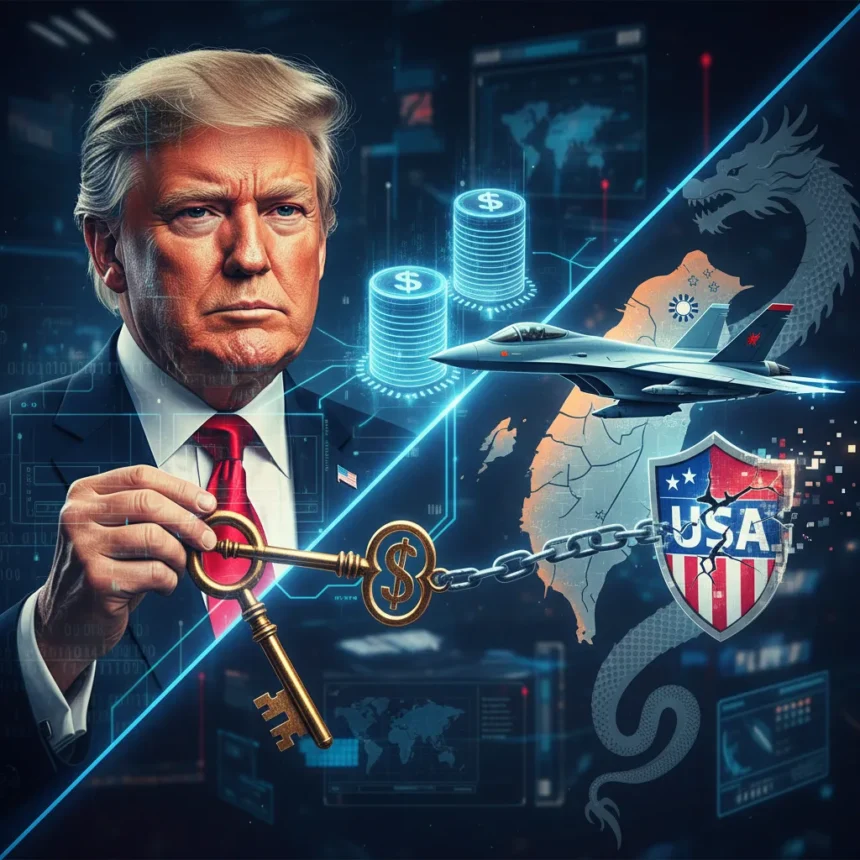
Trump’s characterization of a $14 billion Taiwan arms deal as a “negotiating chip” with China fundamentally reframes how Washington deploys its security commitments to the island. Taiwan arms deal leverage has become explicit policy rather than implicit strategy, signaling that the incoming administration views defense hardware as a transactional tool in broader U.S.–China negotiations rather than as a non-negotiable legal obligation.
Key Takeaways
- Trump called the $14 billion Taiwan arms sale a “negotiating chip” in talks with China, not a firm commitment.
- Chinese President Xi Jinping warned that mishandling Taiwan could trigger “clashes and even conflicts” between Washington and Beijing.
- Trump told Taiwan to “cool it a little bit,” signaling pressure on Taipei to avoid provocative actions.
- Taiwan’s government insists arms sales are protected by U.S. law and are not subject to negotiation with China.
- The deal’s approval remains pending, with Trump weighing his options in broader U.S.–China strategy.
Trump Redefines Taiwan Arms Sales as Leverage, Not Law
The $14 billion arms package sits at the intersection of U.S. law and Trump’s transactional diplomacy. Under the Taiwan Relations Act, Washington is obligated to provide Taiwan with defensive weapons. Trump’s framing of this obligation as a “negotiating chip” directly challenges that legal framework. By treating a congressionally mandated commitment as a bargaining counter, Trump signals that Taiwan’s security is subordinate to his broader negotiating strategy with Beijing.
This approach contradicts Taiwan’s explicit position: officials emphasized that U.S. arms sales are protected by American law and are not negotiable with China. Yet Trump’s rhetoric suggests otherwise. The pending nature of the deal—neither approved nor rejected—leaves Taipei in strategic limbo. Is the sale a given, or will it be withheld to extract concessions from Beijing? That ambiguity is precisely Trump’s leverage.
Xi’s Warning: Taiwan Could Trigger Military Confrontation
Chinese President Xi Jinping’s message was blunt. Mishandling the Taiwan issue could lead to “clashes and even conflicts,” he warned Trump at the close of their two-day summit. This framing shifts responsibility for escalation to Washington and Taipei. By warning of military consequences, Xi pressures Trump to restrain Taiwan and limit arms transfers—or face the risk of U.S.–China military confrontation.

Trump’s response—telling Taiwan to “cool it a little bit”—reveals how he is responding to that pressure. Rather than reaffirming U.S. security commitments, Trump is asking Taipei to step back. The signal is unmistakable: the U.S. administration wants Taiwan to avoid actions or statements that could provoke Beijing, even as Washington ostensibly supports Taiwan’s defense. This creates a contradiction: how can Taiwan maintain deterrence against China while simultaneously being told to avoid provoking Beijing?
Why This Matters for Tech Supply Chains and Regional Stability
The Taiwan arms deal debate appears on technology industry platforms because Taiwan’s security directly affects global semiconductor supply chains and tech manufacturing. Taiwan produces over 60 percent of the world’s semiconductors and over 90 percent of advanced chips. Military instability on the island threatens the hardware that powers everything from smartphones to data centers.



Trump’s willingness to use Taiwan’s defense as a negotiating tool introduces uncertainty into supply chain planning. If the U.S. security commitment to Taiwan becomes conditional on broader trade or diplomatic negotiations, investors and manufacturers face new risk calculations. A Taiwan arms deal that is approved one day and withheld the next creates unpredictability that ripples through global tech markets.
The contrast is stark: Taiwan’s government insists that arms sales are law-based and non-negotiable. Trump treats them as transactional. That gap between legal obligation and political reality is where risk emerges. Investors, manufacturers, and governments are now watching whether Trump will approve the pending $14 billion package or use it as leverage to extract concessions from China on trade, intellectual property, or other issues unrelated to Taiwan’s defense.
Can Taiwan Deter China While Being Told to “Cool It”?
Taiwan’s strategic position has always been precarious: maintain credible deterrence against China while avoiding actions that provoke military response. Trump’s advice to “cool it” complicates that balance. If Taiwan reduces military exercises, avoids diplomatic outreach, or softens its public statements to appease Beijing, it weakens its deterrent posture. Deterrence requires visible, credible capability and will. A Taiwan that is pressured to stay quiet is a Taiwan that appears weak.
Yet Trump’s framing suggests that visible Taiwan strength—military readiness, diplomatic engagement, defense procurement—is now seen as destabilizing rather than stabilizing. This inverts decades of U.S. policy. The traditional logic held that a well-armed, confident Taiwan was less likely to be attacked because the cost of invasion would be prohibitive. Trump’s logic appears to be that a quiet, restrained Taiwan is less likely to provoke Chinese action. These two strategies are incompatible.



The Pending Deal and What Comes Next
The $14 billion arms package remains unapproved. Trump has not rejected it outright, but he has not endorsed it either. That suspension is itself a form of leverage. By keeping the deal in limbo, Trump maintains pressure on both Taiwan and China. Taiwan cannot assume the weapons are coming, so it cannot plan its defense around them. China cannot assume they are blocked, so it must account for the possibility that they arrive.
How long Trump will hold the deal in this state is unclear. Will he use it to extract trade concessions from China? Will he eventually approve it as a gesture to Taiwan after securing other wins? Will he cancel it to signal alignment with Beijing? The uncertainty itself is the point. Trump’s transactional approach thrives on ambiguity.
Does Trump’s approach violate the Taiwan Relations Act?
The Taiwan Relations Act legally obligates the U.S. to provide Taiwan with defensive weapons. Trump’s framing of the sale as a “negotiating chip” raises questions about whether conditioning the sale on concessions from China violates that obligation. However, Trump has not explicitly canceled the deal—he has only characterized it as leverage. Whether that constitutes a violation depends on how courts or Congress interpret the law, an interpretation that remains untested.
Could Trump use the arms deal to negotiate a broader U.S.–China agreement?
Yes. Trump has a history of using security commitments as bargaining chips in larger negotiations. The Taiwan arms deal could be traded away in exchange for Chinese concessions on trade, technology transfer, intellectual property, or other issues. That would align with Trump’s transactional worldview but would contradict Taiwan’s insistence that arms sales are non-negotiable legal obligations, not diplomatic currency.
How does Trump’s stance differ from previous administrations?
Previous administrations treated Taiwan arms sales as legally mandated commitments, though they sometimes delayed or adjusted packages for diplomatic reasons. Trump’s explicit framing of the sale as a “negotiating chip” makes the transactional nature of the arrangement explicit. He is not hiding the leverage; he is announcing it. That transparency is either refreshingly honest or dangerously destabilizing, depending on your perspective.
Trump’s weaponization of the Taiwan arms deal reveals a fundamental shift in how the new administration views security commitments: not as inviolable obligations, but as tradable assets in a larger negotiation with China. For Taiwan, that shift introduces profound uncertainty. For global supply chains dependent on Taiwan’s stability, it introduces risk. For the U.S.–China relationship, it opens a new avenue for both cooperation and confrontation. The $14 billion package is now the focal point of all three dynamics, and its fate will signal whether Trump’s transactional approach can navigate Taiwan’s strategic complexity or will destabilize it further.
Edited by the All Things Geek team.
Source: Tom's Hardware