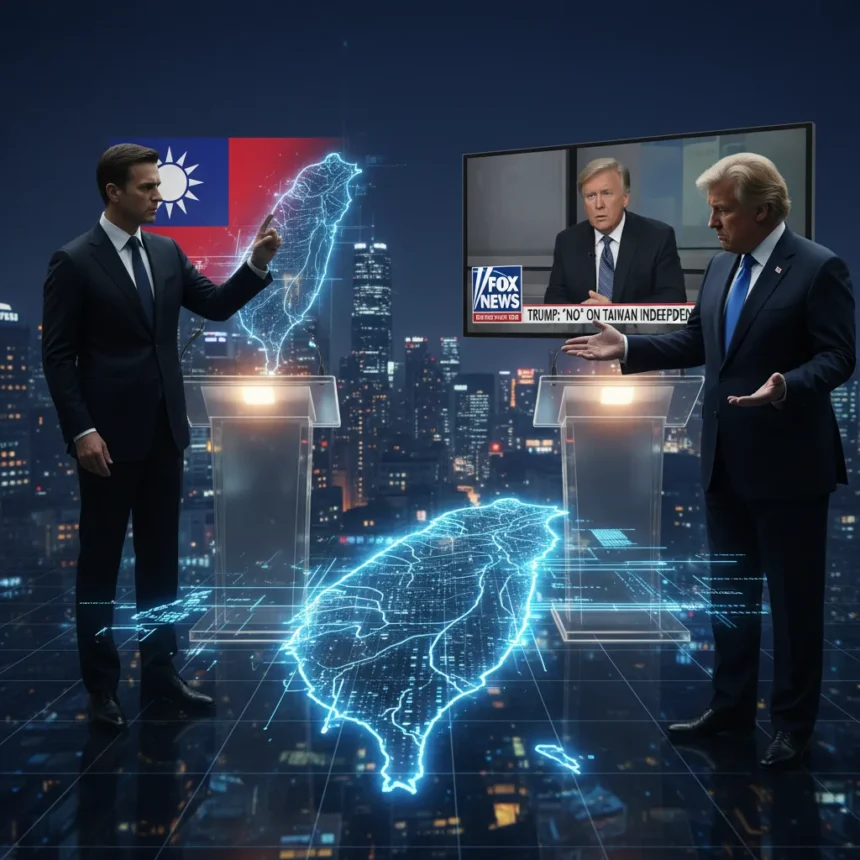
Taiwan sovereignty independence became the focal point of regional tensions after the island declared itself sovereign and independent, responding directly to Donald Trump’s comments on Fox News opposing Taiwan pursuing formal independence.
Key Takeaways
- Taiwan declared itself sovereign and independent hours after Trump’s Fox News statement.
- Trump explicitly stated opposition to Taiwan pursuing formal independence.
- The timing links Taiwan’s sovereignty messaging directly to US defense commitment questions.
- The dispute centers on Taiwan’s international status and US security backing.
- The statement reflects broader China-Taiwan-US geopolitical tensions.
Taiwan’s Immediate Response to Trump’s Independence Opposition
Taiwan’s declaration came within hours of Trump’s remarks, framing the island’s sovereignty stance as a direct counter to his position. The timing was deliberate—not a routine policy announcement but a reactive statement underscoring Taiwan’s resolve on its own status. Trump’s opposition to formal independence created the catalyst for Taiwan to publicly reassert what it considers non-negotiable: its sovereign standing.
The declaration signals Taiwan’s unwillingness to accept external constraints on its self-determination, particularly from a US administration questioning the depth of American defense commitments. By moving quickly, Taiwan avoided the appearance of passivity in the face of Trump’s skepticism. This is not a new policy shift but a restatement of existing sovereignty claims, sharpened by the immediate political context.
Trump’s Defense Commitment Questions and Their Regional Impact
Trump’s remarks questioning US defense support for Taiwan strike at the heart of regional stability. His opposition to formal independence creates ambiguity about what level of US backing Taiwan can expect, a concern that reverberates across Asia. The statement essentially challenges the status quo that has held since the 1979 normalization of US-China relations—a framework where the US provides Taiwan defensive capabilities without explicitly endorsing independence.


This ambiguity matters because it forces Taiwan and its neighbors to recalculate security assumptions. Japan, South Korea, and the Philippines all rely on implicit US security guarantees. When Trump questions one commitment, others wonder if theirs are equally negotiable. Taiwan’s rapid response was partly defensive—an attempt to clarify its own position before Trump’s skepticism hardened into policy.
The Broader Taiwan Status Dispute and China’s Role
Taiwan’s sovereignty declaration also plays into the wider China-Taiwan-US triangle. Beijing has long opposed formal Taiwanese independence, viewing it as a red line. Trump’s opposition aligns with China’s preference, even if his reasoning differs—his concern is cost, China’s is territorial integrity. Taiwan finds itself pressured from multiple directions: resisting China’s claims, managing US commitment doubts, and maintaining its own democratic legitimacy.



The island’s declaration reasserts what most Taiwanese citizens already believe—that Taiwan functions as a sovereign state with its own government, military, and democratic institutions. What Taiwan cannot do is achieve formal international recognition without either China’s consent or a dramatic shift in US policy. Trump’s remarks highlight this gap between Taiwan’s de facto sovereignty and its de jure international isolation.
What Taiwan’s Statement Actually Changes
In practical terms, Taiwan’s declaration does not alter its legal status or international standing. It remains unrecognized by most countries due to China’s diplomatic pressure. What the statement does is mark a boundary: Taiwan will not accept external powers—even its security guarantor—defining the limits of its own sovereignty claims. This is a message to domestic audiences and allies as much as to Washington and Beijing.
The real question is whether Trump’s skepticism translates into policy. Statements and actual defense commitments diverge. Taiwan will watch whether Trump’s words about opposing independence become reduced military aid, delayed weapons systems, or withdrawn security guarantees. For now, Taiwan has chosen public defiance rather than quiet diplomacy, betting that reasserting sovereignty is stronger than negotiating its limits.
Does Taiwan’s declaration change its international status?
No. Taiwan’s declaration reasserts existing sovereignty claims but does not alter its de facto status or international recognition. Most countries recognize Beijing, not Taipei, due to diplomatic pressure from China. The statement is political messaging, not a legal transformation.



What does Trump’s opposition to Taiwan independence actually mean?
Trump’s statement suggests he prefers the current ambiguous status quo—where Taiwan operates as independent but remains unrecognized—over formal independence that would provoke China directly. His concern appears focused on cost and entanglement rather than principle.
How does this affect US-Taiwan military support?
Trump’s remarks raise questions about future defense aid levels and commitment depth, but no immediate policy changes have been announced. Taiwan and its allies will monitor whether words translate into reduced weapons transfers or weakened security guarantees in coming months.
Taiwan’s declaration of sovereignty and independence reflects a critical moment where geopolitical pressure forced the island to publicly state what it had previously left implicit. Trump’s skepticism about US defense commitments and opposition to formal independence created the catalyst. Taiwan responded not by negotiating its sovereignty but by reasserting it—a gamble that clarity serves its interests better than ambiguity. Whether this stance strengthens or weakens Taiwan’s position depends entirely on what the Trump administration does next.
Edited by the All Things Geek team.
Source: Tom's Hardware