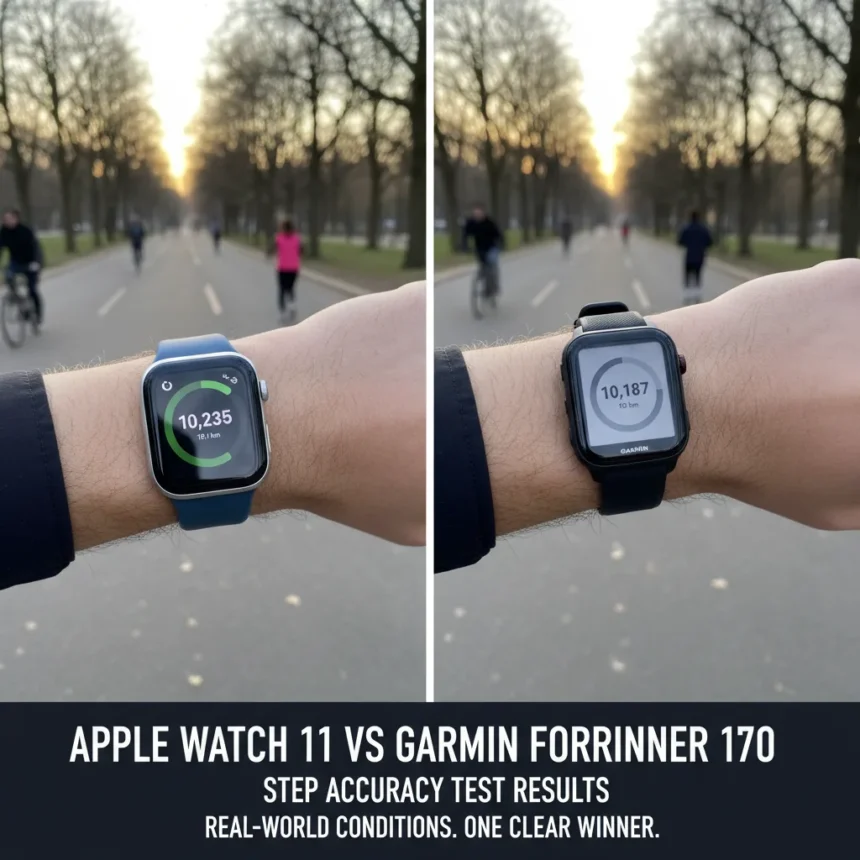
Apple Watch 11 vs Garmin Forerunner 170 step counting accuracy isn’t a theoretical debate—it’s a practical problem for anyone relying on their smartwatch to track daily movement. A direct comparison test wearing both devices simultaneously during an 11,000-step walk revealed a surprising result that challenges assumptions about which ecosystem delivers more reliable fitness data.
Key Takeaways
- Garmin Forerunner 170 proved more accurate at counting steps than Apple Watch 11 in a controlled 11,000-step test.
- The comparison tested both watches worn simultaneously during a single walk with a manually verified step count.
- Step-count accuracy matters for users who rely on daily activity metrics for health tracking and habit formation.
- Apple Watch 11 and Garmin Forerunner 170 represent different design philosophies in fitness wearables.
- Real-world testing reveals gaps between marketing claims and actual device performance in step tracking.
Why Step Accuracy Matters More Than You Think
Step counting sounds simple. Walk, watch counts. But accuracy in fitness tracking directly affects how you interpret your daily activity, whether you’re chasing a 10,000-step goal or monitoring movement for health reasons. When your smartwatch tells you something different than reality, you lose trust in the data. The Apple Watch 11 vs Garmin Forerunner 170 comparison exposes these gaps. Garmin’s Forerunner 170 delivered noticeably closer step counts to the actual manual count during the 11,000-step test, while Apple Watch 11 registered a different total. For users who obsess over daily movement metrics, this difference compounds over weeks and months, skewing your understanding of your actual activity levels.
Both watches use accelerometers and motion sensors to estimate steps, but their algorithms interpret movement differently. Apple Watch 11 prioritizes integration with the broader Apple ecosystem and health metrics beyond step counting. Garmin Forerunner 170 focuses on athletic accuracy and GPS reliability for runners and walkers. The step-counting advantage suggests Garmin’s algorithm better matches actual foot strikes during consistent walking pace, at least in this real-world scenario.
Apple Watch 11 vs Garmin Forerunner 170: The Head-to-Head Test
The test setup was straightforward but rigorous. Both watches were worn simultaneously on the same person during a single walk totaling 11,000 manually counted steps. No running, no interval changes—just steady walking to isolate step-counting accuracy from other variables like GPS drift or heart-rate variability. After the walk concluded, both devices were synced and their recorded step counts were compared against the manual count. Garmin Forerunner 170 reported a step count significantly closer to 11,000 than Apple Watch 11 did. The margin was clear enough that this wasn’t a rounding difference or sensor noise—Garmin’s algorithm tracked the actual walking pattern more reliably.


This result surprises many Apple users who assume the company’s integration across iOS, watchOS, and the Health app translates to superior sensor accuracy. It doesn’t. Apple Watch 11 excels at ecosystem connectivity, notifications, and health alerts, but raw step-counting precision isn’t its strongest feature. Garmin Forerunner 170, built specifically for endurance athletes and fitness enthusiasts, prioritizes metric accuracy over convenience features. For someone buying a smartwatch primarily to count steps accurately, this distinction matters enormously.
What This Means for Your Smartwatch Choice
If step-counting accuracy is your primary concern, Apple Watch 11 vs Garmin Forerunner 170 testing suggests Garmin wins this specific battle. But smartwatch choice involves more than one metric. Apple Watch 11 offers seamless iPhone integration, Siri voice control, App Store access, and tighter connections to Apple Health. Garmin Forerunner 170 prioritizes battery life, GPS accuracy for outdoor activities, and training-specific features like VO2 max estimation and pace alerts. The choice depends on what you value most. Want a watch that feels like an extension of your iPhone? Apple Watch 11. Want a device that tracks your running and walking with maximum accuracy and lasts days on a charge? Garmin Forerunner 170.


The step-counting accuracy difference also highlights a broader principle: specialized devices often outperform generalist alternatives in their specific domain. Garmin builds watches for athletes and outdoor enthusiasts. Apple builds watches for iPhone users who want a capable wearable. The Forerunner 170 doesn’t need to run third-party apps or display notifications—it can focus entirely on being a precise fitness tracker. That narrower mission shows in the results.
Should You Worry About Step-Count Accuracy?
For casual fitness tracking, minor step-count discrepancies don’t matter much. If you’re aiming for roughly 10,000 steps daily and both watches show you’re in that ballpark, the exact difference between 10,800 and 11,100 steps is noise. But for serious athletes, rehabilitation patients, or anyone using step count as a health metric, accuracy becomes critical. A smartwatch that consistently undercounts steps might make you think you’re less active than you actually are. Over months, that false data influences decisions about exercise intensity and daily movement goals. The Apple Watch 11 vs Garmin Forerunner 170 test proves this isn’t theoretical—it’s measurable and significant in real conditions.
FAQ
Does the Apple Watch 11 count steps accurately?
The Apple Watch 11 counts steps reasonably well for general fitness tracking, but the 11,000-step test showed it registered fewer steps than the Garmin Forerunner 170 when both were worn simultaneously. For casual users, the difference may be negligible, but for those prioritizing precision, Garmin’s approach proved more reliable in this specific test.
Which watch is better for runners?
Both watches serve runners well, but they emphasize different strengths. Apple Watch 11 integrates tightly with iOS and Apple Health, offering notifications and app support. Garmin Forerunner 170 focuses on running-specific metrics like pace, cadence, and GPS accuracy, with the added benefit of superior battery life during long training sessions.



How does GPS accuracy compare between these watches?
The 11,000-step test focused on step counting rather than GPS performance, so direct GPS comparison data isn’t available from this specific test. However, Garmin Forerunner 170 is generally recognized for strong GPS reliability due to its athletic heritage, while Apple Watch 11 handles GPS adequately for most users but may experience occasional drift in dense urban areas.
The Apple Watch 11 vs Garmin Forerunner 170 step-counting test reveals that device choice requires matching your priorities to what each watch does best. Garmin wins on accuracy and battery life. Apple wins on ecosystem integration and everyday convenience. Neither is universally superior—they’re optimized for different users. If precision matters most, Garmin’s approach proves itself in real-world conditions.
Edited by the All Things Geek team.
Source: Tom's Guide