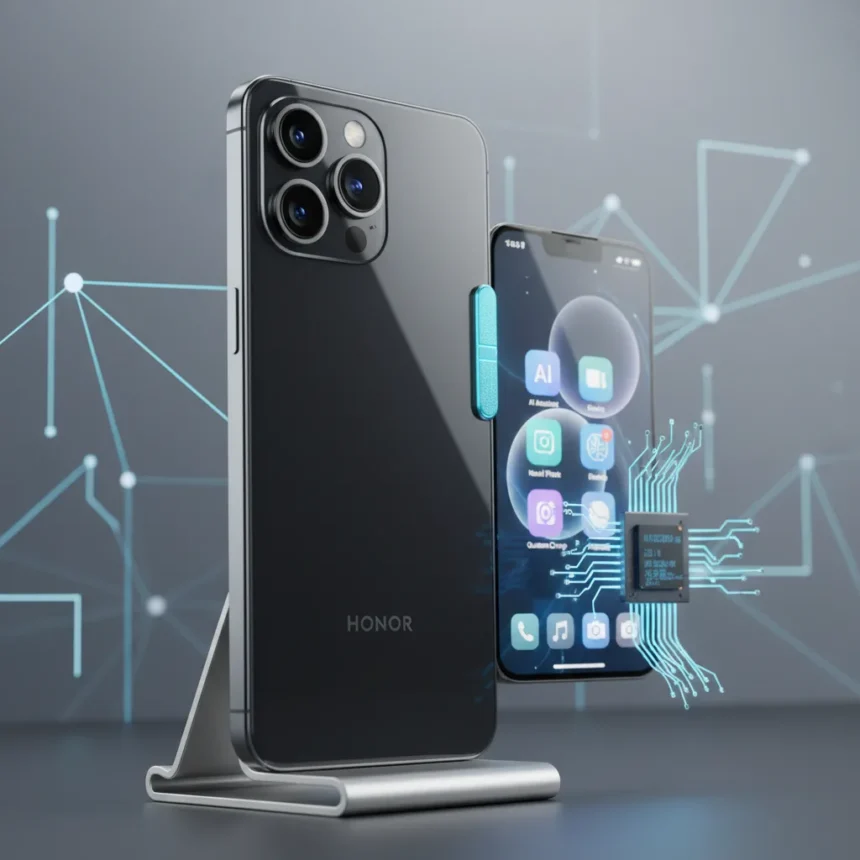
The Honor 600 Pro is a mid-range Android smartphone that copies the iPhone 17 Pro’s design language while introducing AI capabilities that Samsung’s flagships still lack. At around €600 (approximately $703 USD), it challenges the assumption that premium design requires premium pricing.
Key Takeaways
- Honor 600 Pro mirrors iPhone 17 Pro’s squared-off design with lightweight build and orange color option
- Features a dedicated AI key for launching tasks and functions with a single button press
- Triple rear cameras in rectangular housing with 6.57-inch 120Hz OLED display
- Magic Portal AI feature enables intent-based actions like auto-sharing text to messaging apps
- Outperforms Samsung’s Galaxy Z Fold 7 in AI image editing and outpainting capabilities
Design That Dares to Copy the iPhone
The Honor 600 Pro doesn’t hide its inspiration. The squared-off frame, premium materials, and lightweight construction directly echo Apple’s flagship aesthetic. What’s striking is how well it works at this price point. The device comes in an orange color option that feels distinctly premium—a choice typically reserved for luxury phones. The 6.57-inch display sits behind a single front-facing cutout that handles both selfies and facial recognition, eliminating the notch-versus-hole debate entirely.
This design philosophy matters because it signals a shift in the mid-range market. For years, budget Android phones felt like budget Android phones. The Honor 600 Pro proves that squared-off edges and minimal bezels aren’t exclusive to phones costing twice as much. The triple rear camera array sits in a rectangular housing that complements rather than dominates the back.
The AI Key Changes How You Interact With Your Phone
The Honor 600 Pro’s most compelling feature is its dedicated AI key—a physical button that launches Honor’s AI suite with a single press. This isn’t a gimmick. Magic Portal, Honor’s flagship AI feature, uses context awareness to anticipate what you want to do next. Select text and the phone offers to share it to messaging apps. Tap an image and it suggests social media platforms. It sounds simple, but it fundamentally changes how you navigate your phone.


Compare this to Samsung’s approach. The Galaxy Z Fold 7 includes AI features, but they’re buried in menus and require multiple taps to access. Honor’s dedicated button makes AI a primary interaction layer, not an afterthought. The Honor 600 Pro also includes AI Eraser for superior image editing compared to Samsung’s Generative Edit tool, AI Upscale for enlarging photos without quality loss, and AI Outpainting to expand your photo canvas.
Perhaps most impressive is the image-to-video feature, which leverages Google’s Veo 2 engine to generate short video clips from still images. This is a feature that separates the Honor 600 Pro from cheaper Android alternatives and even some more expensive phones. It’s the kind of capability that makes you reach for your phone instead of a dedicated camera.



Battery and Performance That Justify the Price
The Honor 600 Pro packs a large battery—around 7,000mAh globally, with a 9,000mAh variant in China. That capacity alone outlasts most mid-range competitors. The rumored Snapdragon 8 Elite Gen 5 chipset (though unconfirmed until launch) would position it ahead of cheaper Android phones using older processors like the Snapdragon 7 Gen 4. Those cheaper alternatives typically pair smaller 5,080mAh batteries with 80W charging, forcing you to plug in more often.
The 120Hz OLED display at 1.5K resolution strikes a balance between visual quality and battery efficiency. You get the smooth scrolling of a flagship without the power drain of a 2K panel. For everyday use—social media, messaging, video streaming—this is more than sufficient.
How the Honor 600 Pro Stacks Against Samsung’s AI Approach
Samsung has been aggressively pushing Galaxy AI as a differentiator, but the Honor 600 Pro exposes gaps in Samsung’s execution. Honor’s AI suite—particularly Magic Portal and AI Outpainting—offers more intuitive, context-aware interactions than Samsung’s equivalents. Samsung’s Generative Edit is a capable tool, but Honor’s AI Eraser delivers superior results. Honor also leads in translation, transcription, and intent-based interactions across the board.
This matters because it suggests Honor’s Alpha Plan, which emphasizes AI integration ahead of competitors, is actually paying off in usable features, not just marketing claims. The dedicated AI key forces users to engage with these tools daily rather than discovering them buried in settings.



Is the Honor 600 Pro Worth Buying?
The Honor 600 Pro targets buyers who want flagship design and AI capabilities without flagship pricing. If you’re tired of plastic mid-range phones and Samsung’s AI features feel half-baked, this is your answer. The trade-off is that you’re buying into Honor’s ecosystem and relying on timely software updates—areas where the company has historically lagged behind Samsung and Apple.
The unconfirmed chipset and upcoming N-series launch mean you should wait for official specs before committing. But based on what’s known, the Honor 600 Pro delivers genuine value that challenges the entire mid-range category.
What is the Honor 600 Pro’s battery capacity?
The Honor 600 Pro features approximately 7,000mAh battery globally, with a larger 9,000mAh variant available in China. This capacity significantly exceeds cheaper Android phones, which typically max out around 5,080mAh.
How does the Honor 600 Pro’s AI compare to Samsung’s Galaxy AI?
The Honor 600 Pro outperforms Samsung in multiple AI areas. Its AI Eraser surpasses Samsung’s Generative Edit for image editing, while Magic Portal offers more intuitive context-aware interactions. Honor also leads in translation, transcription, and the new image-to-video capability using Google’s Veo 2 engine.
Does the Honor 600 Pro have a notch or hole-punch camera?
The Honor 600 Pro uses a single front-facing cutout that handles both selfies and facial recognition, eliminating the traditional notch versus hole-punch debate.
The Honor 600 Pro represents a genuine shift in what mid-range phones can deliver. It proves that premium design and advanced AI features don’t require premium pricing. Whether Honor can sustain this momentum with software support and timely updates remains to be seen, but on hardware and AI alone, it’s already outpaced competitors costing significantly more.
Edited by the All Things Geek team.
Source: Android Central