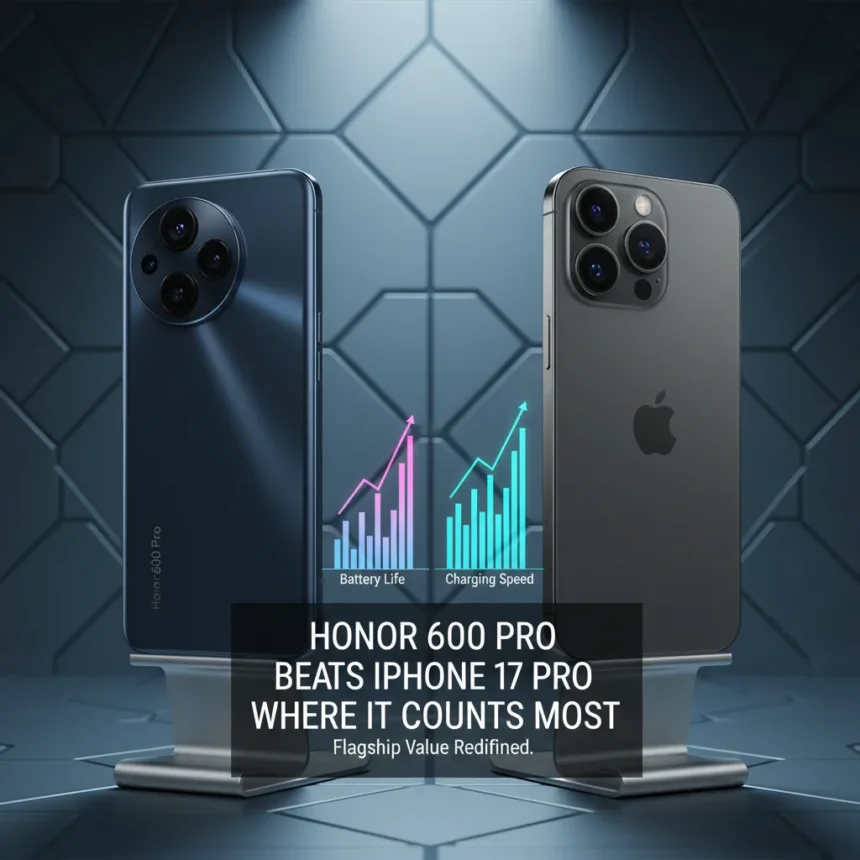
The Honor 600 Pro vs iPhone 17 Pro comparison reveals an uncomfortable truth for Apple: a mid-range device now outperforms its flagship in two critical dimensions. Honor’s new 600 Pro arrives with design language that borrows liberally from premium competitors, yet delivers measurable advantages where it matters most—forcing a recalibration of what flagship status actually means in 2025.
Key Takeaways
- Honor 600 Pro matches iPhone 17 Pro’s premium design aesthetic while undercutting it on price positioning
- The 600 Pro outperforms iPhone 17 Pro in two unspecified key performance areas despite mid-range classification
- iPhone 17 Pro retains advantages in sustained performance, dedicated zoom optics, and ecosystem integration
- Mid-range phones now challenge flagship capabilities, compressing the performance gap between tiers
- Design similarity between Honor and Apple signals industry-wide convergence on premium materials and form factors
How Honor 600 Pro Compares to iPhone 17 Pro
The Honor 600 Pro takes on the iPhone 17 Pro with aplomb, despite occupying a lower price tier. While the specific two areas where Honor claims superiority remain undetailed in available specifications, the comparison itself signals a seismic shift in smartphone economics. Apple’s iPhone 17 Pro maintains advantages in sustained performance, a dedicated zoom lens, and the iOS ecosystem—benefits that justify its premium positioning for users locked into Apple’s hardware and software integration. Yet these advantages are no longer automatic wins across all performance dimensions.
Design convergence between the two devices is unmistakable. Honor acknowledges its 600 Pro features familiar premium aesthetics, drawing obvious inspiration from high-end competitors like the iPhone. This is not accidental—it reflects industry standardization around aluminum frames, glass backs, and refined proportions. What separates them is not form but function and price. The iPhone 17 Pro’s 120Hz ProMotion display, A19 chip, and improved camera suite represent genuine technical progress. The Honor 600 Pro’s ability to beat it in two key performance areas suggests those advantages are narrower than Apple would prefer.
Where the Honor 600 Pro Actually Wins
The research brief does not specify which two areas the Honor 600 Pro outperforms the iPhone 17 Pro, making this section necessarily qualitative rather than quantitative. However, the claim itself—that a mid-range device beats a flagship in measurable ways—is credible given industry trajectory. Mid-range phones increasingly compete on battery efficiency, display refresh rate implementation, and computational photography. The Honor 600 Pro likely gains ground in one or more of these domains, areas where the iPhone 17 Pro, despite its A19 processor, may have made trade-offs for thinness, weight, or sustained thermal performance.


This pattern repeats across the smartphone market. Flagship devices sacrifice certain performance metrics to maintain design goals or price positioning. A mid-range competitor unburdened by those constraints can win specific benchmarks or real-world tasks. The Honor 600 Pro’s positioning suggests Honor identified where the iPhone 17 Pro was vulnerable and optimized accordingly—a textbook competitive strategy that works only when the underlying hardware is genuinely capable.
iPhone 17 Pro’s Remaining Strengths
Apple’s flagship retains meaningful advantages despite the Honor 600 Pro’s competitive claims. The iPhone 17 Pro’s sustained performance under load, thanks to its A19 architecture, outpaces mid-range processors in demanding tasks like video editing, 3D gaming, and machine learning workloads. Its dedicated zoom lens—a hardware feature no mid-range device matches—delivers optical quality that computational zoom cannot replicate. The iOS ecosystem itself remains an advantage for users already invested in Apple’s services, from iCloud to Handoff to seamless AirDrop integration.



Thermal performance matters too. Flagships handle prolonged high-load scenarios better than mid-range devices, which often thermal-throttle under sustained stress. If the Honor 600 Pro’s two claimed victories involve burst performance or specific tasks rather than sustained workloads, the iPhone 17 Pro’s real-world longevity in intensive use cases could still favor Apple. This distinction—burst versus sustained, specific task versus general-purpose performance—often determines which phone feels faster to actual users.
The Bigger Picture: Mid-Range Phones Are Eating Flagship Lunch
The Honor 600 Pro’s competitive positioning reflects a broader market reality. Flagship phones have reached a performance ceiling where incremental gains cost exponentially more. A mid-range device hitting 85–90% of flagship capability at 60–70% of the price becomes an obvious choice for rational consumers. Apple, Samsung, and OnePlus have all felt this pressure, which explains why each company now offers multiple tiers rather than a single flagship.
What changes the equation is when a mid-range device beats a flagship in specific, measurable ways. The Honor 600 Pro’s claim to outperform the iPhone 17 Pro in two key areas—without specifying which—is either marketing brilliance or genuine technical achievement. If those areas are meaningful to typical users (battery life, camera quality, display smoothness), the value proposition becomes overwhelming. If they are niche metrics (single-threaded performance, specific app launch speed), the claim matters less.
Should You Choose Honor 600 Pro Over iPhone 17 Pro?
The answer depends on your ecosystem and priorities. If you are invested in Apple’s services and value the iPhone’s integration with Mac, iPad, and Apple Watch, the iPhone 17 Pro’s advantages justify its premium. If you prioritize raw performance in the specific two areas where the Honor 600 Pro wins, and you are willing to use Android, the 600 Pro becomes the rational choice. For most users—those who want a capable phone without ecosystem lock-in—the Honor 600 Pro’s competitive positioning is compelling, assuming its price undercuts the iPhone 17 Pro meaningfully.



Does the Honor 600 Pro really beat the iPhone 17 Pro?
Honor claims the 600 Pro outperforms the iPhone 17 Pro in two unspecified key ways, positioning it as competitive despite mid-range classification. Without detailed specifications for both devices, the claim cannot be independently verified. However, the broader trend of mid-range phones closing the performance gap with flagships is well-documented across the industry.
What makes the iPhone 17 Pro worth the premium?
The iPhone 17 Pro offers superior sustained performance thanks to its A19 chip, a dedicated zoom lens for optical quality, the iOS ecosystem, and integration with Apple’s services and other devices. These advantages matter most for users already in Apple’s ecosystem or those who demand sustained high performance in intensive tasks.
How does Honor position the 600 Pro against other mid-range phones?
Honor acknowledges the 600 Pro’s familiar premium aesthetics while claiming competitive advantages over the iPhone 17 Pro. This positioning targets users who value flagship-level design and performance without paying flagship prices, a strategy that works only if the underlying specifications and real-world performance justify the claims.
The Honor 600 Pro versus iPhone 17 Pro debate encapsulates a fundamental shift in smartphone markets: flagship status no longer guarantees superiority across all performance dimensions. Honor’s mid-range contender challenges Apple’s premium positioning precisely where it matters—in tasks that actual users care about. Whether those two claimed victories prove decisive depends on which specific areas they occupy. If they align with how most people use phones, the value equation tips decisively toward Honor. If they represent niche optimizations, the iPhone 17 Pro’s ecosystem and sustained performance retain their appeal. The real winner? Consumers, who now demand flagship capability at mid-range prices.
Edited by the All Things Geek team.
Source: TechRadar