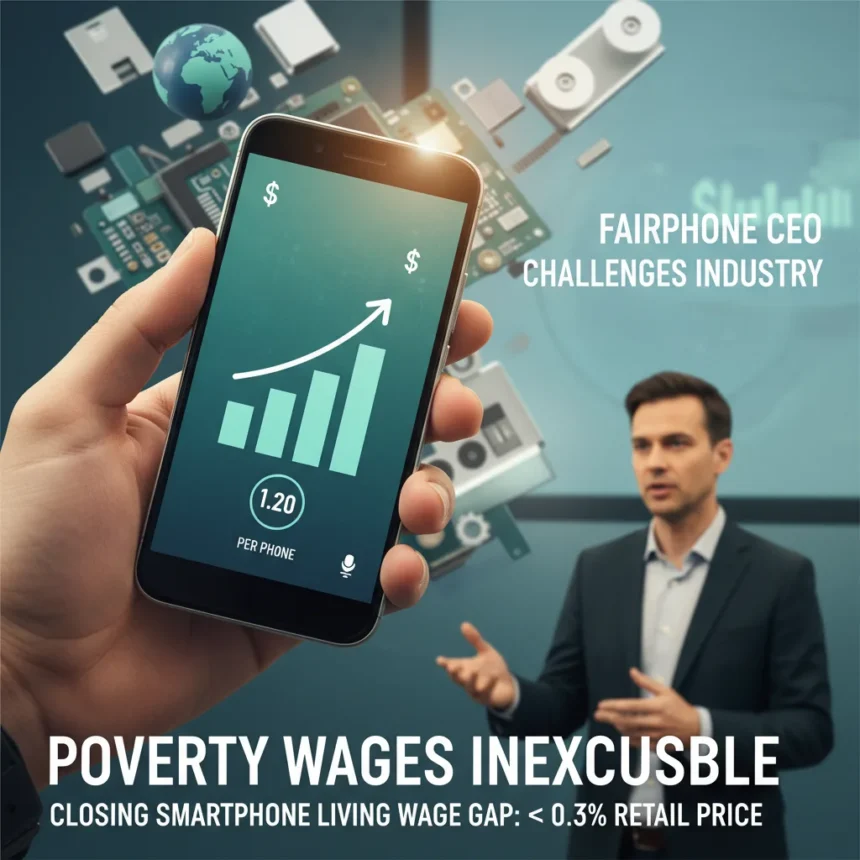
The smartphone living wage gap is closing, but the industry is refusing to acknowledge the cost. Fairphone’s 2025 Impact Report reveals that bridging the wage shortfall for assembly workers costs as little as $1.20 per device—or 1.50 EUR—representing less than 0.3% of a phone’s retail price. If manufacturers cannot justify that expense, they are not facing a financial constraint. They are making a choice.
Key Takeaways
- Smartphone living wage gap closure costs $1.20 per phone, under 0.3% of retail price
- Fairphone pioneered the first living wage program in electronics in 2019, distributing over $1 million in bonuses since
- In 2024, Fairphone paid $91,000 in living wage bonuses to over 1,500 workers across three factories
- Over 18 million electronics workers endure poverty wages and 70–100-hour work weeks
- One Fairphone sub-supplier now pays full living wages to all employees, regardless of brand
Why the Smartphone Living Wage Gap Persists Despite Minimal Cost
The economics are stark. Over 18 million people work in electronics manufacturing under conditions that would be unthinkable in wealthy nations—poverty wages paired with mandatory overtime stretching to 70 or even 100 hours per week. Yet the cost to fix this is trivial. A living wage bonus of $1.20 per smartphone translates to less than a rounding error on the retail price. No financial constraint exists. What persists is indifference.
Fairphone’s approach reveals the mechanics. The company calculates the gap between a worker’s actual wage and the living wage target—in one documented case, 5,000 RMB (roughly 670 EUR) before taxes in a specific region. That gap is divided across all hours worked and all units produced, then paid quarterly as a bonus to low-wage workers on the production line. The math works. The will does not.
Since 2019, when Fairphone introduced the first living wage program in the electronics industry, the company has distributed over $1 million USD in bonuses to supply chain workers. In 2024 alone, Fairphone paid out $91,000 across three factories—two supplier facilities and one sub-supplier—reaching over 1,500 workers. These are not theoretical numbers. They are real workers receiving real money that lifts them above subsistence.


The Smartphone Living Wage Gap and Industry Resistance
Fairphone’s challenge to competitors is direct: there is no financial excuse for poverty wages. Yet the broader industry has resisted. Most companies maintain codes of conduct and audit compliance, but these mechanisms fail to address systemic low wages and excessive overtime. They create the appearance of responsibility without the substance of change.
The obstacle is not cost. It is scale and willingness. Fairphone’s production volume is small compared to Samsung, Apple, or other giants, making it harder to absorb bonus costs across a massive supply chain. But that is an argument for industry coordination, not for inaction. If Fairphone can afford $1.20 per phone, so can every other manufacturer. The difference is that Fairphone chose to pay.



One sub-supplier has moved beyond bonuses to full living wage implementation for all employees, not just those assembling Fairphone products. This demonstrates that the model scales. When a supplier commits to living wages across its entire workforce, the economics work. The precedent exists. What is missing is competitive pressure and regulatory enforcement to make it standard.
What Closing the Smartphone Living Wage Gap Actually Means for Workers
In the first six months of Fairphone’s program, workers received up to 3,000 RMB (approximately 422 EUR) in additional compensation per person—equivalent to 1.5 times their monthly legal minimum wage. That money is not luxury. It is the difference between renting a stable apartment or sleeping in a dormitory with 20 others. It is the ability to buy food without calculating every meal. It is savings for medical emergencies or a child’s education.
A living wage, as Fairphone defines it, affords a decent standard of living: rent, food, clothing, basic necessities, and modest savings without requiring excessive overtime. It is the baseline for human dignity. Yet the industry treats it as a luxury add-on.
Fairphone supports the WageIndicator Foundation, which tracks living wage data across over 165 countries, ensuring that bonus calculations reflect regional economic reality rather than arbitrary minimums. This precision matters. A living wage in Vietnam is not a living wage in China, and neither matches the cost of living in Mexico. Fairphone’s approach respects that complexity. Most competitors ignore it entirely.



Can the Smartphone Living Wage Gap Be Closed at Scale?
The 2025 Impact Report, released in April 2025 and audited by independent assurance firm ERM CVS, covers 2024 data and demonstrates that Fairphone’s program now supports over 7,500 workers across its supply chain. The model works. It scales. The only question is whether the industry will adopt it.
Fairphone participates in the IDH Roadmap on Living Wages and UN Global Compact working groups, pushing for systemic change. These efforts matter, but they rely on voluntary participation. Without regulatory pressure or consumer demand, most manufacturers will continue calculating the cost of a living wage bonus and deciding it is not worth the reputational effort.
The smartphone living wage gap persists not because it is expensive to close, but because closing it requires treating workers as stakeholders rather than line items. At $1.20 per phone, the financial argument evaporates. What remains is a moral choice.
Why Does the Smartphone Living Wage Gap Matter Right Now?
Fairphone released its 2025 Impact Report amid a darkening policy landscape. Trade protectionism is rising. Regulatory rollback is accelerating. Political will for labor standards is fading. In this environment, companies that voluntarily commit to living wages become increasingly rare. Fairphone’s insistence that no financial excuse exists is not just a business statement—it is a counterweight to a broader retreat from worker protections.
How much does it cost to close the smartphone living wage gap?
Closing the smartphone living wage gap costs $1.20 per phone or 1.50 EUR, representing less than 0.3% of retail price. This calculation is based on the difference between actual wages and target living wages, divided across production hours and units produced, then paid quarterly as a bonus.
Has any smartphone manufacturer adopted a living wage program besides Fairphone?
Fairphone pioneered the first living wage program in electronics in 2019. While the company has not disclosed widespread industry adoption, one Fairphone sub-supplier now pays full living wages to all employees regardless of brand, demonstrating the model’s viability. Most competitors rely on codes of conduct and audits that fail to address systemic low wages.
How many workers have received living wage bonuses from Fairphone?
Since 2019, Fairphone has distributed over $1 million USD in living wage bonuses. In 2024, the company paid $91,000 to over 1,500 workers across three factories, with the program now supporting over 7,500 workers total. Bonuses are paid quarterly on top of regular salary.
The smartphone living wage gap reveals an uncomfortable truth: the industry’s inaction is not driven by economics but by choice. At $1.20 per phone, every manufacturer can afford to close it. The question is whether they will.
Edited by the All Things Geek team.
Source: TechRadar