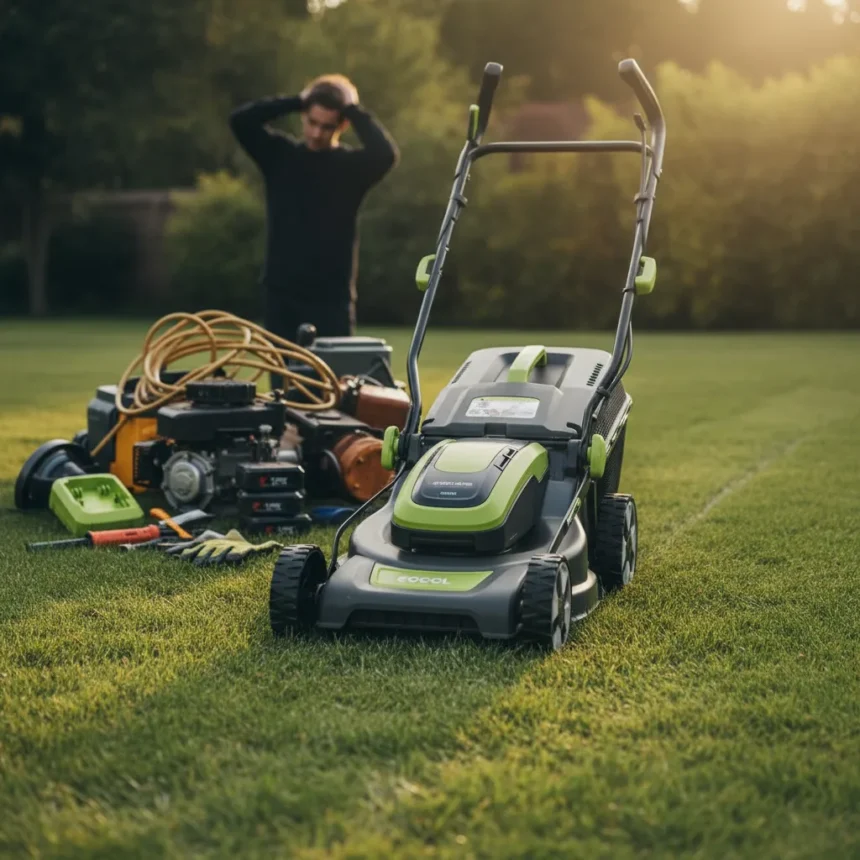
Switching to cordless lawn mower technology sounds straightforward: ditch the petrol, charge a battery, cut grass. The reality is messier. Battery-powered cordless mowers have become genuinely viable thanks to advances in lithium-ion technology, but they come with overlooked trade-offs that catch most buyers off guard.
Key Takeaways
- Battery runtime varies significantly by model voltage and lawn size; cordless may not match petrol endurance on large properties.
- Cordless mowers offer direct terrain control that robot mowers cannot match, especially on uneven or complex layouts.
- Battery management and regular charging become routine maintenance tasks, not one-time setup hassles.
- Terrain preparation—scanning for debris like twigs, toys, and stones—protects both battery efficiency and cutting performance.
- Cordless models cost less than robotic alternatives but require more manual labor than petrol equivalents.
Battery Runtime Doesn’t Tell the Whole Story
The spec sheet promises 30 minutes or 45 minutes of runtime, but that number assumes ideal conditions on flat, manicured grass. Real lawns are messier. Thick patches, slopes, and dense weeds drain batteries faster than marketing suggests. Runtime depends heavily on model voltage and battery capacity—a 40V system behaves differently than a 60V setup—but even identical mowers perform inconsistently across different properties. The uncomfortable truth: on a half-acre lot with varied terrain, you might finish in one charge, or you might need to swap batteries mid-session. This unpredictability frustrates owners accustomed to petrol mowers, which simply run until fuel runs out.
Cordless mowers are still more affordable than robot lawn mowers, which cost significantly more and require permanent boundary setup. But that cost advantage disappears if you buy extra batteries to guarantee uninterrupted cutting. Plan to budget for at least one spare battery if your lawn is larger than average.
Terrain Control Beats Automation—But Demands Manual Labor
Robot mowers automate the cutting process entirely, but they struggle on uneven terrain, complex garden layouts, and slopes. Cordless mowers give you direct control over mowing patterns and handle difficult terrain far better than robots because you guide the blade yourself. This is their strongest advantage, especially for gardens with obstacles, slopes, or irregular shapes. However, direct control means you do the work. There is no hands-off operation. If you are buying cordless expecting to reduce physical effort, robot mowers—despite their higher cost and setup complexity—are a better fit.


The Stihl RMA 239C exemplifies this trade-off: its monohandle design and lightweight build make it easy to maneuver across uneven ground, and the switchable battery pack means you can swap in a fresh charge without stopping mid-cut. But you are still pushing the mower for 30-45 minutes. Eco-friendliness and affordability come at the cost of physical exertion.
Battery Management Becomes Routine Maintenance
Petrol mowers demand fuel storage, spark plug maintenance, and seasonal servicing. Cordless mowers eliminate those headaches but introduce battery discipline. Your mower is only useful if its battery is charged. This sounds obvious, but the psychology shifts your relationship with the equipment. You cannot simply grab the mower on a Saturday morning if you forgot to charge it Friday night. Many owners report this is more annoying than they anticipated—not a deal-breaker, but a genuine lifestyle adjustment.



Storage matters too. Batteries degrade faster if stored wet or in extreme temperatures. Unlike petrol mowers, which can sit dormant for months, cordless batteries benefit from dry, climate-controlled storage. This is similar to other garden equipment, but it is one more variable to manage. Forgetting to charge or storing the battery improperly does not break the mower, but it shortens battery lifespan faster than expected.
Lawn Preparation Protects Battery Efficiency
Before each cut, scan your lawn for debris: twigs, fallen branches, toys, stones. This step is critical for cordless mowers because hitting hard objects not only damages the blade but forces the motor to work harder, draining the battery faster. Petrol mowers tolerate debris better because their engines simply power through; cordless systems are more sensitive to load spikes. Owners who skip this step report shorter runtimes and faster battery drain than the manual promised.
This is not a complicated task, but it is one more step between you and cutting grass. Robot mowers handle some debris automatically, though they are less effective on very rough lawns. Cordless mowers demand more active lawn preparation.
Cordless Is Not a Universal Petrol Replacement
Cordless mowers work best on small to medium properties with relatively flat terrain. On large estates or commercial-scale lawns, petrol mowers still win on pure runtime and power. Robot mowers suit hands-off owners with budget to spend. Cordless sits in the middle: eco-friendly, affordable, manual, and terrain-capable. But this middle ground is not suitable for every homeowner. If your lawn is larger than a quarter-acre, uneven, or overgrown, cordless might leave you charging batteries more often than you like.



The switch from petrol to cordless works best for owners who value environmental impact, do not mind manual labor, and have realistic expectations about battery life. Those who want automation should look at robots. Those with very large properties should stick with petrol or consider a cordless model as a secondary tool.
Is cordless mower runtime really that different from petrol?
Yes, significantly. Runtime depends on battery voltage and lawn conditions, not on fuel capacity. Cordless mowers typically run 30-45 minutes per charge, while petrol mowers run until fuel depletes—often 1-2 hours. On average-sized gardens, cordless is sufficient; on larger properties, petrol’s longer runtime is a genuine advantage.
Do I need to buy extra batteries for a cordless mower?
Not necessarily, but many owners do. A single battery works for small lawns, but if your property is larger than average or terrain is complex, a spare battery ensures you can finish cutting without waiting for a recharge.
How does cordless mower maintenance compare to petrol?
Cordless eliminates spark plugs, fuel storage, and seasonal servicing, but introduces battery charging and storage discipline. Both require regular cleaning and proper storage, though cordless batteries are more sensitive to wet conditions.
Switching to a cordless lawn mower is not a simple upgrade—it is a shift in how you approach lawn care. Battery technology has made cordless genuinely viable for most homeowners, but the trade-offs are real. You gain eco-friendliness and affordability; you lose petrol’s endurance and automation’s convenience. Know what you are trading before you buy.
Where to Buy
48 Amazon customer reviews | £169.99
Edited by the All Things Geek team.
Source: T3