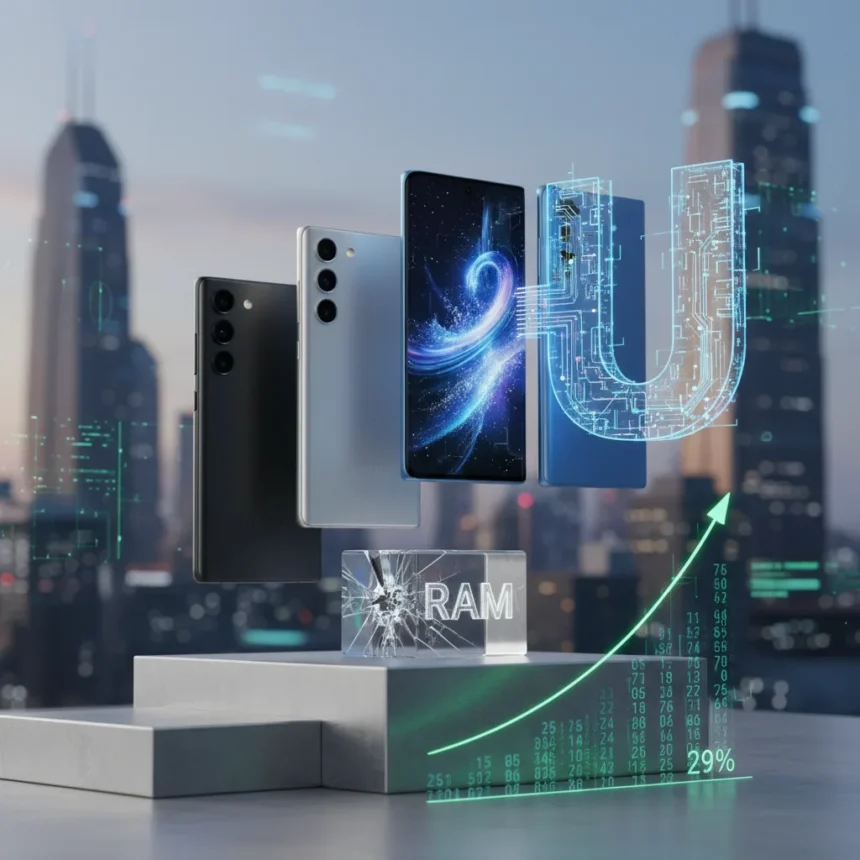
The Samsung Galaxy S26 price hike is real, it’s significant, and buyers don’t seem to care. Samsung raised the price of the base Galaxy S26 and the S26 Plus by $100 each compared to their predecessors, citing a memory shortage that Samsung’s own COO Won-Joon Choi called a “significant contribution” to the higher price tag. Yet early U.S. sales of the Galaxy S26 series are running 29% ahead of the Galaxy S25 series at the same point in the launch cycle. That’s not a rounding error — that’s a statement about where the premium smartphone market is headed.
Key Takeaways
- Galaxy S26 and S26 Plus prices rose by $100 each over their predecessors, driven partly by a RAM shortage.
- Early U.S. sales of the Galaxy S26 series are 29% higher than the Galaxy S25 series at the same stage.
- The Galaxy S26 Ultra holds the same price as the S25 Ultra and accounts for roughly 70% of pre-orders in South Korea.
- Samsung boosted Galaxy S26 Ultra production to 1.5 million units and base S26 production to 1.3 million units after March orders exceeded expectations.
- IDC has warned of a potential 12.9% dip in global smartphone shipments in 2026, making Samsung’s strong start even more notable.
Why the Samsung Galaxy S26 price hike happened
The Samsung Galaxy S26 price hike isn’t purely a profit grab — though the timing is convenient. A global memory shortage has pushed up the cost of the RAM components inside flagship phones, and Samsung’s mobile COO Won-Joon Choi acknowledged publicly that this shortage made a “significant contribution” to the higher price. Tariffs and rising material costs are also in the mix. The uncomfortable reality for consumers is that the RAM crisis isn’t expected to resolve until mid-2027 at the earliest, which means this isn’t a one-cycle anomaly — it’s the new baseline.
The Galaxy S26 series also launched with new memory variants tied directly to those cost increases. Samsung isn’t simply charging more for the same hardware. But whether the upgrades justify the premium depends heavily on which model you’re buying — and that’s where the story gets interesting.
The Galaxy S26 Ultra is doing the heavy lifting
The Galaxy S26 Ultra is the real engine behind Samsung’s strong launch numbers. Samsung kept the Ultra’s price flat against the S25 Ultra — a smart move that made the price hike story primarily a base-model problem rather than a flagship-wide crisis. The Ultra brought genuine upgrades: better cameras, a thinner build, a more one-handed-friendly design, and a new Privacy Display feature. Buyers noticed. The Galaxy S26 Ultra captured roughly 70% of pre-orders in South Korea alone.


That demand forced Samsung’s hand on production. After March orders shattered internal projections, Samsung boosted Galaxy S26 Ultra production to 1.5 million units — an increase of 200,000 — and ramped base Galaxy S26 production to 1.3 million units, up 500,000. The Galaxy S26 Plus, meanwhile, got cut to around 200,000 units, down 100,000. The message from the market is clear: buyers want either the best or the most affordable option. The middle is a hard sell at any price.
How does the Galaxy S26 compare to the S25 series?
Compared to the Galaxy S25 series, the S26 generation is outselling its predecessor by 29% in early U.S. figures despite costing more. The S25 Ultra launched at the same price point as the S26 Ultra, so the flat pricing on the Ultra model removes a direct head-to-head price disadvantage there. Where the comparison stings is on the base and Plus models — buyers upgrading from an S24 or S25 are now paying $100 more for a starting point, and the value case rests entirely on whether the new memory variants and design changes feel worth it in daily use.



The base Galaxy S26 is priced at $899 in the U.S., with potential discounts of $100 to $200 available through various channels. That discount window matters: a $699 or $799 Galaxy S26 is a very different proposition than a $899 one, and Samsung’s retail strategy will likely lean on those promotions to sustain momentum through the mid-cycle.
What the Galaxy S26 sales surge means for the broader market
IDC has flagged a potential 12.9% dip in global smartphone shipments in 2026. Against that backdrop, Samsung’s early numbers look even more remarkable. The premium segment is holding while the broader market wobbles — a pattern that echoes what Apple has demonstrated for years. Consumers who can afford flagship phones are proving less price-sensitive than analysts expected, at least when the product offers a clear reason to upgrade.
The risk is complacency. If Samsung interprets this launch as proof that buyers will absorb any price increase, the next cycle could test that assumption harder. The RAM crisis provides cover now, but mid-2027 is the earliest relief date — and by then, the S27 will need its own compelling story to justify whatever price Samsung sets.
Is the Galaxy S26 worth buying at the higher price?
The Galaxy S26 Ultra is the easiest yes in the lineup. It holds the same price as the S25 Ultra while adding meaningful hardware upgrades, which makes the value case straightforward for anyone already considering the Ultra tier. The base Galaxy S26 at $899 is a harder call — worth watching for promotional pricing that could bring it into more comfortable territory.



Will Samsung raise prices again on the Galaxy S27?
Almost certainly, unless the RAM shortage resolves faster than expected. The memory crisis isn’t projected to ease until mid-2027 at the earliest, and tariffs and material costs aren’t trending downward. If the S26 cycle proves that premium buyers will absorb higher prices, Samsung has little structural incentive to hold the line on the S27.
How does the Galaxy S26 Plus compare to the Ultra in demand?
The Galaxy S26 Plus is the weakest performer in the lineup by a significant margin. Samsung cut Plus production to around 200,000 units while boosting Ultra and base model output. The $100 price increase hit the Plus hardest — it occupies a middle ground that buyers on both ends of the lineup are actively avoiding.
Samsung’s Galaxy S26 launch is a case study in how strong product differentiation can override sticker shock. The Ultra’s upgrades at a flat price did most of the work, but even the pricier base model is outselling its predecessor. The RAM crisis is real, the price hikes are real, and for now, the demand is real too. Whether that holds through the full S26 cycle — and into the S27 — is the question Samsung’s pricing team should be losing sleep over.
Edited by the All Things Geek team.
Source: Android Central