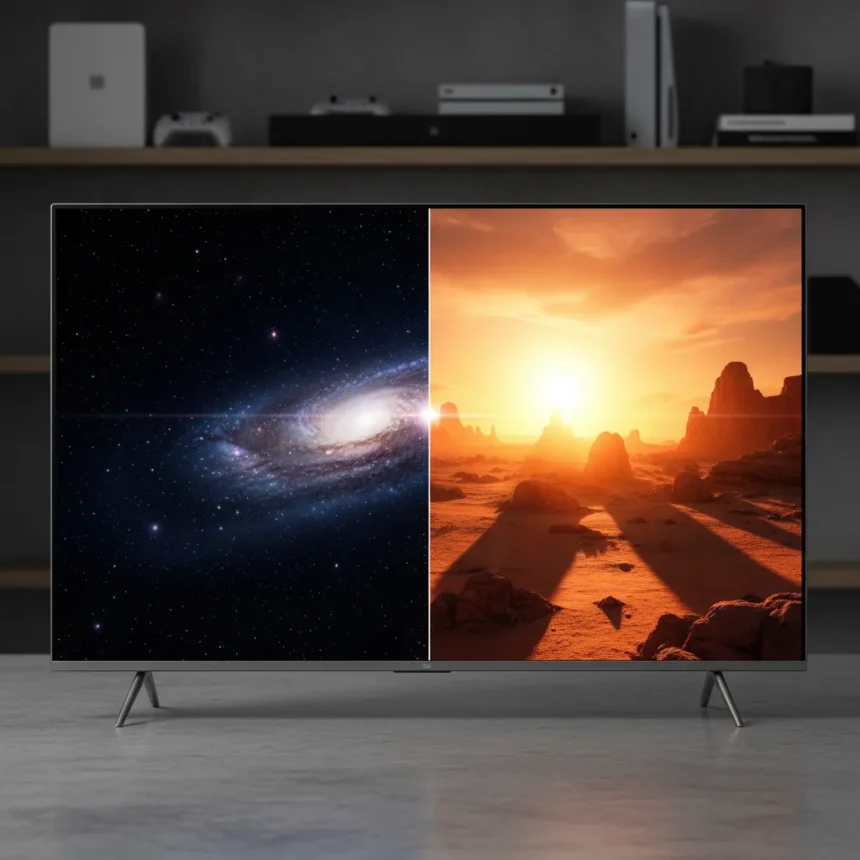
Xiaomi’s latest QD-Mini LED TV proves that QD-Mini LED technology has emerged as the breakthrough display architecture for buyers prioritizing picture quality and value this year. After a week of hands-on testing, the combination of quantum dot technology with Mini LED backlighting delivers the brightness, contrast, and local dimming precision that OLED cannot match at comparable price points.
Key Takeaways
- QD-Mini LED combines quantum dots with Mini LED backlighting for superior brightness, contrast, and color accuracy
- Mini LED backlighting uses hundreds of independently controlled dimming zones for precise local dimming control
- Xiaomi’s QD-Mini LED TV supports Dolby Vision, HDR10+, and gaming features like VRR and ALLM
- QD-Mini LED delivers better value than OLED for mainstream buyers seeking high brightness and durability
- Competitors like Hisense, TCL, and Samsung are adopting Mini LED as the standard for premium LCD TVs
What Makes QD-Mini LED Different
QD-Mini LED technology merges two proven innovations: quantum dot layers that amplify color vibrancy and contrast, paired with Mini LED backlighting that divides the display into hundreds of independently dimmed zones. This architecture solves a fundamental problem with traditional LED TVs—they lack the precision to control brightness locally, resulting in washed-out blacks and blooming around bright objects. Mini LED backlighting eliminates that compromise. Xiaomi’s implementation demonstrates that this hybrid approach delivers vibrant, punchy images with the deep blacks that LCD technology traditionally struggles to achieve.
The dimming zone count matters more than marketing claims suggest. Hisense’s U8H Mini-LED TV, for example, features 336 dimming zones on its smallest screen size, enabling granular control over brightness across the panel. This density of zones means the TV can brighten specific regions without affecting adjacent areas, creating the impression of OLED-like contrast while maintaining the brightness advantage that LCD inherently possesses. Xiaomi’s QD-Mini LED TV applies the same principle—hundreds of zones working in concert to sculpt the image with precision.
QD-Mini LED vs. OLED: The Real Trade-off
OLED TVs achieve perfect blacks because each pixel produces its own light and can switch completely off. That sounds superior until you consider brightness. QD-Mini LED TVs can achieve substantially higher peak brightness than OLED, a critical advantage for bright rooms and HDR content that demands luminosity. LG’s C3 OLED delivers a vibrant image and excellent upscaling via its Alpha a9 Gen6 processor, supporting 4K gaming at 120Hz across four HDMI 2.1 ports. But in side-by-side tests, OLED struggles to match the brightness intensity that Mini LED achieves, particularly in scenes with small bright objects on dark backgrounds.


The durability argument also favors QD-Mini LED. OLED panels suffer from potential burn-in if static images display for extended periods—a real concern for users who leave the same content on screen for hours. Mini LED technology has no such vulnerability. For buyers planning to keep a TV for five to seven years without worrying about image retention, QD-Mini LED removes that anxiety entirely. Xiaomi’s approach leverages this reliability advantage, positioning the technology as the practical choice for long-term ownership.
Gaming and HDR Performance
Gaming on Xiaomi’s QD-Mini LED TV feels responsive and visually stunning. The TV supports variable refresh rate (VRR) and auto low-latency mode (ALLM), essential features for competitive gaming. TCL’s Q Series QD-Mini LED TVs push this further, delivering 4K gaming at 144Hz via HDMI 2.1 (48 Gbps bandwidth, eARC, and Dynamic HDR support). This specification matters for PC gamers who demand high frame rates without compromise. Xiaomi’s implementation similarly prioritizes gaming features, recognizing that modern TV buyers expect console and PC gaming to feel as smooth as dedicated monitors.



HDR content—movies, streaming shows, games—looks exceptional on QD-Mini LED. The technology supports Dolby Vision and HDR10+, the two dominant HDR standards. The combination of quantum dots and Mini LED backlighting means HDR scenes retain both shadow detail and highlight brightness without crushing either end of the tonal range. Streaming services like Netflix and Disney+ have optimized content for this type of display, making the visual payoff immediate and obvious.
Xiaomi’s QD-Mini LED TV vs. Predecessors and Rivals
Xiaomi’s older Mi QLED TV 75 represented a solid value, featuring 192 local dimming zones, a quantum dot layer for color and contrast, Dolby Vision support, and a 120Hz refresh rate. That TV proved that Xiaomi understood what buyers wanted. But it lacked 4K@120Hz gaming capability and suffered from a laggy interface that frustrated daily use. Xiaomi’s new QD-Mini LED TV addresses both shortcomings—it delivers the gaming features modern consoles demand and a snappier software experience. The step forward is meaningful for anyone upgrading from a five-year-old TV.
OnePlus TV U1, positioned as a direct rival around ₹50,000 in India, offers a vibrant 4K display with Dolby Vision and HDR10+ support, plus a premium design. But OnePlus TV U1 uses standard LED backlighting, not Mini LED, which means it cannot match the local dimming precision or brightness intensity that Xiaomi’s QD-Mini LED TV achieves. The gap in picture quality justifies Xiaomi’s positioning as the superior choice for buyers who prioritize image performance.
Samsung has already signaled the industry direction by adopting Quantum Mini LED in its Neo QLED lineup and announcing 8K Mini LED TVs. This convergence around Mini LED technology signals that the industry recognizes QD-Mini LED as the pragmatic sweet spot—superior to standard LCD, more affordable and brighter than OLED, and free from OLED’s burn-in concerns.



Should You Buy Xiaomi’s QD-Mini LED TV?
If you watch a mix of streaming content, movies, and gaming, and you want a TV that will look exceptional for years without image retention worries, Xiaomi’s QD-Mini LED TV deserves serious consideration. The technology delivers on the promise of superior picture quality without forcing you to compromise on brightness, gaming responsiveness, or durability. For mainstream buyers, QD-Mini LED represents the most balanced approach to TV technology available today.
What exactly is QD-Mini LED technology?
QD-Mini LED combines quantum dot technology—a layer that enhances color vibrancy and contrast—with Mini LED backlighting, which uses hundreds of independently controlled dimming zones. This hybrid approach delivers the brightness and color accuracy of quantum dots with the local dimming precision that traditional LED backlighting cannot match.
How does Xiaomi’s QD-Mini LED TV compare to OLED?
Xiaomi’s QD-Mini LED TV achieves higher peak brightness than OLED and eliminates burn-in risk, making it ideal for bright rooms and long-term ownership. OLED delivers perfect blacks and excellent contrast but at higher cost and with potential image retention concerns. For most buyers, QD-Mini LED offers better value and reliability.
Is QD-Mini LED the future of TV technology?
Major manufacturers including Hisense, TCL, and Samsung are rapidly adopting Mini LED and QD-Mini LED for premium LCD models. The technology solves key weaknesses of traditional LCD while remaining more affordable and durable than OLED, suggesting QD-Mini LED will dominate the mid-to-premium TV market for the next several years.
Xiaomi’s QD-Mini LED TV proves that the future of television belongs to technologies that balance picture quality, brightness, gaming performance, and durability. If you are shopping for a TV in 2025, QD-Mini LED should be at the top of your list—it delivers the performance of far more expensive displays without the compromises that have historically forced buyers to choose between brightness and black levels.
Edited by the All Things Geek team.
Source: Android Central