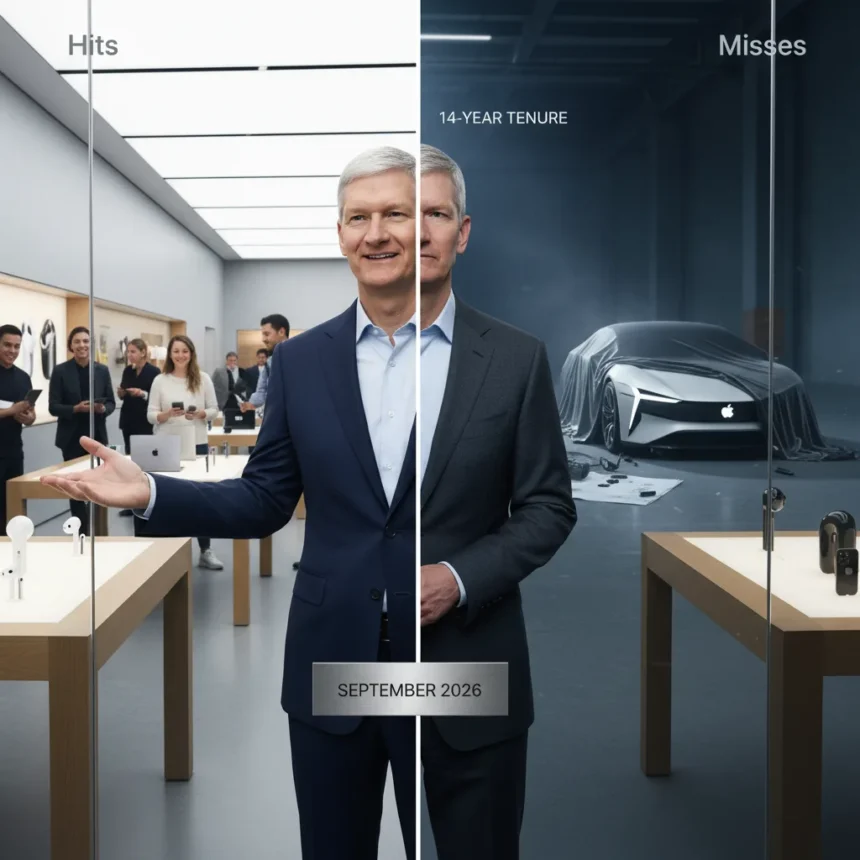
Tim Cook’s tenure as Apple CEO is ending in September 2026, marking the close of an era that redefined the company beyond the iPhone. After 14 years steering Apple, Cook will hand the reins to John Ternus, senior VP of hardware engineering, while assuming the role of executive chairman. The transition represents not just a leadership change but a moment to assess what Cook got right—and spectacularly wrong—during his time at the helm.
Key Takeaways
- Tim Cook steps down as Apple CEO on September 1, 2026, succeeded by John Ternus
- AirPods and Apple Watch emerged as defining product hits of Cook’s era
- Apple’s custom Silicon chips under Johny Srouji transformed the company’s hardware strategy
- The canceled Apple Car represents Cook’s most visible failure in post-iPhone diversification
- Cook remains as executive chairman after stepping down from the CEO role
The Products That Defined Tim Cook’s Era
Tim Cook is stepping down as Apple CEO in September 2026, with his tenure remembered for both groundbreaking launches and strategic stumbles. AirPods emerged as one of Cook’s signature wins—a product category Apple invented that became a cultural phenomenon and a major revenue driver. The wireless earbuds proved skeptics wrong when the company ditched the headphone jack, a move many ridiculed at the time. Apple Watch followed a similar trajectory, transforming wearables from a niche market into a lifestyle essential. These weren’t incremental upgrades; they were category-defining products that competitors still chase.
Beyond consumer hardware, Cook’s era was shaped by Apple’s shift toward custom silicon. The company’s move away from Intel dependency through Apple Silicon chips, championed by Johny Srouji, fundamentally altered Apple’s competitive position. This wasn’t flashy consumer marketing—it was infrastructure that made everything else possible. MacBooks, iPhones, and iPads all benefited from chips designed specifically for Apple’s ecosystem, delivering performance advantages that Intel-based systems couldn’t match. Srouji’s role was so critical that Apple created a new position of chief hardware officer to retain him, signaling how central chip design had become to Cook’s vision.
Where Tim Cook’s Apple Failed to Innovate
Not every bet paid off. The Apple Car, Cook’s most ambitious diversification attempt, never made it to market. After years of development and reported struggles with the project’s direction, Apple canceled it—a rare public failure for a company that usually keeps product roadmaps under wraps. The car represented Cook’s push to move Apple beyond iPhone dependency, a legitimate strategic concern given that single product’s dominance of company revenue. But execution faltered, and the project became a cautionary tale about the limits of Apple’s design and manufacturing prowess outside its core competencies.


Cook’s era also faced criticism for what some viewed as slowing innovation cycles. While iPhone iterations continued, the incremental nature of yearly updates frustrated users expecting the kind of transformative leaps that defined earlier Apple eras. The company now faces a critical challenge: proving it can deliver meaningful innovation beyond the iPhone, a device that still accounts for the bulk of its revenue. This pressure falls on Cook’s successor, John Ternus, who must navigate the gap between hardware excellence and genuine category-creation that defined Cook’s early wins.
The Succession and What Comes Next
John Ternus takes over as CEO on September 1, 2026, inheriting a company worth trillions but facing questions about its post-iPhone future. Ternus, who has led hardware engineering, understands Apple’s manufacturing and design philosophy intimately. His promotion signals continuity rather than radical change—Apple is betting on someone who knows how to execute Cook’s vision rather than overhaul it.



The elevation of Johny Srouji to chief hardware officer reinforces Apple’s commitment to silicon supremacy as a competitive moat. With Cook moving to executive chairman, the company is structuring itself to retain institutional knowledge while refreshing leadership. Whether this transition produces the next category-defining product or continues the incremental-upgrade pattern remains the central question facing Apple’s next chapter.
Did Tim Cook Succeed or Fail as Apple CEO?
Cook’s legacy resists simple judgment. He inherited a company at peak iPhone success and kept it profitable and dominant, no small feat in a brutally competitive market. AirPods and Apple Watch proved Apple could still create new categories, not just refine existing ones. Yet the Apple Car’s failure and the lack of a transformative post-iPhone product suggest Cook’s era ended before solving Apple’s fundamental challenge: what comes after the device that changed everything.
Who is taking over from Tim Cook?
John Ternus, Apple’s senior VP of hardware engineering, becomes CEO on September 1, 2026. Ternus has spent years leading the teams that design and manufacture Apple’s products, making him a natural choice to continue the company’s hardware-first strategy.
What was Tim Cook’s biggest failure as Apple CEO?
The canceled Apple Car stands as Cook’s most visible failure—an ambitious diversification bet that never reached consumers despite years of development. The project symbolized both Cook’s ambition to move beyond the iPhone and the limits of Apple’s ability to dominate entirely new categories.



Tim Cook’s 14-year reign as Apple CEO delivered iconic products that reshaped entire categories and a company that remained dominant through discipline and execution. Yet his departure marks the end of an era defined more by refinement than revolution—and leaves Apple’s next leader with the unfinished work of proving the company can innovate beyond the iPhone.
Where to Buy
Save up to 20% on AirPods at Amazon
Edited by the All Things Geek team.
Source: Creativebloq