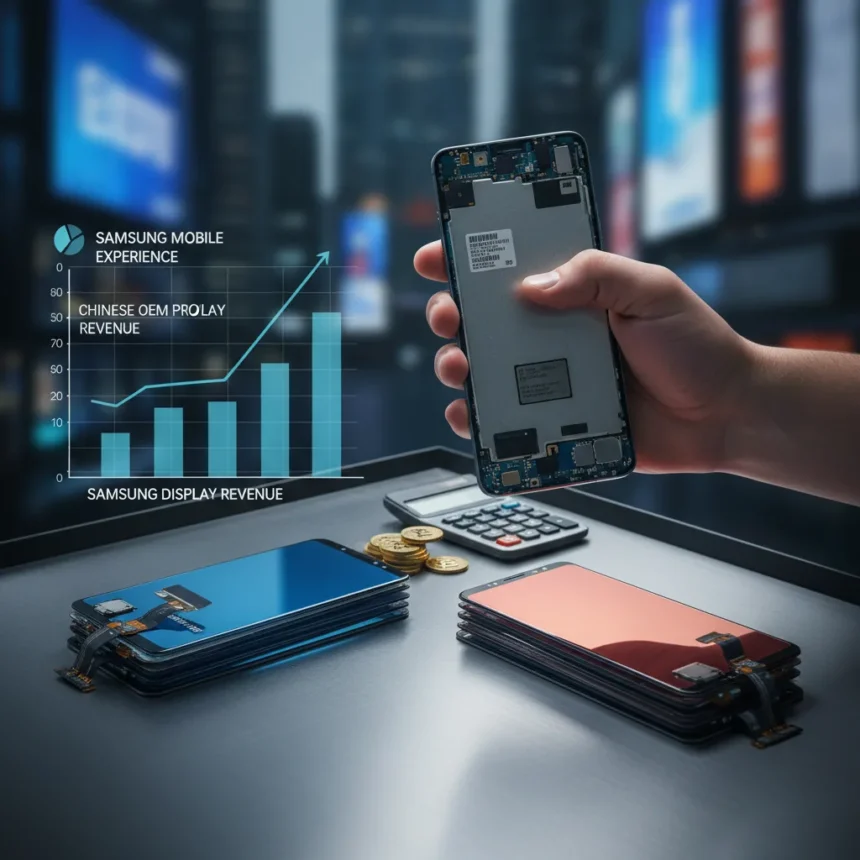
Samsung OLED display sourcing is undergoing a dramatic shift that reveals just how severe cost pressures have become in the smartphone industry. Samsung’s Mobile Experience division has ordered approximately 15 million OLED panels from Chinese manufacturer China Star Optoelectronics Technology (CSOT), a move that marks an unprecedented willingness to abandon its own component division.
Key Takeaways
- Samsung MX division ordered 15 million OLED panels from Chinese manufacturer CSOT instead of Samsung Display
- CSOT panels cost at least 20% less than Samsung Display’s offerings
- Rising RAM costs are squeezing smartphone manufacturers’ margins across the industry
- The shift affects Galaxy A-series and Fan Edition models
- Internal friction erupted when Samsung Display challenged the sourcing decision
Why Samsung is abandoning its own display division
The decision to source from CSOT reflects a brutal cost calculus. Memory chip prices have surged, forcing manufacturers to cut costs elsewhere just to maintain competitive pricing. For a vertically integrated company like Samsung, this means even internal divisions must compete on price. Samsung Display’s panels are premium products—but premium costs money that the Mobile Experience division simply cannot justify in the mid-range segment anymore.
CSOT panels undercut Samsung Display by at least 20%, a gap too large to ignore when every dollar matters. This is not a choice born from technological preference. It is a choice born from survival. The smartphone market’s razor-thin margins have forced Samsung to make a decision that would have been unthinkable five years ago: buy from a competitor instead of your own factory.
Which phones are affected by Samsung OLED display sourcing changes
The shift targets Galaxy A-series phones and some Fan Edition models—Samsung’s volume plays in the mid-range market. These are the devices sold in the millions, where cost per unit compounds into massive bottom-line impact. Premium Galaxy S and Z-series phones remain untouched, at least for now. Samsung Display retains its position supplying flagship devices. But the fact that mid-range phones are now fair game signals how desperate the situation has become.

This segmentation is telling. Samsung Display is being sidelined for entire product lines, not just individual models. The company’s own display subsidiary is losing market share to external suppliers—within its own corporate family. That internal friction escalated when Samsung Display attempted to challenge the sourcing decision, according to supply chain sources. The challenge failed. Cost won.
What this means for Samsung’s display business long-term
Samsung Display faces a troubling precedent. Once a manufacturer proves it can live with third-party panels, the pressure to expand that sourcing grows. If CSOT panels work acceptably in Galaxy A phones, why not Galaxy A Pro? Why not some Z-series variants? The slope is slippery, and Samsung Display now occupies a weaker negotiating position within its own parent company.



The move also signals broader industry fragility. When even vertically integrated giants abandon their own divisions to chase cost savings, it suggests the entire smartphone market is under stress. RAM costs are the immediate culprit, but the underlying issue is saturation. Consumers are upgrading less frequently. Margins are collapsing. Manufacturers are forced to choose between profitability and market share, and most are choosing market share—which means cutting costs wherever possible.
Does cheaper mean lower quality?
The research indicates that the shift does not necessarily mean a noticeable quality drop in displays themselves. CSOT is a legitimate manufacturer with established production capability. But the move underscores something more important than panel quality: it underscores cost pressure rather than technological advancement. Samsung is not switching to CSOT because CSOT displays are better. It is switching because they are cheaper.
For consumers, this creates a subtle risk. Mid-range Galaxy phones may look and feel identical, but they will be built to different component economics. That does not guarantee visible problems—but it does guarantee that Samsung Display’s quality standards are no longer the baseline for these devices. CSOT has its own standards, and those standards are priced for a different market.
Is Samsung Display losing the smartphone display war?
Not yet. Samsung Display still supplies the flagship Galaxy S and Z-series phones, the devices that define the brand. But the loss of mid-range volume is significant. It represents a crack in what was once a seemingly unbreakable vertical integration advantage. Samsung Display cannot compete on price with CSOT, and in the current market, price is the only metric that matters.


The company could respond by cutting its own costs, but that would require reducing quality or accepting lower margins—both painful options. Or it could invest in new manufacturing processes that lower production costs while maintaining quality. But that requires capital and time, neither of which Samsung has in abundance when competitors are already moving. Samsung Display is caught between two bad choices, and the sourcing decision to CSOT proves it is losing the internal battle.
FAQ
Why would Samsung source displays from competitors instead of its own division?
Rising RAM costs are squeezing smartphone manufacturers’ margins, forcing even vertically integrated companies like Samsung to cut costs wherever possible. CSOT panels cost at least 20% less than Samsung Display’s offerings, a gap too large to ignore in the mid-range segment.
Does this affect Samsung Galaxy S and Z-series flagship phones?
No. The sourcing change applies to Galaxy A-series and Fan Edition models only. Premium flagship devices continue to use Samsung Display panels, at least for now.
Will cheaper OLED panels affect display quality in Galaxy A phones?
The shift does not necessarily indicate a noticeable quality change in displays. However, it does mean that Samsung Display’s quality standards are no longer the baseline for these devices—CSOT has its own standards priced for a different market.
Samsung’s decision to source displays from CSOT reveals a company under cost pressure so severe that even internal divisions cannot protect themselves from external competition. The smartphone industry is no longer about innovation or quality—it is about survival. Samsung Display’s loss of mid-range volume is a warning sign that vertical integration, once considered an unbeatable advantage, is now just another cost center fighting to justify its existence in a market that cares only about price.
Where to Buy
Samsung Galaxy S26 Ultra£1,449£1,279ViewSee all prices
Edited by the All Things Geek team.
Source: T3