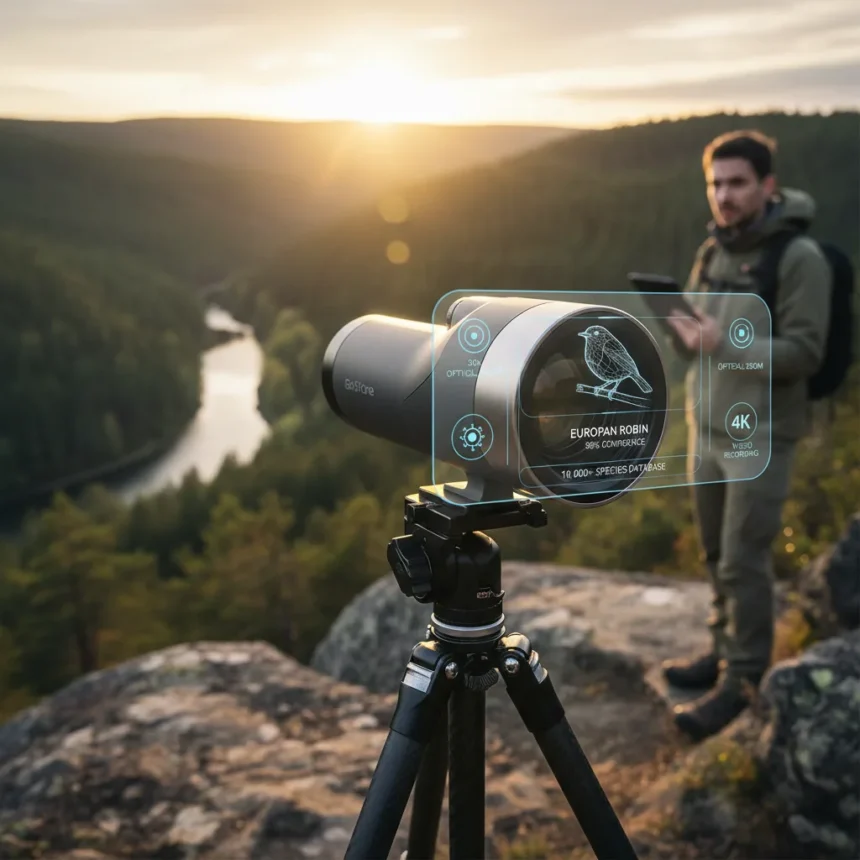
The Go Birding M One Smart AI spotting scope is a smart spotting scope made by Go Birding, designed to identify up to 10,000 bird species while delivering 30x optical zoom, 4K video recording, and subject-tracking autofocus. This device signals a fundamental shift in how birders approach their hobby—moving away from pure optics toward computational identification and video capture.
Key Takeaways
- Identifies up to 10,000 bird species using AI-powered recognition technology
- Features 30x zoom magnification for detailed long-distance viewing
- Records 4K video with subject-tracking autofocus for moving subjects
- Combines traditional spotting scope optics with modern smart features
- Positions birding as a data-driven, documented activity rather than observation-only
What Makes the Go Birding M One Smart AI Spotting Scope Different
Traditional spotting scopes have remained largely unchanged for decades—they magnify, they focus, and that is where the innovation stops. The Go Birding M One Smart AI spotting scope flips that model by embedding AI-driven bird identification directly into the optical path. Instead of manually cross-referencing field guides or relying on memory and experience, users point the scope and let the system identify what they are looking at.
The 30x zoom delivers the magnification birders expect from a quality spotting scope, but the real differentiator is what happens next. The 4K video recording with subject-tracking autofocus means you are not just observing—you are documenting. Subject tracking autofocus keeps moving birds sharp even as they shift position, a feature that elevates the device beyond a static observation tool into something closer to a sports camera mounted on optics.
This represents a meaningful departure from how birders have traditionally worked. A conventional spotting scope is a passive instrument. The Go Birding M One Smart AI spotting scope is active—it analyzes, identifies, and records. For casual birders, that shift removes friction. For serious ornithologists, it creates a searchable archive of sightings.



How AI Bird Identification Changes the Birding Experience
The promise of identifying up to 10,000 bird species sounds remarkable until you consider the mechanics. The Go Birding M One Smart AI spotting scope’s identification system relies on what you point it at—the quality of the optical path, lighting conditions, and the bird’s visibility all factor into whether the AI can make a confident match. This is not a magic wand that works equally well in every scenario.
For common species in good light, instant identification is genuinely useful. A beginner with the Go Birding M One Smart AI spotting scope can confidently name what they are seeing without years of field study. That democratizes birding in a real way. For rare or cryptic species, or in poor visibility, the identification system becomes a starting point rather than a conclusion. You still need judgment.



The 10,000-species database is comprehensive—it covers virtually every bird on Earth—but the practical value depends on your region and the birds you encounter. A birder in North America will encounter a fraction of that database in practice. The scope’s usefulness is not diminished by this; it is simply a reminder that the headline number reflects maximum potential, not typical daily use.
4K Video and Subject Tracking Autofocus in Action
The Go Birding M One Smart AI spotting scope records 4K video, which is a significant step beyond what traditional scopes offer. 4K resolution means you can capture detail that would be impossible to see in real time, especially for small species or distant subjects. You can review footage later, zoom digitally, and spot details you missed during the live observation.
Subject-tracking autofocus is the feature that makes this practical. Birds move. They hop, they fly, they turn their heads. A conventional scope with fixed focus would lose sharpness constantly. Subject tracking keeps the autofocus locked on your target, maintaining sharpness even as the bird moves within the frame. This is the same technology used in mirrorless cameras for wildlife photography, adapted here for optical magnification.
The combination means the Go Birding M One Smart AI spotting scope functions as a hybrid tool—part optics, part camera, part identification engine. You get the magnification of a scope, the recording capability of a video camera, and the intelligence of a recognition system, all in one device. That integration is what makes this scope genuinely different from pairing a traditional scope with a smartphone.


Spotting Scopes Then and Now
Conventional spotting scopes are proven tools, refined over generations. They are durable, require no batteries for basic operation, and deliver consistent optical quality. They do one thing exceptionally well: magnify distant subjects. The trade-off is that they are passive. You observe, you remember, you consult a guide later if you are unsure of an identification.
The Go Birding M One Smart AI spotting scope trades some of that simplicity for capability. It requires power, it depends on software, and it introduces variables like AI accuracy and video file storage. For someone who wants a scope that works identically every time with zero learning curve, a traditional scope remains the safer choice. For someone who wants to document, identify, and archive their birding observations, the Go Birding M One Smart AI spotting scope opens new possibilities.
The real question is not whether one approach is objectively better—it is whether the added complexity delivers value for your specific use case. A casual backyard birder might find the AI identification feature delightful. A professional ornithologist might see it as a useful tool for rapid field documentation. Someone who values simplicity and optical purity might prefer the traditional route.
Is the Go Birding M One Smart AI Spotting Scope Worth the Investment?
The device sits at the intersection of several trends: the rise of AI-powered consumer tools, the growing interest in nature-based hobbies, and the expectation that devices should do more than one thing. The Go Birding M One Smart AI spotting scope checks all three boxes. Whether it is worth your money depends on what you want from your birding experience.
If you want instant species identification without field guide consultation, the Go Birding M One Smart AI spotting scope delivers. If you want to document your sightings in 4K video, it does that. If you want a scope that works flawlessly with zero setup or software updates, it is not the right tool. The device asks you to accept a different model of birding—one where observation, identification, and documentation happen simultaneously rather than sequentially.
How does the Go Birding M One Smart AI spotting scope identify birds so quickly?
The Go Birding M One Smart AI spotting scope uses embedded AI recognition that analyzes the optical image in real time. The system compares what it sees against a database of 10,000 bird species, returning matches based on visible features like plumage, size, and shape. Identification speed and accuracy depend on image clarity, lighting, and how distinctive the bird is.
Can you use the Go Birding M One Smart AI spotting scope for non-birding activities?
The 30x zoom and 4K video recording make the Go Birding M One Smart AI spotting scope useful for wildlife observation beyond birds, landscape photography, or surveillance applications. The subject-tracking autofocus works on any moving subject. However, the AI identification system is specifically trained for birds, so that feature would not apply to other uses.
Does the Go Birding M One Smart AI spotting scope work in low light conditions?
Like all optical devices, the Go Birding M One Smart AI spotting scope performs best in good daylight. Low light reduces image clarity, which affects both the optical view and the AI identification accuracy. The 4K video recording will also struggle in dim conditions. Early morning and late afternoon birding may produce less reliable results than midday observation.
The Go Birding M One Smart AI spotting scope represents a genuine evolution in birding technology, not a gimmick. It takes the core function of a spotting scope—magnified observation—and wraps it in identification, video, and autofocus capabilities that traditional optics simply cannot match. Whether that evolution matters to you depends on whether you want birding to remain a pure observation experience or whether you are ready to embrace a more data-driven, documented approach. For birders who have wanted a tool that combines optics, identification, and recording into one device, this scope finally delivers.
Edited by the All Things Geek team.
Source: TechRadar