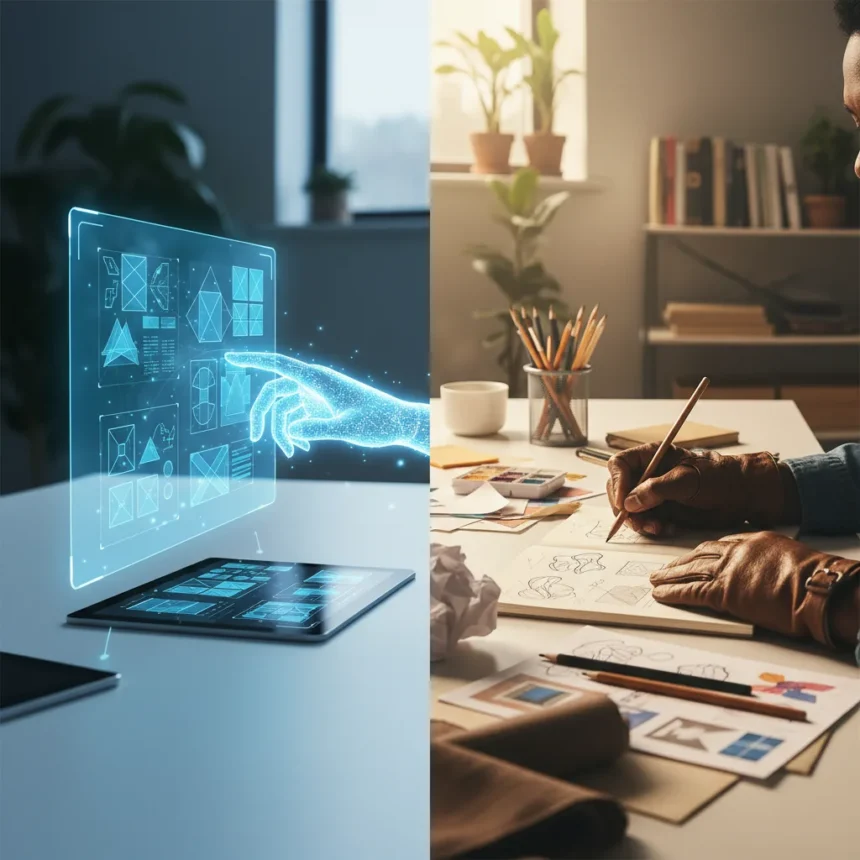
AI design tools human designers face a critical inflection point. As artificial intelligence becomes embedded in creative workflows, a counterintuitive truth emerges: the skills that make designers valuable are becoming more essential, not less. The industry is not consolidating around automation—it is splitting into two camps: commodity output and crafted work. Only one will survive.
Key Takeaways
- AI can replicate knowledge-based and routine creative tasks, but cannot replicate human judgment or taste.
- Designers’ lived experience and informed taste are becoming competitive advantages in an AI-saturated market.
- The future belongs to work that feels crafted and considered, not cookie-cutter and templated.
- Good designers already possess the skills needed to thrive in an AI-shaped industry.
- Human ingenuity in directing and evaluating AI output remains the limiting factor in design quality.
AI Design Tools Can Execute, But Not Decide
AI design tools can perform knowledge-based work and execute creative tasks traditionally done by humans. They generate layouts, suggest color palettes, and iterate on compositions at inhuman speed. But speed is not the same as vision. According to industry experts, no matter how advanced AI models become, they are ultimately limited by the quality of the models and input they receive and who is doing that input. An AI system has no taste. It has no sense of what matters, what resonates, or why. It optimizes for patterns it has seen before, which means it excels at producing what already exists and fails at imagining what could be.
Design is shaped by countless parameters and decisions. Each one reflects a human choice: contrast or harmony, bold or subtle, familiar or surprising. AI can weight these parameters mathematically, but it cannot understand the human behavior or cultural context that makes a choice feel right. This is not a limitation that will vanish as models improve—it is architectural. An AI system trained on existing design work will always be constrained by that training data. It cannot access lived experience. It cannot feel the weight of a decision the way a designer who has spent fifteen years refining their eye can feel it.
Why Instinct and Experience Matter More Now
The paradox of AI in design is that it makes human judgment more valuable, not less. As AI design tools flood the market with competent-but-generic output, the work that stands out is the work that feels intentional. Dougal Marwick, creative strategist and copywriter at The Touch Agency, frames this clearly: as the industry heads toward a future in which all designers rely on the same cookie-cutter tech, tools and templates, the work that feels more crafted, considered and human will continue to resonate. The designer’s job is no longer to execute—it is to decide what should be executed and why.



This shift rewards experience. A designer with ten years of client work, failed experiments, and refined taste can spot a weak concept in seconds. They know why a solution works before they can articulate it. They can feel when something is missing. These instincts are not magical—they are the compressed result of thousands of small decisions, feedback loops, and pattern recognition that no AI system has access to. Lived experience, informed taste, and the ability to gate-keep quality become not luxuries but necessities.
Versatility and Adaptation Are the Real Defense
The designers who will thrive are those who view AI not as a threat but as a shift in their toolkit. Terrance, a design industry commentator, captures this pragmatism: today’s designers are much more versatile, out of necessity, and they will continue to successfully adapt their skills and tools in the era of AI. The role is not disappearing—it is evolving. A designer in 2025 needs to understand how to direct an AI system, critique its output, and know when to override it. They need to understand the limitations of their tools well enough to work around them.



This requires confidence in human ingenuity and skepticism toward AI applications. Not all AI suggestions are improvements. Not all efficiency gains are worth the loss of nuance. A good designer knows the difference. They can look at ten AI-generated variations and recognize that none of them capture the brief, and they have the skill to fix it themselves. That combination—the ability to use AI as a tool while trusting your own eye—is the actual competitive advantage.
The Market Is Already Sorting
The design industry is not waiting for some distant AI-powered future. It is sorting now. On one side are designers who treat AI as a shortcut to volume—pumping out dozens of variations and hoping one lands. On the other are designers who use AI to accelerate the parts of their work that are genuinely routine, freeing time for the thinking that requires taste and judgment. The first group is already becoming commoditized. The second is becoming more valuable.
This is not a prediction. It is already visible in how clients respond to work. Campaigns that feel generic—the kind that AI produces naturally—underperform. Work that feels intentional, that carries the fingerprint of a human sensibility, continues to cut through noise. The market is voting with its attention, and it is voting for craft. The designers who understand this will not be displaced by AI. They will be the ones directing it.
Can AI Ever Close the Gap?
The honest answer is no, not in any meaningful way. AI’s ability to innovate and understand underlying human behaviors or motivations is always likely to be limited. The technology can improve at executing patterns, but it cannot develop the kind of judgment that comes from living in the world, making mistakes, and learning from them. An AI system that has never failed has no basis for understanding what success means. A designer who has spent years learning from failure has something no algorithm can replicate.


This does not mean AI design tools will not improve or that they will not become more useful. They will. But utility is not the same as replacement. A hammer is useful. It does not replace a carpenter. The carpenter’s judgment about where to swing, how hard, and why is what turns raw materials into a house.
What Good Designers Already Know
Here is the reassuring part: good designers already possess the kinds of skills needed to remain valuable in an AI-shaped industry. The designers who have spent years developing taste, learning from clients, understanding culture, and refining their instincts are not starting from zero. They are starting from a position of strength. They know how to critique work. They know how to push back on briefs. They know when something feels off, even if they cannot immediately say why.
These are not skills that can be automated. They are the opposite of automation. They are the human part of design, the part that requires judgment, taste, and the kind of learning that only comes from doing the work and paying attention to how the world responds.
Is AI replacing graphic designers?
No. AI is replacing routine, commodity design work—the kind that was already becoming commoditized. What AI cannot replace is judgment, taste, and the ability to understand why a design choice matters. Good designers are becoming more valuable, not less, because their instincts and experience are what separate intentional work from generic output.
What skills do designers need to stay relevant in the AI era?
Designers need to understand AI design tools as tools, not replacements. They need to develop stronger taste and judgment so they can critique AI output. They need versatility and the ability to adapt as workflows change. Most importantly, they need to trust their instincts and be willing to override AI suggestions when their experience tells them something is wrong.
Will AI design tools eventually become good enough to eliminate the need for human designers?
The evidence suggests no. AI design tools are limited by the quality of their training data and the judgment of the people directing them. They cannot develop the kind of taste or cultural understanding that comes from lived experience. As AI-generated work becomes more common, the market is already rewarding work that feels intentional and human-made. The future of design belongs to the designers who can use AI skillfully while trusting their own eye.
The real story is not about AI replacing designers. It is about the design industry splitting into two tiers: one where AI does most of the work and output is cheap and generic, and one where designers use AI as a tool while their instinct and taste remain the real product. The question for every designer is which tier they want to be in. The good news is that the answer is still in their hands.
Edited by the All Things Geek team.
Source: Creativebloq