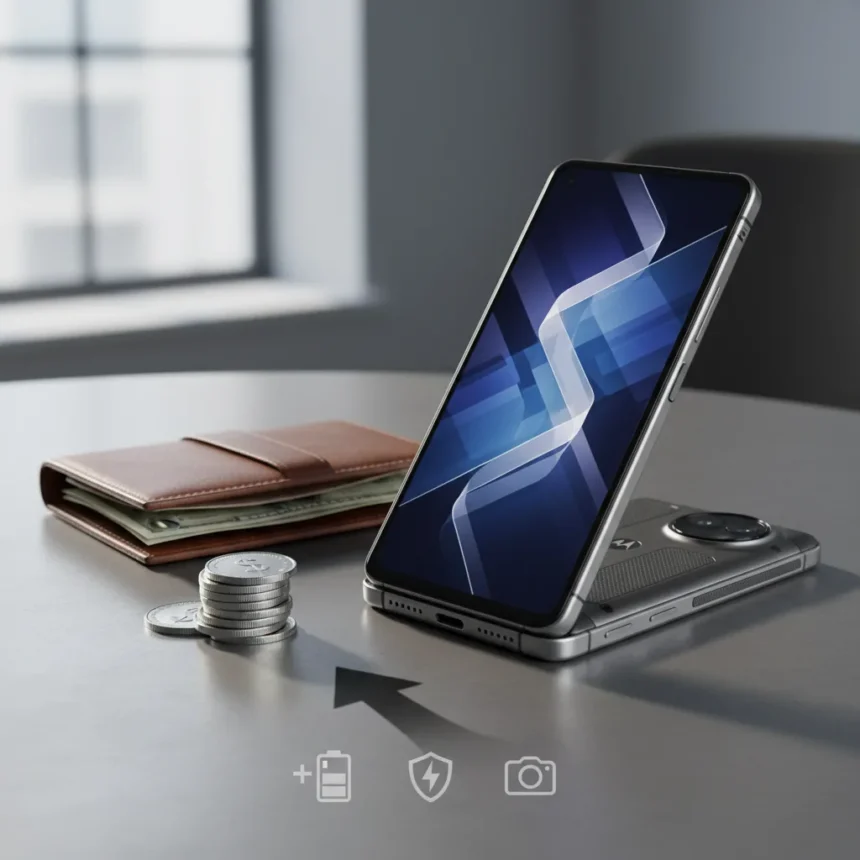
The Motorola Razr 2026 represents a genuinely better phone than its 2025 predecessor—until you look at the price tag. Motorola’s new clamshell foldable, arriving May 21, packs a larger 4,800mAh battery, tougher display glass, improved cameras, and Android 16 straight out of the box. But the base Motorola Razr 2026 now costs $799, a $100 jump that strips away the model’s original appeal as an affordable foldable option.
Key Takeaways
- Base Motorola Razr 2026 starts at $799, up $100 from the 2025 model.
- Battery capacity increases across all three models without size growth.
- New Gorilla Glass Victus outer display protection improves durability.
- MediaTek Dimensity 7450X chip offers only modest performance gains.
- Storage halved to 128GB on the base model despite higher price.
Motorola Razr 2026 specs and pricing breakdown
The Motorola Razr 2026 lineup launches in three tiers: the base Razr at $799, the Razr Plus at $1,099, and the Razr Ultra at $1,499. All three models went into preorder on May 14, with retail availability beginning May 21. The price increases hit hard across the board—the Plus and Ultra each jumped $100 and $200 respectively versus their 2025 counterparts. For the base model, that $100 hike is significant when the phone already sits at the premium end of mid-range pricing.
Motorola justified these increases by upgrading battery capacity, display protection, and processing power. The base Razr jumps from 4,500mAh to 4,800mAh, the Plus grows from 4,000mAh to 4,500mAh, and the Ultra expands from 4,700mAh to 5,000mAh. All three clamshell phones now ship with Android 16 at launch, a rare perk that gives early adopters immediate access to Google’s latest OS features without waiting for a future update.
Battery and durability gains in the Motorola Razr 2026
The real story here is battery. Motorola managed to increase capacity across the entire lineup without thickening the devices, a genuine engineering win in foldable design. The base Motorola Razr 2026’s 300mAh bump may sound modest, but it directly addresses the previous generation’s Achilles’ heel—mediocre all-day endurance on the smaller inner display.


Durability improvements match the battery upgrades. The base Razr 2026 and Razr Plus 2026 debut Gorilla Glass Victus on their outer displays, while the Razr Ultra 2026 steps up to Gorilla Glass Ceramic 3, Motorola’s toughest cover glass option. These upgrades matter in daily use. Foldable phones live and die by hinge reliability and screen protection, and Motorola’s new glass standards directly address both concerns. The hinges themselves are also improved across the lineup, though Motorola has not detailed the specific mechanical changes beyond claiming enhanced durability.
Processor and performance: modest gains at a premium price
The base Motorola Razr 2026 moves from the MediaTek Dimensity 7400X to the Dimensity 7450X, a generational bump that Android Central says delivers only modest performance improvements. The new chip promises up to 7% faster AI processing and improved connectivity, but raw compute gains remain incremental. The Razr Plus 2026 and Razr Ultra 2026 retain their 2025 chipsets—the Snapdragon 8s Gen 3 and Snapdragon 8 Elite respectively—yet both models carry price increases anyway, a choice that undercuts Motorola’s upgrade narrative.



This is where the value proposition fractures. If you buy the Plus or Ultra, you are paying more for better batteries, glass, and cameras, but not for faster processing. That strategy works for users who do not chase benchmark scores, but it feels disingenuous to raise prices without meaningful performance bumps on the premium models.
Camera and display improvements
All three Motorola Razr 2026 models gain Ultra HDR support, with Motorola’s camera app and Instagram integration enabling up to 5x enhanced dynamic range. This is a real upgrade for photo enthusiasts who shoot in challenging lighting. The outer displays also benefit from the new glass, though Motorola has not announced display size or refresh rate changes, suggesting the screens remain largely unchanged from 2025.
The base Razr 2026 uses two Extreme AMOLED panels, while the Plus and Ultra inherit their predecessors’ display stacks. Where Motorola diverges is storage: the base model now maxes out at 128GB, half the previous generation’s capacity, despite the $100 price increase. This is the trade-off that hurts most. Removing storage capacity while raising the price feels punitive, especially for users who rely on local storage for photos, videos, or games.
How the Motorola Razr 2026 compares to competitors
Samsung’s Galaxy Z Flip 7 remains the closest competitor, and the Razr Ultra 2026 trades blows with it on slimness and weight, though direct specs are not provided in available comparisons. The Razr lineup’s real advantage is pricing flexibility—the base model undercuts most flagship phones at $799, and the entire family launches with Android 16, a software advantage Samsung cannot match on day one. However, the Razr 2026 no longer feels like the budget foldable option it once was. At $799, the base model sits closer to flagship pricing than true value territory.



Is the Motorola Razr 2026 worth buying?
If you own a 2025 Razr, the upgrade is not mandatory. The battery and durability improvements matter, but they are not revolutionary. If you are shopping for your first foldable, the Motorola Razr 2026 is still competitive, though the higher price demands careful consideration of your actual needs. The base model’s storage cut is a real problem for power users, and the lack of processor upgrades on the Plus and Ultra raises questions about value at those price points.
Should I upgrade from the 2025 Razr to the 2026 model?
Only if battery life is your primary pain point. The larger capacity, improved hinge durability, and new display glass justify an upgrade for heavy users, but casual users will find the 2025 model perfectly adequate. The $100 price increase makes this a marginal call rather than a clear win.
Does the Motorola Razr 2026 come with Android 16?
Yes. All three Motorola Razr 2026 models ship with Android 16 out of the box, giving early buyers immediate access to Google’s latest OS without waiting for a future update. This is a rare perk in the smartphone market and gives the Razr lineup an advantage over competitors that will receive Android 16 later.
The Motorola Razr 2026 is a competent refinement that improves where it matters most—battery, durability, and software freshness. Yet the price hike transforms it from a compelling value play into a premium mid-range option that demands careful justification. Motorola has built a better phone, but not necessarily a better deal.
Where to Buy
$799.99 at Amazon | $799.99 at Amazon | $799.99 at Amazon | $799.99 at Amazon | $519.99 at Amazon
Edited by the All Things Geek team.
Source: Android Central