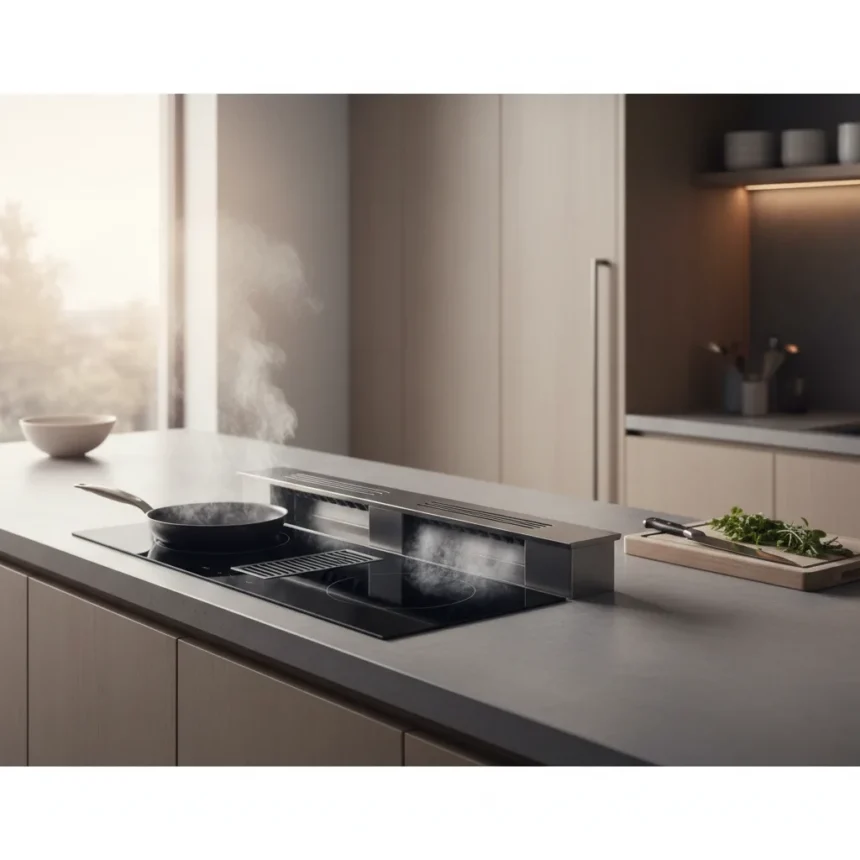
Miele’s downdraft extractor hoods finally bring a practical solution to one of induction cooking’s most persistent problems: extracting steam, smoke, and odors without an obstructive overhead hood dominating the kitchen. After unveiling the technology at IFA, the German appliance maker is now moving these hoods into full production and market launch.
Key Takeaways
- Downdraft extractor hoods sit at or near the cooking surface rather than overhead, capturing cooking byproducts where they originate.
- Miele’s design addresses a major limitation of traditional induction hobs paired with standard overhead extraction systems.
- The hoods eliminate the visual bulk of ceiling-mounted extractors, opening up kitchen design possibilities.
- Downdraft extraction works differently from overhead systems, using proximity to the heat source for efficiency.
- The launch follows months of development after the IFA reveal, signaling market readiness.
Why Induction Hobs Have Always Had an Extraction Problem
Induction hobs reshaped stovetop cooking by heating cookware directly through magnetic induction, delivering precise temperature control and energy efficiency. But they introduced a ventilation challenge that overhead extractors struggle to solve effectively. Traditional range hoods mounted above the cooktop work by pulling rising heat and steam upward—a design that assumes convection patterns created by gas or electric coil heat. Induction generates intense, localized heat directly in the pan, not ambient warmth that naturally rises. This mismatch means overhead hoods often miss a significant portion of cooking fumes before they disperse into the kitchen.
The result? Induction hob owners face a dilemma: install an oversized, expensive overhead extractor that may still underperform, or accept compromised air quality and lingering cooking odors. Neither option is ideal, especially in modern kitchens where clean lines and minimalist aesthetics matter as much as functionality.
How Downdraft Extractor Hoods Change the Game
Miele’s downdraft extractor hoods operate on a fundamentally different principle. Instead of relying on rising heat, they position extraction directly at the cooking surface, capturing steam and smoke at their source before they have a chance to spread. This proximity-based approach is inherently more efficient for induction cooking because it intercepts fumes the moment they’re generated, not after they’ve already begun dispersing into the kitchen air.


The downdraft design also eliminates the visual footprint of a traditional overhead hood. For kitchens where the cooktop is an island or a focal point, removing a bulky extractor overhead opens up sightlines and design flexibility. The kitchen no longer revolves around accommodating ventilation infrastructure—the ventilation adapts to the kitchen’s layout instead.
Downdraft Extraction vs. Traditional Overhead Systems
The practical difference between these two approaches matters significantly for induction users. Overhead extractors rely on convection and air movement patterns that work well with gas flames or radiant heat but are less effective with induction’s concentrated magnetic heating. Downdraft systems, by contrast, are engineered specifically for cooktops that generate intense, localized heat. They capture fumes at point of origin, reducing the volume of air that needs to be moved and processed to achieve the same result.



Traditional overhead hoods also require ceiling space, ductwork integration, and aesthetic compromises in kitchen design. Downdraft hoods, positioned at counter level or integrated into the cooktop surround, offer installation flexibility and visual discretion. For renovations or new builds, this architectural advantage can simplify kitchen planning and reduce construction complexity.
What This Means for Induction Hob Owners
For anyone using or considering an induction hob, Miele’s downdraft extractor hoods represent a maturation of the induction cooking category. The technology removes a genuine functional barrier that has limited induction adoption in kitchens where ventilation is a priority. It also signals that appliance makers are actively solving real-world problems rather than simply releasing incremental updates.
The move from IFA announcement to production launch indicates Miele has worked through engineering and manufacturing challenges. This is not vaporware—it is a product ready for kitchens. For consumers weighing induction hobs against gas or electric alternatives, the availability of purpose-built extraction removes a significant disadvantage that previously favored other cooktop types.
Is Miele’s downdraft extractor hood compatible with all induction hobs?
The research brief does not specify compatibility details, model numbers, or integration requirements. Compatibility depends on the specific hood model and hob design. Miele’s documentation and sales team will clarify which hoods work with which cooktops and kitchen configurations.



How does downdraft extraction compare to overhead hoods in terms of noise?
Downdraft systems operate at the cooking surface, which can affect noise perception differently than overhead hoods. Proximity to the noise source may make some users more aware of fan operation, while others appreciate the reduced visual clutter overhead. Actual noise levels depend on the specific model’s fan design and power rating.
What kitchen layouts work best with downdraft extractor hoods?
Downdraft hoods excel in kitchens where the induction hob is an island, peninsula, or focal point—layouts where overhead extraction would create visual obstruction. They also work well in kitchens with low ceilings or open-plan designs where a traditional hood would feel cramped. Kitchens with limited ductwork infrastructure may find downdraft installation simpler than retrofitting overhead systems.
Miele’s downdraft extractor hoods represent a genuine advancement for induction cooking, finally delivering extraction that matches the technology’s heating approach rather than forcing induction into a gas-era ventilation paradigm. If you have been holding back on induction because of extraction concerns, this is the solution that changes the calculus.
Edited by the All Things Geek team.
Source: T3