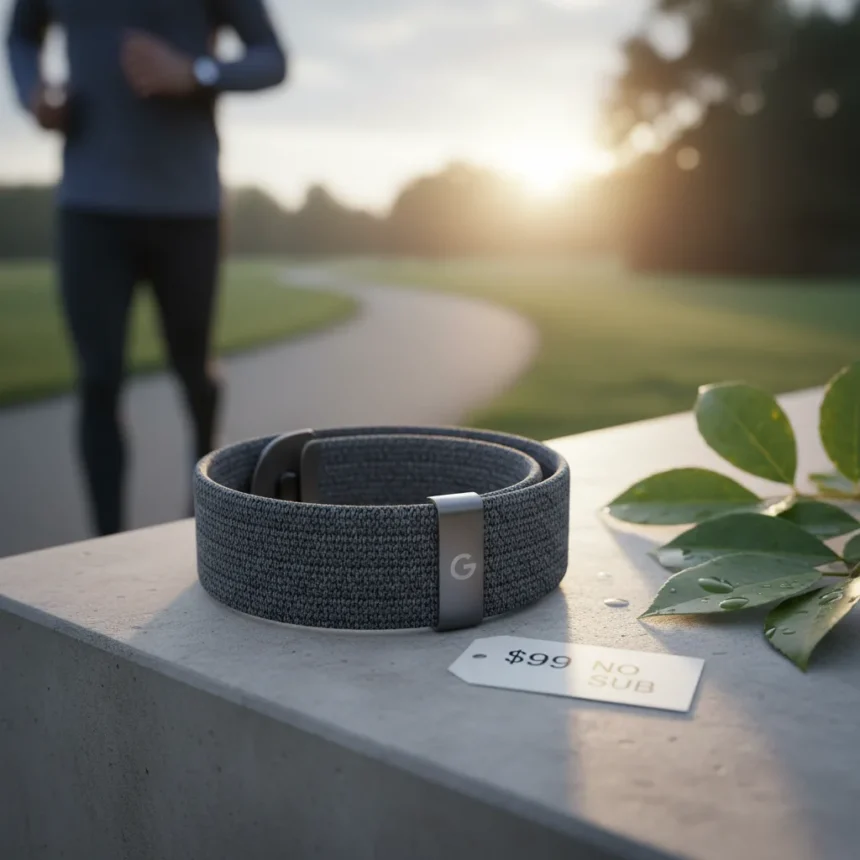
The Fitbit Air fitness tracker is Google’s new screenless wearable device, priced at $99 with no mandatory subscription, launching May 26, 2026. After early hands-on testing, reviewers are already impressed by its simplicity and value proposition in a market dominated by expensive subscription-based alternatives.
Key Takeaways
- The Fitbit Air costs $99 with no required subscription, undercutting premium wearables significantly.
- The device is screenless, weighing roughly 5 grams on its own and about 12 grams with a band.
- Battery life reaches up to seven days per charge, minimizing frequent charging hassles.
- It tracks sleep stages, heart rate, heart rate variability, and oxygen saturation.
- The tracker is compatible with both Android and iOS, syncing data through the Google Health app.
Why the Fitbit Air fitness tracker matters now
Google’s Fitbit Air fitness tracker arrives at a critical moment when consumers are rejecting expensive subscription-based wearables. The device undercuts premium trackers like Whoop, which require ongoing monthly fees, by offering core wellness features without mandatory subscriptions. This positions the Fitbit Air as the entry point for users who want serious health insights without the financial commitment that has kept many people from adopting wearables in the first place.
The screenless design is the key differentiator. By eliminating a display, Google reduced manufacturing complexity and cost while paradoxically improving the user experience for people who simply want to track metrics passively rather than stare at notifications. Early testers report the simplicity feels refreshing in an era of smartwatch bloat.
Fitbit Air fitness tracker: what makes it stand out
The Fitbit Air fitness tracker delivers three core advantages that explain the early enthusiasm. First, the seven-day battery life eliminates the charging anxiety that plagues smartwatch users. Second, the no-subscription model means the $99 purchase is genuinely all-in—no recurring $10 monthly fees that inflate the real cost. Third, the device is small enough to wear comfortably during sleep tracking without the bulk of traditional fitness watches.


The tracker flags irregular heart rhythms and monitors atrial fibrillation, adding a safety layer beyond basic step counting. It syncs all data through the Google Health app, creating a unified ecosystem for users already invested in Android or Google services. The device works across both Android and iOS, though the experience is tighter on Android where Google’s ecosystem integration runs deepest.
How the Fitbit Air compares to alternatives
Against Whoop, the Fitbit Air wins decisively on price and subscription structure. Whoop demands a monthly commitment and targets serious athletes; the Fitbit Air targets everyday health-conscious users. The screenless design also differentiates it from the Pixel Watch, which offers full smartwatch functionality at a higher price point. The Fitbit Air succeeds precisely because it refuses to compete on features—it competes on simplicity and value, two things the wearable market has neglected.



The device is positioned as the smallest Fitbit ever made, making it genuinely pocketable or wrist-wearable without the visual weight of larger trackers. This matters for users who find traditional fitness watches too chunky or fashion-incompatible for daily wear across work, gym, and casual settings.
Fitbit Air fitness tracker: availability and pricing
The Fitbit Air is available for preorder on Amazon now, shipping May 26, 2026. The $99 price includes the tracker and band. No subscription is required to access basic tracking, though Google offers trial access to Google Health Premium, with continued access costing $9.99 per month or $99.99 annually for those who want expanded insights.
Availability is currently confirmed for the US market, with international rollout details still emerging. The device’s screenless design and global health app integration suggest broader availability is likely, though specific regional pricing and launch timing remain unconfirmed.
Is the Fitbit Air worth buying?
For users tired of subscription wearables and smartwatch complexity, the answer appears to be yes. The Fitbit Air trades screen convenience for simplicity and price—a trade that makes sense for anyone who views wearables as health tools rather than notification devices. The seven-day battery life alone justifies the purchase for people who resent constant charging.



Does the Fitbit Air require a subscription?
No subscription is required. The $99 price grants full access to core tracking features including sleep, heart rate, and workout data. Google Health Premium is optional, offering expanded insights for $9.99 monthly or $99.99 annually.
How long does the Fitbit Air battery last?
The Fitbit Air delivers up to seven days of battery life per charge, significantly outlasting most smartwatches and reducing charging friction to near-zero for typical weekly wear patterns.
The Fitbit Air succeeds because it rejects the arms race of features and subscriptions that has made wearables complicated and expensive. For $99 with no strings attached, it offers legitimate health tracking in a package small enough to disappear into your wrist. In a market where premium trackers cost three times as much and demand monthly fees, that simplicity is revolutionary.
Where to Buy
Fitbit Air: | $34.99 via Amazon
Edited by the All Things Geek team.
Source: Tom's Guide