





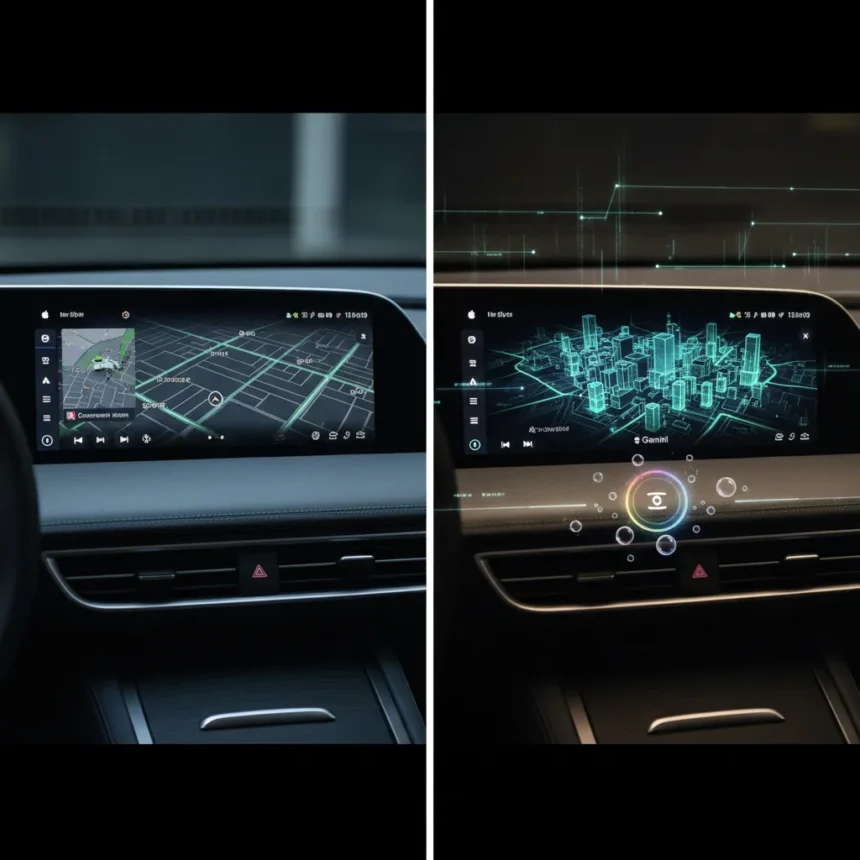
Google’s next-generation Android Auto redesign represents a fundamental shift in how drivers interact with their vehicles, introducing capabilities that make Apple CarPlay look dated by comparison. The redesign brings two major upgrades to the in-car experience: 3D Immersive Navigation and agentic Gemini-powered car controls that fundamentally change what drivers can accomplish hands-free.
Key Takeaways
- 3D Immersive Navigation is the headline feature of Google’s next-generation Android Auto redesign.
- Agentic Gemini car controls enable voice-driven vehicle management without traditional menu navigation.
- The redesign positions Android Auto as a direct competitor to Apple CarPlay’s ecosystem dominance.
- Early hands-on testing confirms the new interface delivers a significant leap over the previous generation.
- Google’s approach to in-car AI integration outpaces Apple’s current CarPlay functionality.
What Makes the Next-Generation Android Auto Redesign Stand Out
The next-generation Android Auto redesign moves beyond simple app mirroring to create an immersive driving interface. Google’s focus on 3D Immersive Navigation transforms how drivers visualize routes, replacing flat 2D maps with spatial, three-dimensional guidance that makes navigation more intuitive and visually compelling. This is not a minor cosmetic update—it represents a fundamental rethinking of how in-car software should present information to drivers.
The agentic Gemini car controls layer adds genuine intelligence to the system. Rather than tapping through menus or reading off specific voice commands, drivers can now use conversational language to control vehicle functions. Ask Gemini to adjust the cabin temperature, change the music, or find a restaurant, and the system understands context and executes tasks without requiring exact command syntax. This bridges the gap between what drivers want to do and what the car actually does.
How the Next-Generation Android Auto Redesign Compares to Apple CarPlay
Apple CarPlay remains the industry standard, but it is also showing its age. CarPlay’s interface relies on app-based navigation and manual control inputs that feel increasingly clunky compared to what Google is now offering. The next-generation Android Auto redesign does not just match CarPlay’s capabilities—it moves the conversation forward by introducing features CarPlay has not yet attempted at scale.


Where CarPlay excels is in ecosystem integration with iPhones and the seamless handoff between devices. However, that advantage narrows when the vehicle itself becomes the primary interface, which is exactly what Google’s redesign accomplishes. The 3D navigation system and agentic controls reduce dependency on the phone as an intermediary, making the car smarter and more responsive. This is a philosophical shift: Google is building for the car, not just mirroring the phone.
CarPlay’s voice control through Siri remains functional but limited. Siri requires specific phrasing and does not learn from context the way Gemini’s agentic approach does. A driver in a CarPlay car must still navigate menus for complex tasks; a driver in the next-generation Android Auto redesign can simply speak naturally and let the system figure out the intent.



The 3D Immersive Navigation Feature Explained
3D Immersive Navigation is the visual centerpiece of the redesign. Traditional navigation apps show a flat overhead map with a blue dot representing the car’s position. The next-generation Android Auto redesign replaces this with a spatial, three-dimensional rendering of the road ahead, surrounding buildings, and upcoming turns. This approach reduces cognitive load—drivers can see the actual shape of the intersection they are approaching rather than interpreting a symbolic representation.
This feature has practical safety benefits. Drivers who can see a 3D preview of a complex interchange are less likely to miss their exit or make sudden lane changes. The immersive approach also makes driving feel less like operating a GPS and more like having a co-pilot who sees the road the same way you do. For long road trips or unfamiliar cities, this difference is substantial.
Agentic Gemini Controls: What This Means for Drivers
Agentic Gemini integration is where the next-generation Android Auto redesign truly diverges from CarPlay. Traditional voice assistants operate on a command-response model: you say exactly what you want, the system does it. Agentic systems work differently. They understand the goal behind your request and can break multi-step tasks into smaller actions without requiring you to specify each step.
In practical terms, a driver could say something like, “I’m getting tired, find me a hotel nearby with good reviews and book a room for tonight.” A traditional voice assistant would struggle with this because it requires understanding context (you are driving), inferring intent (you want to stop soon), and executing multiple discrete actions (search, filter, book). Gemini’s agentic approach handles this kind of conversational complexity naturally. This is not just incremental improvement—it is a different category of in-car assistant.



Early Testing Confirms the Leap Forward
Hands-on testing of the next-generation Android Auto redesign demonstrates that Google has closed the gap on interface polish and responsiveness. The system responds quickly to voice commands, the 3D navigation renders smoothly even on older hardware, and the overall experience feels cohesive rather than cobbled together from different apps. This level of integration was missing from previous Android Auto iterations, which often felt like a phone interface forced into a car context.
The redesign also addresses a long-standing complaint about Android Auto: fragmentation. Different car manufacturers implemented Android Auto differently, leading to inconsistent experiences. The next-generation redesign appears to standardize the interface more tightly, ensuring that a driver switching between vehicles experiences similar functionality and layout. This consistency matters for muscle memory and safety.
Why This Matters Now
In-car software is becoming a major differentiator for vehicle manufacturers. Drivers spend significant time in their cars, and a clunky infotainment system erodes the ownership experience more than most people realize. Apple’s dominance in CarPlay gave them an unfair advantage—iPhone users got a polished, integrated experience while Android users often got fragmented, poorly-maintained implementations. The next-generation Android Auto redesign levels this playing field.
Google’s investment in 3D navigation and agentic AI also signals where the industry is heading. Autonomous driving is still years away for most consumers, but semi-autonomous features and intelligent assistance are here now. The next-generation Android Auto redesign positions Google to lead in this space, offering drivers capabilities that feel genuinely futuristic rather than just iterative improvements.
Will the next-generation Android Auto redesign be available on all vehicles?
The research brief does not specify rollout timelines or vehicle compatibility details. Early access appears limited to testing partners, with broader availability expected to follow. Adoption will likely depend on individual car manufacturers integrating the new system, similar to how CarPlay requires manufacturer support.
How does the next-generation Android Auto redesign handle offline navigation?
The research brief does not detail offline capabilities. Given that 3D Immersive Navigation relies on rendering spatial data, offline functionality would require significant local storage. This is an area where traditional 2D maps have an advantage, though Gemini’s integration might allow for hybrid approaches.
Can you use the next-generation Android Auto redesign with older Android phones?
Compatibility requirements are not specified in the available information. The agentic Gemini integration suggests minimum processing power requirements, but specific device or Android version minimums are not confirmed in the research brief.
The next-generation Android Auto redesign is Google’s answer to years of playing second fiddle to Apple CarPlay. By introducing 3D navigation and conversational AI controls, Google has moved beyond matching Apple’s feature set to defining what modern in-car software should actually do. For Android users tired of inferior infotainment experiences, this redesign is a long-overdue victory.
Edited by the All Things Geek team.
Source: Tom's Guide




