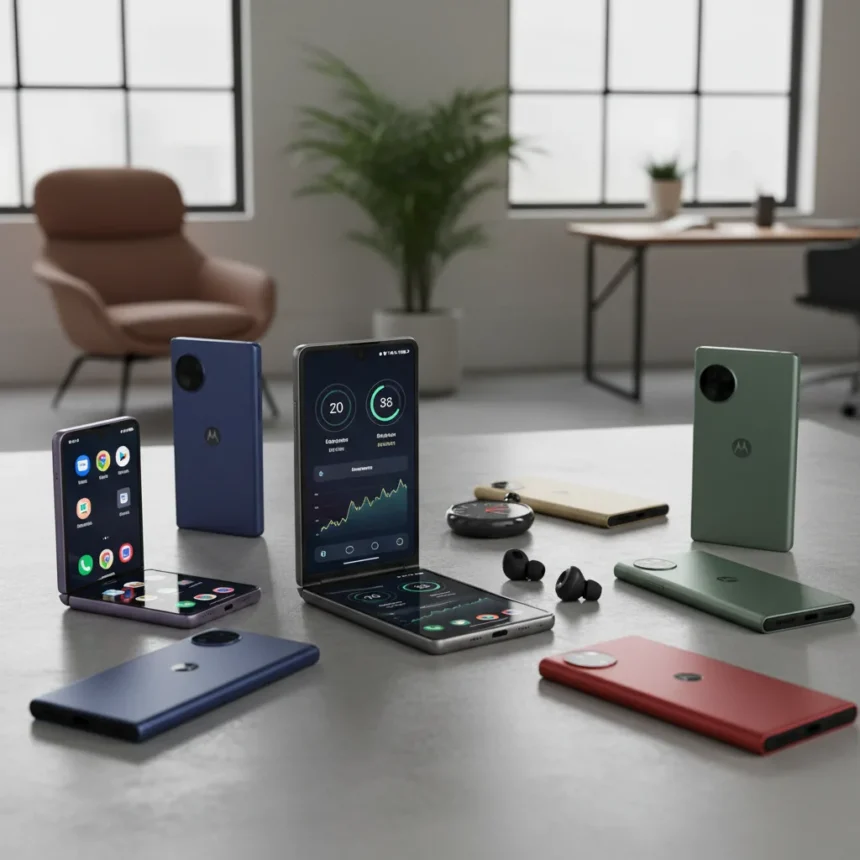
The Motorola Razr 2026 lineup is Motorola’s answer to Samsung’s dominance in foldable phones, and after a week of hands-on testing across all four models, the verdict is complicated. The most expensive option—the Razr Ultra 2026 at $1,500—is also the most controversial, caught between modest hardware improvements and a price tag that invites comparison to a far more capable alternative just $400 higher.
Key Takeaways
- Motorola’s 2026 Razr lineup includes four foldables ranging from budget to premium tiers.
- The Razr Ultra 2026 costs $1,500 with a 7-inch internal display and 4-inch outer screen.
- The Razr Fold, at approximately $1,900, adds a Snapdragon 8 Elite Gen 5 chipset and triple camera system with 3x optical zoom.
- Core hardware across the 2026 lineup remains largely unchanged from previous generations despite refinements.
- The Razr Ultra’s expensive positioning makes the Razr Fold appear as the more compelling premium choice.
Razr Ultra 2026: Premium Price, Incremental Gains
The Razr Ultra 2026 represents Motorola’s flagship foldable ambition, but at $1,500, it occupies an uncomfortable middle ground. The device features a 7-inch internal display and a 4-inch external screen, making it genuinely spacious for multitasking and content consumption. The hardware feels polished—available in Pantone Orient Blue with an Alcantara finish or Pantone Cocoa with a wood-grain back—but the specifications tell a familiar story. A 5,000 mAh silicon-carbon battery powers the device, paired with 68W wired charging and 30W wireless charging, which is respectable but not revolutionary for a $1,500 phone.
The camera system includes a 50MP main sensor at f/1.8, a 50MP ultrawide at f/2, and a 50MP front-facing camera at f/2. On paper, this is solid. In practice, the Razr Ultra 2026 delivers competent photography without the standout features that justify its premium positioning. The real problem emerges when you consider what Motorola offers just $400 higher in the lineup.
The Razr Fold: Where Value Shifts Dramatically
The Razr Fold upends the Razr Ultra’s value proposition by adding the Snapdragon 8 Elite Gen 5 chipset and a more robust triple camera system that includes a dedicated telephoto lens with 3x optical zoom. For someone willing to spend close to $1,900, the Razr Fold becomes the more thoughtfully engineered choice. The telephoto lens alone addresses a genuine gap in the Razr Ultra’s imaging toolkit—a gap that $400 should close if you’re already paying flagship prices.


This dynamic explains why the Razr Ultra 2026 feels controversial. It is not a bad phone, but it exists in a pricing tier where the next step up delivers measurably more capability. Motorola has created a scenario where the second-most-expensive model in the lineup is harder to recommend than the most expensive one.
The Broader Motorola Razr 2026 Lineup Context
The Motorola Razr 2026 lineup extends below the Ultra with more affordable flip-style foldables, though the exact specifications and pricing of those entry-level models remain less defined in the available testing data. What matters is the architecture: Motorola has built a four-tier system where hardware refinements exist, but core technology remains largely unchanged across the range. This is not inherently a weakness—incremental improvement is standard in the phone industry—but it means buyers at every price point are getting a mature, stable foldable experience rather than a revolutionary leap.



The Razr Plus 2026 sits between the base model and the Ultra, occupying the middle-market position where most foldable buyers actually make their decision. Without full specification details from the testing period, the strategic play appears to be pushing users toward either the Ultra for maximum display size or toward the Fold for maximum capability.
Design and Durability: Where Motorola Competes
Foldable durability remains a concern for the entire category, and the Motorola Razr 2026 lineup does not dramatically change the equation. The devices are built to last through normal use, but the crease is still visible, the hinge still represents a potential failure point, and the gap between the two halves is still present. Samsung’s Galaxy Z Fold series has spent years refining these elements, and Motorola has not yet closed that gap with the 2026 generation.
What Motorola does offer is a different form factor philosophy. The Razr Ultra 2026, with its 4-inch external display, lets you interact with notifications and quick tasks without opening the phone fully. Samsung’s approach prioritizes the large inner display. Neither is objectively better—they serve different use cases. But if you spend time on your phone’s exterior screen, the Razr Ultra’s larger outer panel makes practical sense.
Which Model Should You Actually Buy?
The testing revealed a clear hierarchy. If you want the largest foldable experience and can justify $1,500, the Razr Ultra 2026 delivers. If you want the best-engineered foldable in Motorola’s lineup and can stretch to $1,900, the Razr Fold is the smarter choice. The jump to the Fold’s Snapdragon 8 Elite Gen 5 and telephoto lens represents genuine capability gain, not just a spec-sheet bump.



For budget-conscious buyers, the entry-level Razr 2026 models provide foldable technology without the Ultra’s premium pricing. The trade-off is smaller displays and fewer camera features, but the core foldable experience remains intact.
Does the Razr Ultra 2026 justify its $1,500 price?
The Razr Ultra 2026 is a capable foldable with a large 7-inch display and solid cameras, but the $400 price gap to the Razr Fold makes it harder to recommend. The Fold’s Snapdragon 8 Elite Gen 5 and telephoto lens represent meaningful upgrades that justify the additional cost for power users and photography enthusiasts.
How does the Motorola Razr 2026 lineup compare to Samsung’s Galaxy Z Fold?
The Motorola Razr 2026 lineup offers a different design philosophy with larger external displays, particularly on the Ultra model. Samsung’s Galaxy Z Fold prioritizes the inner screen experience. Both are mature foldable systems, but Samsung currently leads in durability refinements and ecosystem integration. Motorola competes on form factor innovation and pricing flexibility across its four-tier lineup.
What is the battery life on the Razr Ultra 2026?
The Razr Ultra 2026 uses a 5,000 mAh silicon-carbon battery with 68W wired and 30W wireless charging. Specific battery life figures in hours were not provided during the testing period, but the capacity is competitive with other flagship foldables. Real-world endurance depends heavily on display usage patterns—the large 7-inch inner screen will consume more power during extended multitasking sessions.
The Motorola Razr 2026 lineup demonstrates that Motorola understands foldable design, but pricing discipline remains a challenge. The Razr Ultra 2026 is not the phone to buy—the Razr Fold is. For everyone else, the entry-level models offer genuine foldable innovation without the flagship tax.
Edited by the All Things Geek team.
Source: Tom's Guide