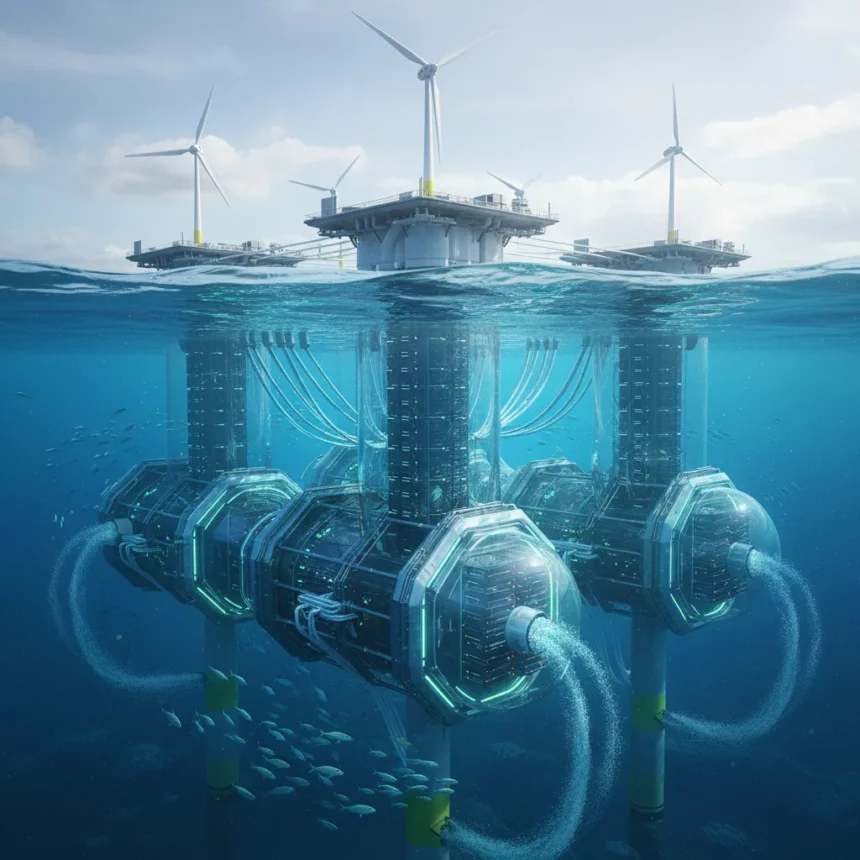
Underwater data center technology refers to the deployment of server infrastructure in subsea pressure-resistant modules, using surrounding seawater as a passive cooling mechanism. China’s new facility in the Lingang Special Area near Shanghai, which entered full commercial operation in late 2025 after an official launch in June 2025, reportedly combines this approach with direct power from nearby offshore wind farms — a combination its developers describe as a world first.
Key Takeaways
- The facility houses nearly 2,000 servers across a 24 MW total capacity, deployed roughly 35 metres beneath the ocean surface.
- Developers claim a Power Usage Effectiveness (PUE) below 1.15, compared to the 1.5 or higher typical of conventional enterprise data centers.
- The cooling system operates without external power, using buoyancy and gravity to circulate refrigerant between servers and a seawater heat exchanger.
- Developer-claimed reductions include 22.8% lower electricity consumption and over 90% less land usage versus comparable land-based facilities.
- The project scaled from a 2.3 MW demonstration facility to its current 24 MW commercial capacity.
Why the underwater data center near Shanghai matters right now
AI workloads are consuming electricity at a pace that has caught the data center industry off guard. Cooling alone accounts for a significant share of that consumption, and conventional approaches — industrial chillers, massive HVAC arrays, water-hungry cooling towers — are straining both power grids and freshwater supplies. The Lingang facility is a direct response to that pressure, and its timing is deliberate.
The facility processes artificial intelligence, big data annotation, and 5G infrastructure workloads, with GPU clusters from China Telecom and LinkWise handling the compute load. That’s not a research demo. Those are production workloads, which means the subsea environment is being stress-tested against real-world AI demand rather than controlled laboratory conditions.
The project began modestly. A 2.3 MW demonstration facility came first, proving the concept before the developers committed to the current 24 MW commercial scale. That staged approach matters — it’s the difference between a press release and an engineering programme.


How the seawater cooling system actually works
The cooling mechanism inside the underwater data center requires no pumps or compressors to move heat away from the servers, according to a representative from HiCloud Technology. Backplane air conditioners draw hot air from the servers and convert refrigerant from liquid to gas. That gas rises naturally to the upper module’s cooling layer due to buoyancy, where a heat exchanger transfers the heat to the surrounding seawater. The refrigerant then condenses back to liquid and returns to the server room under gravity, completing the cycle.
The elegance of that design is worth pausing on. A cooling loop that relies entirely on buoyancy and gravity — with no external power input — is architecturally simpler than anything running in a conventional land-based facility. Fewer moving parts means fewer failure points. The ocean provides an effectively unlimited cold sink at 35 metres depth, where water temperatures are stable year-round in ways that ambient air temperatures simply are not.



Developers claim the system reduces electricity consumption by 22.8% and cuts freshwater use, though neither figure has been independently audited. The land-use reduction claim — over 90% compared to equivalent land-based infrastructure — is more straightforwardly credible given that the modules sit on the seabed rather than occupying surface real estate near an increasingly land-constrained city like Shanghai.
How does this underwater data center compare to land-based alternatives?
The reported PUE of below 1.15 is the number that should get data center operators paying attention. PUE measures how much total energy a facility consumes relative to what its servers actually use — a score of 1.0 would be perfect, meaning zero overhead. Conventional enterprise data centers commonly operate at 1.5 or higher, meaning for every unit of energy the servers use, another half-unit is lost to cooling and other overhead.
A PUE below 1.15 puts this facility in the same efficiency range as the most advanced hyperscale land-based data centers operated by major cloud providers, which have spent billions optimising their cooling infrastructure over decades. The difference is that the Lingang facility reportedly achieves that figure through passive seawater cooling rather than sophisticated active systems — and it does so while also eliminating the freshwater consumption that water-cooled land-based facilities require.
The comparison with conventional infrastructure isn’t entirely straightforward. Land-based data centers can be built, expanded, and decommissioned with far more flexibility than a subsea module. Maintenance access at 35 metres underwater is a genuine engineering challenge that the developers have not publicly addressed in detail. And the claim of being the world’s first offshore wind-powered underwater data center, while reported by Chinese media, has not been independently verified.



Is China’s underwater data center model replicable globally?
The Lingang Special Area sits adjacent to both the East China Sea and one of the world’s busiest port corridors, which makes it an unusually convenient location for a subsea deployment. Not every coastal region combines accessible offshore wind resources, suitable seabed depth, and proximity to high-density compute demand the way the Shanghai coast does. Replicating this model in the North Sea, the Gulf of Mexico, or Southeast Asian coastal zones would require site-specific engineering that the Chinese project’s specifications don’t automatically transfer to.
That said, the underlying principle — use the ocean as a free cooling resource and co-locate with offshore renewable generation — is geographically portable in ways that, say, building a data center next to a hydroelectric dam is not. Offshore wind capacity is expanding across Europe, East Asia, and the US Atlantic coast. The question isn’t whether the physics work. It’s whether the operational economics and maintenance logistics hold up at scale over years, not months.
Is the PUE figure below 1.15 independently verified?
No. The PUE figure below 1.15 is a developer claim reported by Chinese media, not an independently audited result. Independent verification of data center efficiency metrics typically requires third-party assessment against a recognised standard. Until that happens, treat the figure as a target or design-intent metric rather than a confirmed operational benchmark.
What workloads does the facility actually run?
The facility is designed to handle AI inference and training workloads, big data annotation tasks, and 5G infrastructure processing. GPU clusters from China Telecom and LinkWise handle the compute. It entered full commercial operation in late 2025 following trials earlier in the year, meaning it is processing live production workloads rather than running in a test configuration.
China’s underwater data center in Lingang is either a glimpse of where AI infrastructure is heading or an expensive proof-of-concept that doesn’t survive contact with long-term operational reality — and right now, the honest answer is that nobody outside the project knows which. What’s clear is that the combination of seawater cooling and offshore wind power addresses two of the most pressing constraints facing data center operators worldwide. Whether the maintenance costs, subsea logistics, and site-specific requirements make it viable beyond China’s coastline is the question the next five years will answer.
Edited by the All Things Geek team.
Source: TechRadar