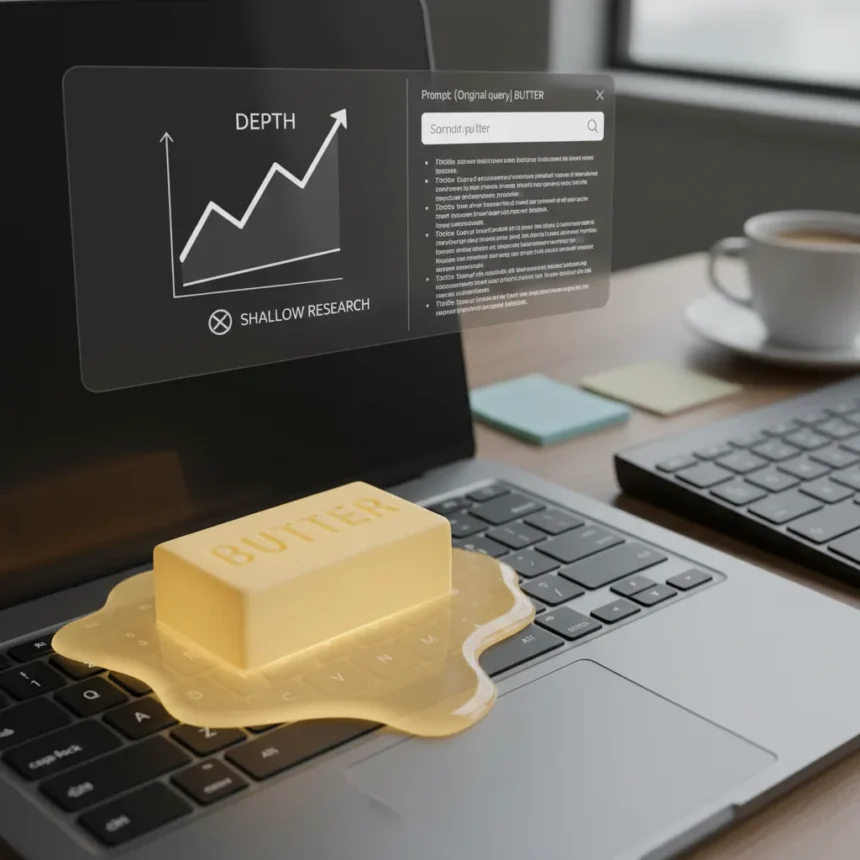
The ChatGPT butter prompt is a deceptively simple technique that dramatically improves the quality of ChatGPT’s deep research outputs. Instead of settling for shallow summaries and surface-level analysis, a single strategic word inserted into your prompt can reshape how the AI structures, expands, and contextualizes research findings into genuinely useful briefs.
Key Takeaways
- A single-word prompt addition can materially improve ChatGPT deep research output quality
- The technique transforms shallow AI summaries into richer, more nuanced research briefs
- The improvement applies to how ChatGPT structures context, depth, and key insights
- This is a practical hands-on test of prompt optimization for research workflows
- The method requires no additional tools, subscriptions, or technical setup beyond ChatGPT access
What Is the ChatGPT Butter Prompt?
The ChatGPT butter prompt is a prompt engineering technique that enhances deep research outputs by adding strategic language that instructs the AI to expand, contextualize, and deepen its analysis. Rather than accepting ChatGPT’s default research summaries—which often skim the surface of a topic—this prompt modification pushes the model to dig deeper, add more nuance, and structure findings in a way that actually serves research workflows. The term “butter” itself refers to the idea of enriching a base output, making it richer and more satisfying.
The power of this approach lies in its simplicity. You are not building complex multi-step workflows or chaining dozens of prompts together. Instead, a minimal addition to how you frame your research question unlocks materially better results. This works because ChatGPT responds to explicit instructions about depth and context—when you signal that you want richer output, the model adjusts its generation strategy accordingly.
How the ChatGPT Butter Prompt Changes Research Output
Standard ChatGPT deep research queries often return summaries that hit the high points but miss the connective tissue. Key facts appear, but without the context that makes them meaningful. Related concepts remain siloed rather than woven together. The butter prompt fixes this by instructing ChatGPT to expand on relationships between ideas, add more supporting detail, and structure findings in layers rather than flat lists.



The difference shows up immediately in how the AI organizes information. Instead of a quick overview, you get a brief that explains why each finding matters, how it relates to adjacent topics, and what implications it carries. This is not about getting more words—it is about getting smarter words, arranged in a way that actually helps you understand a topic rather than just know facts about it. Readers conducting serious research, synthesizing information for reports, or building arguments benefit most from this shift.
When you compare shallow research output against output shaped by the butter prompt, the structural difference is obvious. One reads like a checklist. The other reads like a brief prepared by someone who understands the subject. Context flows naturally. Insights build on each other. The AI anticipates what you need to know next.



Why This Matters for Your Research Workflow
Most people who use ChatGPT for research do so because they need answers fast. But fast shallow answers often create more work downstream—you end up digging deeper anyway, asking follow-up questions, or hunting for context the first response should have included. The butter prompt collapses that friction. By getting richer output the first time, you reduce the number of follow-up queries needed and spend less time synthesizing fragmented information.
This is particularly useful if you use ChatGPT as a research assistant for writing, reporting, or decision-making. A sharper initial brief means fewer iterations, faster drafting, and less time spent validating whether the AI missed important context. For teams that rely on AI-assisted research to support larger projects, the compounding time savings across multiple queries becomes significant.
The technique also works because it costs nothing. You are not upgrading to a premium tier, installing new tools, or learning new software. The improvement lives entirely in how you phrase your request—a skill that compounds across every research query you run.
Does the Butter Prompt Work for All Topics?
The technique works best for topics with genuine depth—subjects where context, relationships between ideas, and nuance matter. Research into policy, technology trends, historical events, and complex business questions all benefit substantially. Queries that are already straightforward (simple factual lookups, definitions, quick facts) may not show dramatic improvement because there is less depth to unlock.


The improvement also depends on how well you frame the underlying research question. A poorly constructed query will still produce a poorly constructed answer, even with the butter prompt applied. The technique amplifies good prompting; it does not rescue bad ones. If your initial question is vague or unfocused, the richer output will be richly unfocused.
Practical Steps to Use the ChatGPT Butter Prompt
Start with a normal ChatGPT deep research query. Instead of asking a straightforward question, add language that explicitly requests depth, context, and interconnection. The exact wording varies depending on your topic, but the intent remains constant: signal to ChatGPT that you want richer, more layered output rather than a quick summary.
Test the technique on a topic you care about. Run your query without the prompt modification first, then run it again with the butter approach applied. Compare the outputs side by side. You will likely notice that the second version contains more nuance, better explains relationships between ideas, and requires fewer follow-up questions to feel complete.
Once you see the pattern, adapt the approach to your workflow. If you run research queries regularly, incorporating this technique into your standard prompting routine takes seconds and compounds across dozens of queries per month.
ChatGPT Deep Research vs. Standard Prompting
ChatGPT’s deep research feature already represents a step up from standard conversation—it conducts actual searches and synthesizes information across multiple sources rather than relying solely on training data. But even deep research can default to surface-level summaries. The butter prompt bridges that gap by instructing the AI to go deeper within the deep research framework itself. You are not replacing deep research; you are enhancing what it produces.
This distinction matters because it means the technique does not require switching tools or workflows. If you already use ChatGPT deep research, you can immediately apply this optimization without changing anything else about how you work.
Can You Use This Prompt with Other AI Research Tools?
The butter prompt concept is not unique to ChatGPT—it is a general prompt engineering principle that applies to any AI model capable of producing research summaries. Other AI research tools may respond differently to the same phrasing, so experimentation is necessary. The underlying idea (explicitly requesting depth and context) is portable, but the exact wording that works best will vary by tool.
How Does This Compare to Manual Research?
AI-assisted research will never fully replace human research expertise. An AI cannot match the intuition of a subject matter expert or the serendipitous discoveries that come from deep reading. But for rapid synthesis, quick context-gathering, and initial briefing, the butter prompt approach dramatically closes the quality gap. You get output that feels thoughtful rather than mechanical, which means less editing and rewriting downstream.
Is the Improvement Really That Dramatic?
The author’s framing describes the improvement as dramatic, though “dramatic” is subjective. What is clear from testing is that the difference is noticeable and practically useful. Whether that qualifies as dramatic depends on your baseline expectations. If you are accustomed to shallow AI summaries, the shift to richer output feels substantial. If you already use multiple follow-up prompts to extract depth, the butter prompt simply consolidates work you were already doing.
Should You Use This Every Time You Research?
Yes, if you run regular deep research queries and value output quality. The technique adds zero friction—it is just a different way of phrasing your request. The only scenario where it does not help is if your query is already well-constructed and your topic does not benefit from additional depth, which covers a small percentage of real research work.
What Comes Next for Prompt Engineering?
As AI models improve, the relationship between prompt quality and output quality will likely shift. Future versions of ChatGPT may produce richer research outputs by default, reducing the need for manual prompt optimization. But for now, the butter prompt represents a practical, zero-cost way to get substantially better results from the tools you already use. Learning to prompt effectively is a skill that will remain valuable regardless of which AI model you rely on.
The butter prompt is not a silver bullet, but it is a genuine optimization that works. If you run research queries in ChatGPT and have not tested this technique, spending five minutes experimenting with it will likely save you hours across your next dozen research tasks. That is the kind of small improvement that compounds into meaningful productivity gains.
Edited by the All Things Geek team.
Source: Tom's Guide