





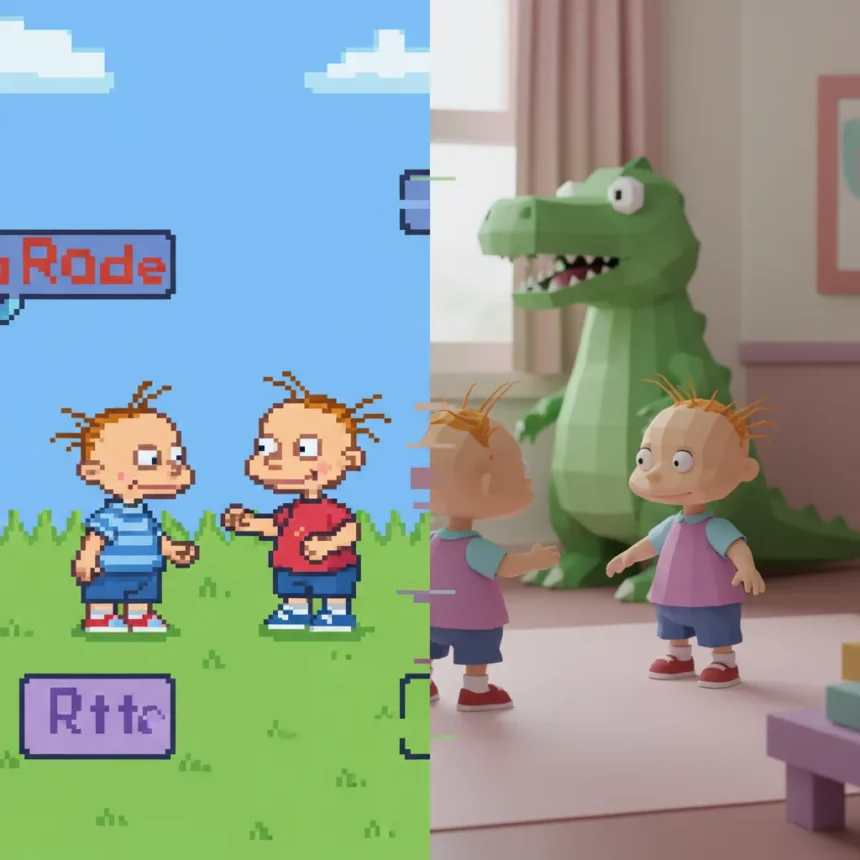
The Rugrats retro game revival is a concept that reimagines the beloved 1990s Nickelodeon cartoon as a video game spanning two distinct visual eras. From 8-bit 2D to low-poly 3D, the project taps into dual waves of gaming nostalgia—the chiptune-era simplicity of early arcade games and the chunky polygonal charm of late-1990s 3D platformers. It is the kind of unexpected revival that catches longtime Rugrats fans completely off guard, repositioning a cartoon franchise into interactive form through a deliberately retro lens.
Key Takeaways
- Rugrats retro game revival combines 8-bit 2D and low-poly 3D visual styles in one project.
- The concept draws on Nicktoons nostalgia and appeals to audiences familiar with both pixel art and early 3D gaming.
- The project repositions a 1990s cartoon franchise into an unexpected video game format.
- Visual design spans two distinct gaming eras, merging arcade-era simplicity with PlayStation-generation aesthetics.
- The revival concept suggests growing appetite for retro-styled games in modern gaming culture.
Why Rugrats as a Retro Game Makes Unexpected Sense
The Rugrats retro game revival works because it targets a specific cultural moment. Audiences who grew up with the cartoon in the 1990s are now old enough to have nostalgia for both the show itself and the games of their childhood—whether that means blowing into NES cartridges or spinning through Crash Bandicoot levels. By wrapping Rugrats in retro game aesthetics rather than updating it to modern 3D graphics, the project leans into authentic period design rather than chasing contemporary visual trends. This approach feels more honest to the source material than a polished remake would.
The visual duality—8-bit 2D paired with low-poly 3D—is particularly clever. It acknowledges that retro gaming was not a single aesthetic moment. Early arcade games and 16-bit home consoles looked nothing like the first PlayStation generation, yet both periods carry equal nostalgic weight for different gaming cohorts. A Rugrats revival that honors both eras simultaneously appeals to a broader slice of the retro-gaming audience than a single-style approach could manage.
The Rugrats Retro Game Revival and Modern Nostalgia Gaming
Nostalgia-driven game revivals have become a reliable market segment. The success of titles that deliberately adopt pixel-art aesthetics or low-poly visual styles demonstrates that players actively seek games that evoke earlier eras rather than games that simply remaster older titles. The Rugrats retro game revival fits into this pattern—it is not a port or a remake of an existing Rugrats game, but a new creative interpretation using visual language that feels authentically rooted in gaming history.



What sets this concept apart is its franchise choice. Rugrats was a cartoon property, not primarily a gaming franchise. Reviving it as a game rather than as an animated reboot or live-action adaptation suggests a creative willingness to explore unconventional medium shifts. Many 1990s cartoons have attempted comebacks through streaming reboots or theatrical films, often with mixed results. Repositioning Rugrats into the gaming space—and specifically into a retro-game aesthetic—is a genuinely different angle that sidesteps the direct competition between legacy animation and modern animation quality.
Visual Design: Bridging Two Gaming Generations
The choice to span both 8-bit 2D and low-poly 3D visual styles is the project’s strongest design decision. Eight-bit graphics conjure the arcade and early home-console era—think Mega Man, Castlevania, or early Super Mario Bros. Low-poly 3D, by contrast, evokes the PlayStation and Nintendo 64 period, when 3D was technically possible but polygon budgets forced a distinctive aesthetic that now reads as charmingly primitive. Together, these two approaches represent roughly three decades of gaming history compressed into a single project.



This dual-aesthetic approach also solves a practical design problem. A purely 8-bit Rugrats game might feel too dated to modern players, while a purely low-poly 3D version could come across as merely nostalgic pastiche. By combining both styles, the project creates visual variety that keeps the experience from feeling one-note. Players encounter both familiar arcade-style sequences and early-3D platforming sections, creating tonal and mechanical diversity within a single nostalgic framework.
Does the Rugrats Retro Game Revival Have a Release Date?
No verified release date, platform, or commercial availability information is currently available for the Rugrats retro game revival. The project exists as a concept rather than a confirmed commercial release with announced launch details.
What Platforms Might the Rugrats Retro Game Revival Target?
Platform information for the Rugrats retro game revival has not been officially announced. The visual design spans retro-era aesthetics, but specific technical requirements or intended distribution channels remain unconfirmed.
How Does This Compare to Other Nicktoons Game Revivals?
The Rugrats retro game revival stands apart by deliberately adopting retro visual styles rather than pursuing modern graphics. Other Nicktoons properties have received game adaptations over the years, but few have chosen to frame their comeback specifically through the lens of gaming nostalgia. This approach prioritizes authenticity to gaming history over technical polish, a choice that inverts the logic of most modern game revivals.



The Rugrats retro game revival represents a refreshing creative choice in an era when most legacy franchises pursue high-fidelity reboots. By embracing retro aesthetics deliberately rather than apologizing for them, the project taps into genuine affection for earlier gaming eras while repositioning a beloved cartoon into an entirely new medium. It is the kind of unexpected move that reminds us nostalgia works best when it is specific, intentional, and willing to take creative risks rather than simply chase brand recognition.
Edited by the All Things Geek team.
Source: Creativebloq