






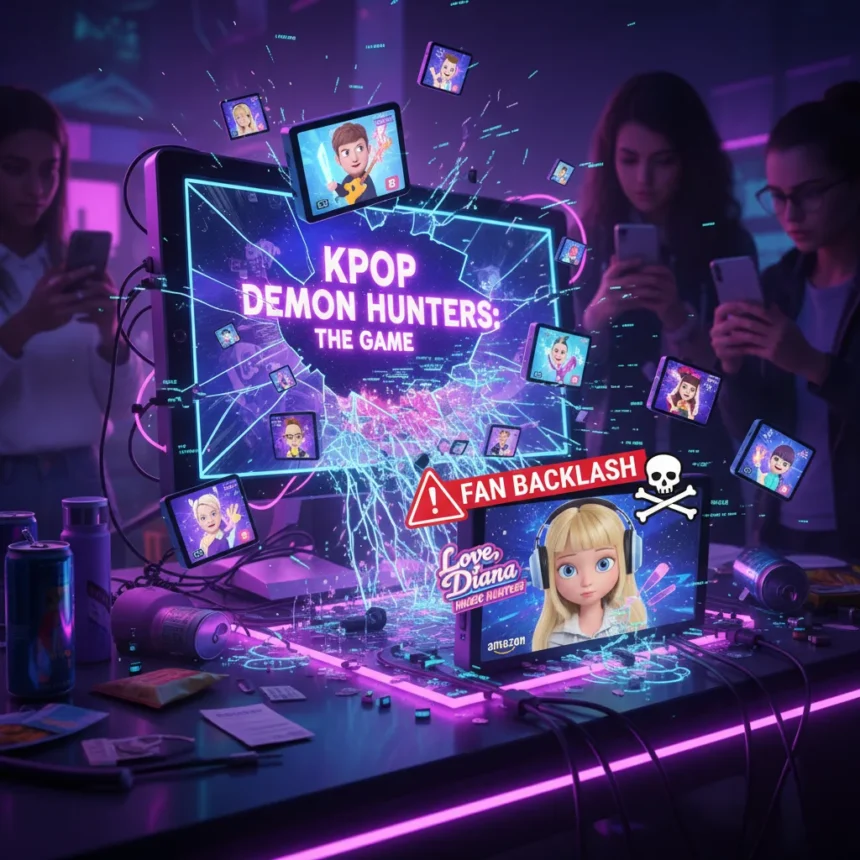
AI animation mockbusters are flooding the KPop Demon Hunters ecosystem, turning what should be a moment of cultural triumph into a minefield of synthetic imitations and fan frustration. Amazon’s Love, Diana Music Hunters exemplifies the problem: a lookalike production designed to piggyback on the success of a genuine breakout hit, using AI tools to manufacture derivative content that exploits viewer confusion and algorithmic visibility.
Key Takeaways
- AI animation mockbusters mimic popular titles to attract viewers and capitalize on existing fanbases.
- Love, Diana Music Hunters transforms a controversial YouTuber into a K-pop idol using AI animation.
- The KPop Demon Hunters ecosystem has been flooded with fake songs, character art, and AI-generated spinoff clips.
- A viral live-action leak attributed to KPop Demon Hunters was later confirmed to be entirely AI-generated.
- Fantasoner, an 80,000-subscriber YouTube channel, produces all its content using AI tools, including fake KPop Demon Hunters derivative material.
What Are AI Animation Mockbusters?
AI animation mockbusters are imitation productions that deliberately echo the titles, aesthetics, and marketing of successful films or shows, using artificial intelligence to generate animation at minimal cost. Unlike official adaptations or licensed spinoffs, mockbusters exist in a gray zone: they are not affiliated with the original property, yet they leverage its cultural momentum to attract clicks and views. The strategy is as old as low-budget filmmaking itself, but AI has weaponized it. Where traditional mockbusters required actual human animators and voice actors, synthetic versions can be produced in days by a single person with access to generative tools.
The KPop Demon Hunters phenomenon makes this problem visible at scale. The property achieved genuine cultural resonance—its song Golden reached a major chart milestone on Billboard’s Hot 100 singles chart—which created enormous incentive for bad actors to flood the ecosystem with imitations. Amazon’s Love, Diana Music Hunters is one of the more brazen examples, a Prime-adjacent production that turns a controversial YouTuber into a K-pop idol, designed to appear as though it belongs in the same universe as the original property.
How AI Animation Mockbusters Exploit Fan Communities
The damage inflicted by AI animation mockbusters goes beyond mere annoyance. These productions actively undermine trust within fan communities by creating plausible-looking derivative content that fans cannot immediately distinguish from official material. A viral live-action leak claiming to be a KPop Demon Hunters adaptation circulated widely before being confirmed as entirely AI-generated, demonstrating how easily audiences can be misled. The psychological effect is corrosive: fans begin to doubt everything they see, from official announcements to fan-created content.


The KPop Demon Hunters ecosystem has been particularly hard hit. Synthetic songs, character art, and spinoff clips flood YouTube and social media, each attracting large view counts and advertising revenue that flows to creators rather than the original property or its actual artists. A channel like Fantasoner, which operates with over 80,000 subscribers and produces exclusively AI-generated content, can manufacture dozens of fake episodes, fake songs, and fake spinoffs in the time it takes legitimate creators to produce a single piece of original work. The economics are inverted: bad-faith actors are rewarded for speed and volume, while artists are punished for quality and authenticity.
Why Amazon’s Love, Diana Music Hunters Sparked Outrage
Amazon’s involvement signals that AI animation mockbusters are no longer the province of low-effort YouTube channels. A major streaming platform betting on synthetic derivative content represents a threshold moment for the industry. Love, Diana Music Hunters is not presented as a parody or homage—it is positioned as a standalone animated series with its own premise, yet its title and aesthetic deliberately echo the original property to capture search traffic and algorithmic recommendations.


The mockbuster strategy relies on confusion. Viewers searching for KPop Demon Hunters content, or encountering the title in recommendation feeds, may click on Love, Diana Music Hunters believing it to be related material. The production quality—acceptable by AI standards but visibly synthetic to trained eyes—does not immediately signal the deception. By the time viewers realize they are watching an imitation, the view count has already registered, the algorithm has already promoted it, and the creator has already captured a slice of attention that should have gone to the original property or legitimate fan creators.
The Broader Threat to Fan Communities and Original IP
If AI animation mockbusters become normalized, the entire ecosystem of fan engagement and original content creation faces systemic degradation. Legitimate creators lose visibility to synthetic noise. Fans waste time on imitations. Original properties see their cultural momentum diluted by a thousand low-effort knockoffs. The problem is not hypothetical—it is already happening across KPop Demon Hunters fan spaces, where real fans must now navigate a landscape where official-looking content might be synthetic, where a song that appears to be from the original property is actually AI-generated, where a live-action leak that seemed to confirm rumors was entirely fabricated.
The distinction between a mockbuster and a legitimate parody or fan work matters. Parodies are transparent about their intent. Fan works are created out of love and typically do not attempt to deceive. Mockbusters, by contrast, deliberately exploit confusion to capture value that does not belong to them. When Amazon or any platform invests in this strategy, it signals that the economics of AI-generated content have shifted enough to make even major studios willing to bet on it.
Is AI animation just another form of fan content?
No. Legitimate fan content is created transparently and does not attempt to deceive audiences about its origin or affiliation. Fan creators typically celebrate the original property and explicitly acknowledge they are not affiliated with it. AI animation mockbusters, by contrast, deliberately exploit confusion and leverage algorithmic systems to capture views and revenue under false pretenses. The intent and transparency are fundamentally different.

How can fans protect themselves from AI animation mockbusters?
Check the creator’s channel history and verified affiliations. Official content comes from verified accounts tied to the original property’s studios or licensed partners. Be skeptical of titles that echo popular properties but add subtle variations. If a video claims to be an adaptation or spinoff, verify it through the official property’s social media or the studio’s website before investing time.
Will streaming platforms continue investing in AI animation mockbusters?
If they prove profitable, yes. The economics are compelling for platforms willing to absorb the reputational risk: AI animation is cheap, derivative content requires minimal creative input, and algorithmic systems reward volume. Unless platforms face significant backlash or regulatory pressure, the incentive structure will continue to favor synthetic mockbusters over higher-cost original or licensed content.
The KPop Demon Hunters backlash is a warning. Fans are not passive consumers—they actively police their communities and punish bad-faith actors. But individual fan resistance cannot compete with algorithmic amplification and studio-backed distribution. If the industry is serious about preserving fan communities and protecting original IP, it needs to establish clear rules about AI-generated derivative content and enforce them consistently. Mockbusters have always existed. AI has simply made them cheaper, faster, and harder to distinguish from the real thing. That is the problem that matters.
Edited by the All Things Geek team.
Source: Creativebloq




