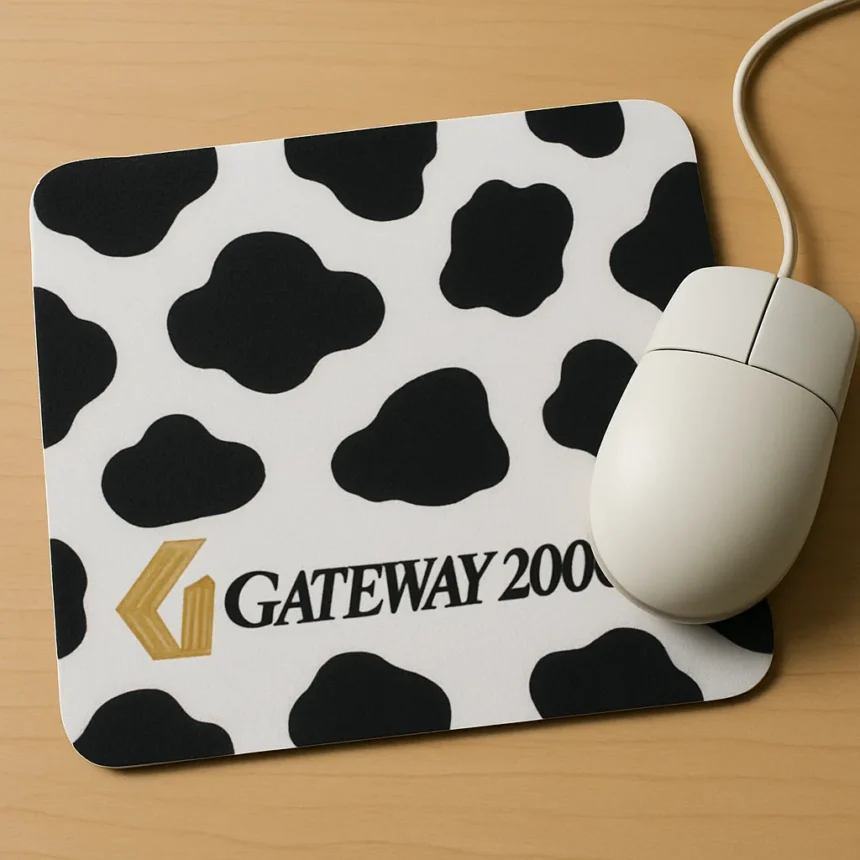
Gateway 2000 nostalgia swept through tech circles recently when a mouse pad bearing the company’s iconic cow-spotted design resurfaced, reminding a generation that one of the most improbable tech success stories began in a Sioux City, Iowa farmhouse. Founded in 1985 by Ted Waitt and Mike Hammond using just a $10,000 loan from Waitt’s grandmother, Gateway grew from selling Texas Instruments peripherals via mail order into a multi-billion-dollar PC powerhouse—then collapsed just as spectacularly. The mouse pad moment reveals something deeper: why a company dead for nearly two decades still commands emotional real estate in the minds of anyone who lived through the PC boom.
Key Takeaways
- Gateway 2000 generated over $100,000 in revenue within its first four months selling peripherals via mail order from a farmhouse
- By 1995, revenues hit $3.7 billion, making Gateway a top-tier PC manufacturer competing directly with Dell and Compaq
- A 1998 headquarters move to California proved catastrophic; founder Ted Waitt later called it “a big mistake”
- The 2007 acquisition by Acer for $710 million marked the end of Gateway as an independent brand
- Gateway’s cow-spotted boxes, tied to Waitt’s cattle farm origins, remain the most recognizable branding in PC history
From Livestock Exchange to PC Dominance
Gateway 2000’s origin story reads like a Silicon Valley fairy tale written by someone who had never left the Midwest. Waitt and Hammond started by selling add-on cards and memory upgrades for Texas Instruments computers from a farmhouse, generating over $100,000 in their first four months. When they pivoted to selling hand-assembled IBM-compatible PCs at prices undercut competitors, they found their moment. By 1987, revenues reached $1.5 million; by 1988, $12 million; by 1989, $70.6 million. The company didn’t just grow—it exploded.
The physical footprint expanded as aggressively as the revenue. Gateway moved from the farmhouse to a 5,000-square-foot Livestock Exchange building in Sioux City, then to North Sioux City, South Dakota, where the company capitalized on regional tax benefits. By 1990, revenues hit $275 million. The company’s mail-order model—direct sales bypassing retail middlemen—undercut Dell and Compaq while offering comparable quality. Gateway even stood out for offering free technical support at a time when competitors charged for phone help. The cow-spotted boxes weren’t marketing gimmick; they were literal branding, a visual reminder of the farm origins that made the entire story credible.
Gateway 2000 Nostalgia Peaks, Then the Company Falters
Gateway 2000 nostalgia was earned through dominance, not just longevity. By 1992, the company released its first notebook computer; revenues reached $1.1 billion. In 1995, Gateway’s $3.7 billion revenue placed it among the world’s largest PC makers. The company built an $18 million manufacturing plant in Hampton, Virginia and expanded globally, opening facilities in Malaysia and acquiring 80 percent of Australian PC maker Osborne Computer. Gateway went public in 1993 and launched gateway.com in 1995, early enough to own the domain that would define the brand online.


Then came the decision that unraveled everything. In 1998, Gateway dropped “2000” from its name and relocated its headquarters to San Diego and La Jolla, California. Waitt would later admit this was “a big mistake”. The move symbolized a shift away from the Midwestern authenticity that had made Gateway special. The company lost its regional identity, its manufacturing edge, and its soul. By 2000, the PC market downturn hit hard; Gateway’s employment peaked at around 25,000 worldwide but the company faced massive losses. When Waitt returned as CEO in 2001 to stabilize the company, he oversaw brutal restructuring: 9,400 jobs eliminated, nearly half the remaining workforce, and a net loss of $1.03 billion.
The Slow Irrelevance and Acquisition
Gateway 2000 nostalgia today exists precisely because the brand became irrelevant so thoroughly. The company tried pivoting to consumer electronics, acquiring eMachines in 2004 for roughly $300 million, but the magic was gone. Outsourced manufacturing replaced the quality-conscious assembly that had built the brand’s reputation. Products grew dull. The Midwestern charm evaporated. By 2006, Gateway employed only about 1,800 people and posted its first profit in years—a hollow victory. In 2007, Acer acquired Gateway for $710 million, absorbing the brand into its own portfolio. Gateway ceased to exist as an independent company, though its cow-spotted boxes occasionally resurface in Walmart, a ghost of former glory.



What makes Gateway 2000 nostalgia resonate is the contrast between what the company was and what it became. Dell pursued aggressive pricing and scale. Compaq chased enterprise customers. Gateway chose a different path: direct sales, regional authenticity, quality at accessible prices, and a visual identity tied to its founder’s actual life on a farm. When that identity was abandoned for California corporate blandness, the company lost the one thing that made it defensible against larger competitors with deeper resources. The mouse pad that sparked this nostalgic moment isn’t just a peripheral—it’s a physical artifact of a time when a company could build a multi-billion-dollar business by staying true to its roots, before the pressure to scale forced it to become something else entirely.
Why Does Gateway 2000 Nostalgia Still Hit So Hard?
The resurgence of Gateway 2000 nostalgia speaks to a broader hunger for tech companies with personality. In the 1990s, buying a Gateway meant buying into a story: a farm kid from Iowa outmaneuvering established PC makers through mail order, direct relationships with customers, and honest pricing. The cow boxes were memorable not because they were flashy but because they were true. Every box shipped was a reminder that this company came from somewhere real, not from a sterile corporate campus.
Today, when tech companies are increasingly interchangeable—when you cannot tell one Android phone from another, when every cloud service promises the same things—there is something almost heroic about a brand that succeeded by being aggressively, unapologetically itself. Gateway 2000 nostalgia is not really about the computers, which are now ancient and obsolete. It is about missing a time when a tech company’s origin story and its market position were inseparable. The mouse pad is just the trigger; the feeling is recognition that something real has been lost.
Could Gateway Have Survived?
The question haunts anyone who lived through Gateway’s collapse: what if Waitt had never moved to California? What if the company had stayed rooted in the Midwest, maintained its direct-sales model, and resisted the pressure to become a generic computer maker? The answer is probably that survival was impossible in the long term. Dell eventually dominated direct sales through superior logistics and scale. Compaq, HP, and other established players had resources Gateway could never match. The PC market commoditized, margins collapsed, and the mail-order advantage that made Gateway special became irrelevant.

But Gateway did not have to die the way it did. The company did not fail because of the market; it failed because it abandoned the strategy and identity that had made it succeed. A company that generated $3.7 billion in revenue in 1995 should not have been vulnerable to commodity competition by 2001. The California move, the outsourced manufacturing, the loss of customer support excellence—these were choices, not inevitabilities. Gateway 2000 nostalgia, then, is tinged with something sadder than simple longing for the past. It is regret for a path not taken, a company that had the resources and the brand equity to adapt but instead chose to become ordinary.
Is Gateway 2000 still in business?
Gateway ceased to exist as an independent company in 2007 when Acer acquired it for $710 million. While the Gateway brand name technically persists in some markets and Walmart occasionally carries products with the cow-spotted design, the company as a standalone PC manufacturer is gone. Acer absorbed all remaining operations and intellectual property.
What made Gateway 2000 different from Dell and Compaq?
Gateway 2000 competed through direct mail-order sales, lower prices, and regional authenticity, while Dell pursued aggressive pricing and scale and Compaq focused on enterprise customers. Gateway’s cow-spotted boxes and Midwestern farm origins gave it a distinctive brand identity that competitors could not replicate. The company also offered free technical support when rivals charged for phone assistance.
Why did Gateway move to California?
In 1998, Gateway relocated its headquarters from South Dakota to San Diego and La Jolla, California. Founder Ted Waitt later acknowledged this was “a big mistake,” as the move symbolized a shift away from the Midwestern identity that had made the brand unique and contributed to the company’s loss of market position and cultural relevance.
Gateway 2000 nostalgia endures because the brand represents a moment when a tech company could build something genuinely different and genuinely successful without needing to become a faceless corporation. The mouse pad that sparked this wave of remembrance is a small artifact of a larger truth: sometimes the most powerful brands are the ones that know who they are and refuse to apologize for it. Gateway forgot that lesson, and the market moved on. But the memory lingers, especially among those who received a computer in a cow-spotted box and believed, for a moment, that a company from a farmhouse in Iowa could change the world.
Edited by the All Things Geek team.
Source: TechRadar