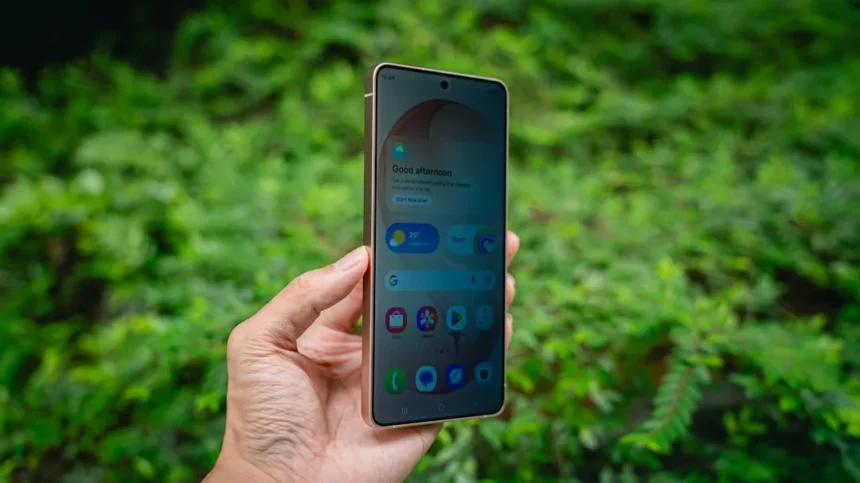
The Galaxy S26 Ultra display is Samsung’s newest flagship screen, but it comes with a hardware quirk that the company has now publicly acknowledged. The 6.9-inch OLED panel uses a modified pixel structure designed for privacy, and that modification creates measurable brightness and color variations when you tilt the phone, even when the Privacy Display feature is turned off.
Key Takeaways
- Galaxy S26 Ultra uses modified pixels for Privacy Display that affect brightness at angles, regardless of whether the feature is enabled
- Variations are most noticeable at maximum brightness and specific viewing angles, less apparent during normal use
- Samsung states the impact on actual usage is negligible, but users report eyestrain and reduced crispness
- Galaxy S25 Ultra maintains superior brightness and color density at angles thanks to its traditional pixel structure
- The issue stems from a square pixel arrangement of two green, one blue, and one red subpixels, deviating from typical diamond PenTile matrices
What Samsung Admits About the Galaxy S26 Ultra Display
Samsung confirmed to TechRadar that the Galaxy S26 Ultra display includes variations in brightness and color when held at certain angles and maximum brightness settings. The company stated: Some variation will be seen when the phone is held at certain angles and when set to maximum brightness, however, any impact on actual usage when holding the phone should be negligible. This marks an unusual admission from Samsung, which typically downplays hardware compromises in flagship devices.
The root cause is the modified M14 OLED panel architecture. Unlike previous Galaxy Ultra models, the S26 Ultra redesigns pixels into wide-angle and narrow-angle types to enable the Privacy Display feature. When Privacy Display is active, the narrow pixels illuminate while wide pixels dim, controlling the light path and reducing off-axis visibility. When the feature is off, both pixel types remain active, but their presence in the panel still affects how light scatters at different angles.
How the Galaxy S26 Ultra Display Compares to Its Predecessor
Side-by-side testing reveals meaningful differences between the S26 Ultra and Galaxy S25 Ultra. The S25 Ultra maintains brighter and more consistent color density when viewed from angles, thanks to its traditional pixel structure and superior anti-reflective coating. A TechRadar reviewer noted that the difference was not immediately obvious during normal use: I never noticed it during my initial testing. To test the theory, I had to put it alongside the S25 Ultra and then view them from an angle to really see the brightness difference.


This suggests the issue may be less noticeable in isolation but becomes apparent in direct comparison or at specific angles. The variations are most pronounced at maximum brightness settings and viewing angles of 30 degrees, 60 degrees, and beyond. At lower brightness levels or normal viewing positions, the effect diminishes considerably.
The Real-World Impact of Galaxy S26 Ultra Display Variations
While Samsung claims the impact is negligible, user reports and technical analysis tell a more complex story. The modified pixel structure affects not just brightness but also perceived crispness. The display appears less sharp overall due to the pixel layout, a compromise mitigated only by a sharpening filter built into the Gallery app. Additionally, some users have reported eyestrain and even nausea from the pixel patterns, which can resemble the visual distortion of uncalibrated 3D screens.



The Privacy Display feature itself, when enabled, dims off-axis visibility by illuminating only the narrow pixels. When disabled, this selective illumination ceases, but the underlying pixel architecture remains. This means the Galaxy S26 Ultra display cannot return to the pixel uniformity of the S25 Ultra or earlier models, regardless of settings.
Should You Worry About the Galaxy S26 Ultra Display?
For most users in typical usage scenarios, the Galaxy S26 Ultra display variations will likely go unnoticed. The phone is held relatively straight during normal viewing, and brightness variations become apparent primarily at extreme angles or maximum brightness. However, if you frequently compare your phone to another device, view content at wide angles, or have sensitivity to pixel patterns, the issue may be noticeable.
The decision ultimately depends on your priorities. The S26 Ultra’s Privacy Display is a legitimate privacy feature that prevents shoulder-surfers from seeing your screen. That feature comes with a trade-off in display uniformity and crispness. If privacy is a priority, the compromise may be acceptable. If display quality is paramount, the Galaxy S25 Ultra remains the superior choice.
Does the Galaxy S26 Ultra Privacy Display actually work?
Yes, Privacy Display does reduce off-axis visibility by controlling the light path through narrow pixels. However, it does not completely block viewing from moderate angles, only significantly dims it. The feature works as intended for its stated purpose, though the pixel modification creates the brightness variation issue even when the feature is off.



Why does the Galaxy S26 Ultra display look less crisp?
The modified pixel arrangement for Privacy Display deviates from the standard diamond PenTile matrix used in previous models. This new square layout of two green, one blue, and one red subpixels reduces perceived sharpness, which Samsung has attempted to mitigate with a sharpening filter in the Gallery app.
How noticeable is the brightness variation in normal use?
The brightness variation is most noticeable at maximum brightness and specific viewing angles like 30 or 60 degrees. During typical use with the phone held at normal angles and moderate brightness, the effect is subtle and likely undetectable to most users.
The Galaxy S26 Ultra display controversy highlights the tension between innovation and compromise in smartphone design. Samsung prioritized privacy features over display uniformity, and that choice comes with visible trade-offs. The company’s admission of these variations, while unusual, at least provides transparency. Buyers now know what they are getting: a privacy-focused display with measurable but generally subtle brightness inconsistencies at extreme angles. Whether that trade-off is worth it depends entirely on how you use your phone.
Edited by the All Things Geek team.
Source: Tom's Guide