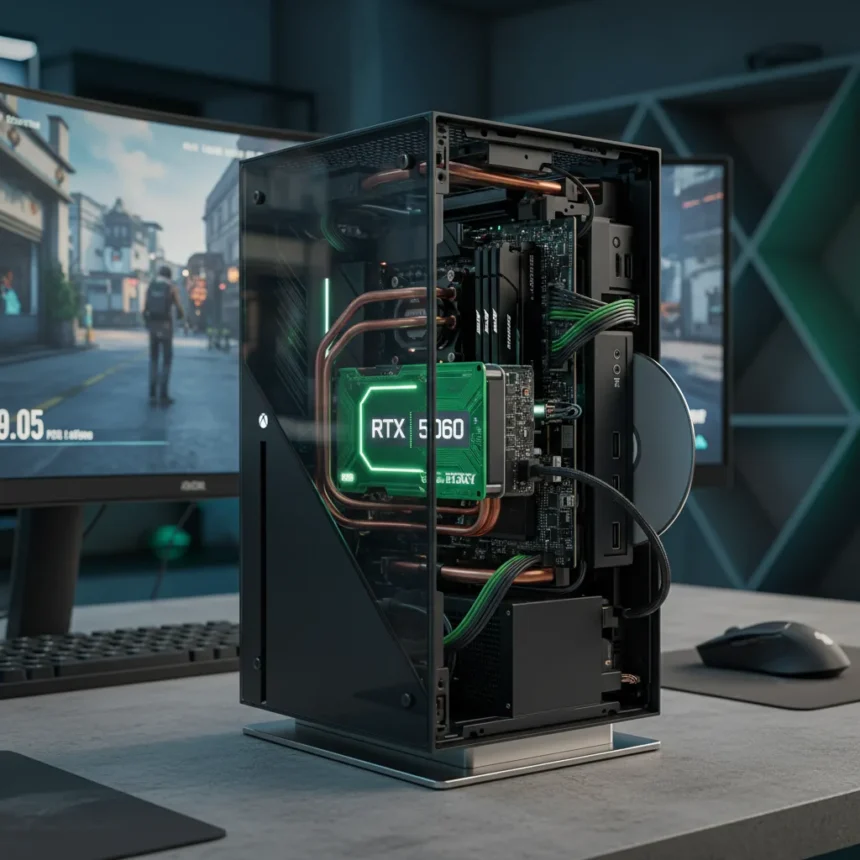
A modder has successfully transformed an Xbox Series X console into a fully functional gaming PC with RTX 5060-level performance, demonstrating that console-to-desktop conversion is not just theoretically possible but practically achievable. The project retains the original disc drive while delivering desktop-class gaming power in a compact form factor, raising questions about the future of gaming hardware design and Microsoft’s rumored next-generation plans.
Key Takeaways
- Xbox Series X GPU matches RTX 5060 Mobile core count at 3328 CUDA cores but runs at lower clocks and power draw
- RTX 5060 desktop variant offers 512 additional cores and superior TFLOPS (19.18 vs 12.15) with DLSS support
- Mod maintains working disc drive functionality while achieving compact gaming PC form factor
- Project Helix, Microsoft’s next-gen Xbox, uses custom AMD SoC with FSR Diamond upscaling, not Nvidia architecture
- Xbox Series X carries 25% more VRAM than RTX 5060 (10 GB vs 8 GB) but lacks dedicated ray tracing and tensor cores
How the Xbox Series X GPU compares to RTX 5060 specs
The Xbox Series X GPU and Nvidia’s RTX 5060 sit in an interesting middle ground when compared directly. The Xbox Series X GPU features 3328 CUDA cores running at 1825 MHz base and 1725 MHz boost, built on a 7 nanometer process with 200W TDP and 12.15 TFLOPS of performance. The RTX 5060 desktop GPU, by contrast, packs 3840 CUDA cores at 2280 MHz base and 2497 MHz boost, manufactured on a newer 5 nanometer process, delivering 19.18 TFLOPS with just 145W TDP.
Where the Xbox Series X wins is raw memory bandwidth. It carries 10 GB of VRAM versus the RTX 5060’s 8 GB, giving it a texture fill rate advantage of 379.6 compared to 299.6. However, the RTX 5060 brings specialized hardware the Xbox GPU lacks: 120 Tensor Cores for AI acceleration, 30 Ray Tracing Cores for real-time ray tracing, and support for DLSS upscaling technology. The 5 nanometer fabrication also means the Nvidia card handles higher clock speeds and greater transistor density (21,900 million versus 15,300 million) within a tighter power envelope.
The RTX 5060 Mobile variant tells a different story. It shares the Xbox Series X’s 3328 core count but runs at significantly lower clocks—952 MHz base and 1455 MHz boost—due to its 45W power budget. This makes the mobile version closer in thermal profile to the console, though it still includes 104 Tensor Cores and 26 Ray Tracing Cores that the Xbox GPU cannot match.


Why this mod evokes Microsoft’s Project Helix concept
The modder’s achievement carries strong echoes of Project Helix, Microsoft’s confirmed next-generation Xbox initiative. While the mod physically transforms an existing console into a PC, Helix represents Microsoft’s vision for a purpose-built handheld gaming device powered by a custom AMD SoC rather than Nvidia silicon. Both projects share a common thread: rethinking the boundary between dedicated gaming hardware and general-purpose computing.
Project Helix incorporates FSR Diamond upscaling technology, AMD’s answer to Nvidia’s DLSS, positioning the next-gen Xbox as a compact, efficient gaming platform. The modded Xbox Series X, similarly, achieves high frame rates and disc drive functionality in a form factor far smaller than a traditional tower PC. This compact custom engineering—whether through hardware modification or purpose-built SoC design—represents where gaming hardware appears to be heading: smaller, more efficient, and less reliant on traditional desktop conventions.


The mod does not run Helix software or use Helix architecture, but the conceptual overlap is genuine. Both demonstrate that console-grade gaming performance no longer requires the bulk of a traditional gaming PC, challenging the assumption that power and portability are inherently at odds.
What makes console-to-PC conversion challenging
Converting a sealed console into a functional gaming PC is not a trivial undertaking. The Xbox Series X was engineered as a closed system with custom cooling, proprietary power delivery, and tightly integrated firmware. A successful mod must address thermal management, ensure stable power distribution, integrate standard PC components (motherboard, power supply, storage), and maintain or replace the original disc drive functionality.
The fact that this modder preserved the disc drive while achieving RTX 5060-equivalent performance suggests careful attention to space constraints and component selection. A standard tower PC leaves room for multiple graphics cards, large heatsinks, and redundant cooling fans. A console-based build offers none of that luxury. Every millimeter counts, and thermal efficiency becomes critical. The original Xbox Series X’s 200W GPU TDP leaves little headroom for additional PC components without risking thermal throttling.
Most console-to-PC conversions either sacrifice performance for portability or abandon the original form factor entirely. This mod achieves both—maintaining the compact console shell while delivering desktop-class gaming performance. That balance is what makes the project noteworthy and what connects it conceptually to Project Helix’s goal of delivering console-tier gaming in a handheld device.


RTX 5060 performance for gaming and everyday use
The RTX 5060 desktop GPU sits at the entry level of Nvidia’s current discrete GPU lineup, but entry-level does not mean weak. With 3840 CUDA cores and 19.18 TFLOPS, the card handles 1440p gaming at high settings across most modern titles, and 1080p gaming at maximum settings with high frame rates. DLSS support means games can push even higher visual fidelity by leveraging AI upscaling, a feature the original Xbox Series X GPU cannot replicate.
For everyday computing—web browsing, content creation, video editing—the RTX 5060 brings enough horsepower to accelerate CUDA-based workflows without the power consumption or heat output of higher-end cards. At 145W TDP, it pairs with modest power supplies and requires minimal cooling infrastructure. This efficiency is one reason the RTX 5060 appeals to modders and system builders seeking balance between performance and practicality.
The modded Xbox Series X, running equivalent performance in a console form factor, essentially offers the same gaming capability with the added benefit of retaining the disc drive for backward compatibility with physical media. For users who value that library of physical games, the mod delivers something a standard RTX 5060 build cannot: preservation of the original hardware’s media ecosystem.
Is console modding the future of gaming hardware?
This project raises a legitimate question: as console and PC hardware continue to converge architecturally, will more users attempt to bridge the gap through modification? The answer likely depends on accessibility and risk tolerance. Console modding voids warranties, requires technical expertise, and carries the risk of permanently damaging valuable hardware if something goes wrong.
Microsoft’s approach with Project Helix suggests the company believes the future lies in purpose-built devices, not user modifications. Rather than expecting gamers to hack their consoles into PCs, Helix aims to deliver a device that is natively both—a handheld with console-grade gaming and PC-like flexibility. That is a more elegant solution than requiring users to perform delicate hardware surgery.
Still, the fact that a modder can successfully perform this conversion at all signals that the technical barriers between console and PC are genuinely eroding. The modded Xbox Series X proves the concept works. Whether it becomes a trend or remains a curiosity depends on whether manufacturers continue locking down their hardware or embrace the modding community’s innovations.
FAQ
Can you actually buy an Xbox Series X and convert it to a PC yourself?
The research brief does not detail the modding process or provide step-by-step instructions, so replication feasibility is unverified. This appears to be a custom engineering project by an experienced modder, not a documented procedure for average users. Attempting such a conversion would void your warranty and risks permanent hardware damage.
Does the modded Xbox Series X outperform a standard RTX 5060 gaming PC?
Performance depends on the specific RTX 5060 variant. The desktop RTX 5060 delivers higher TFLOPS (19.18 vs 12.15) and includes DLSS support, giving it an edge in demanding games. The RTX 5060 Mobile matches the Xbox Series X’s core count but runs at lower clocks. Real-world gaming performance would depend on cooling, power delivery, and driver optimization in the modded system versus a standard PC build.
What is Project Helix and how does it relate to this mod?
Project Helix is Microsoft’s confirmed next-generation Xbox, powered by a custom AMD SoC with FSR Diamond upscaling technology. While the mod repurposes existing console hardware into a PC, Helix represents Microsoft’s vision for purpose-built next-gen hardware combining console gaming with PC-like flexibility. Both challenge traditional assumptions about gaming hardware form factors and power efficiency.
The modded Xbox Series X proves that console-to-PC conversion is technically feasible, but it remains a niche undertaking requiring specialized expertise and significant risk. What matters more is that the project demonstrates the blurring line between console and PC architectures—a trend that will likely accelerate as manufacturers like Microsoft develop devices like Project Helix that natively bridge both ecosystems. For now, most gamers are better served waiting for purpose-built hardware than attempting their own conversions.
Edited by the All Things Geek team.
Source: Windows Central