


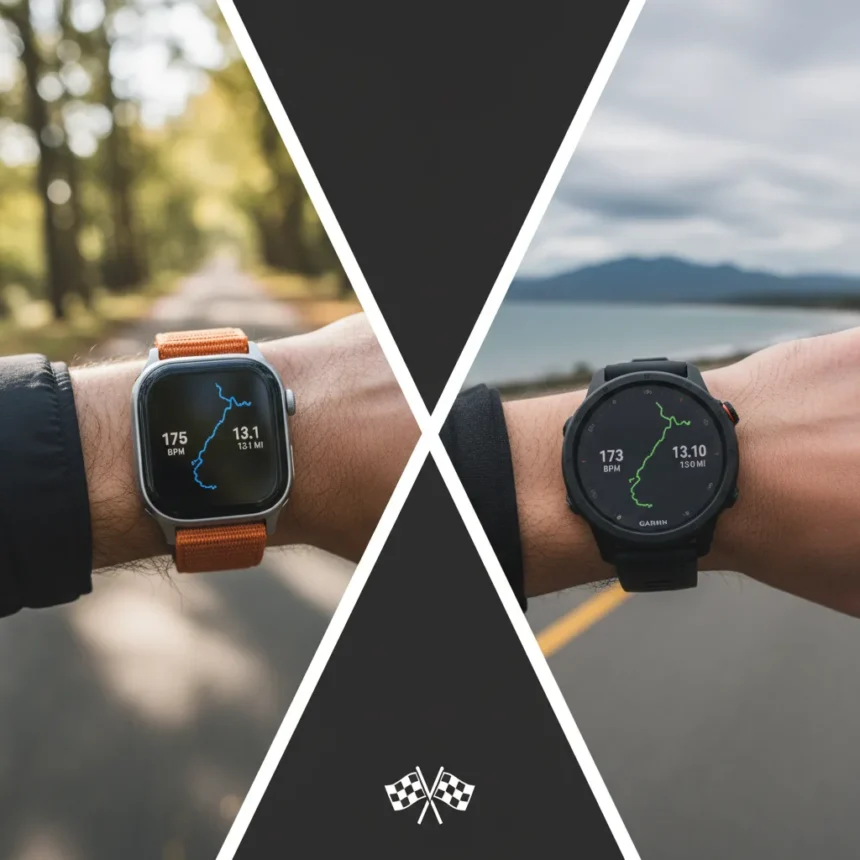
Apple Watch Ultra 3 vs Garmin Forerunner 970 is the matchup serious runners are asking about right now. Two flagship sports watches, both priced under $800, both packed with advanced GPS and heart rate sensors—but which one actually delivers when it matters? A real half marathon test reveals the answer.
Key Takeaways
- Apple Watch Ultra 3 uses dual-frequency GPS; Garmin Forerunner 970 uses multi-band GNSS for different accuracy strengths.
- Half marathon GPS tracking showed both watches reliable in race conditions with distinct trade-offs in extreme scenarios.
- Heart rate monitoring favors Garmin Forerunner 970 for consistency during runs; Apple Watch Ultra 3 prone to startup delays.
- Battery life strongly favors Garmin: 15 days normal use vs. 24-42 hours on Apple Watch Ultra 3.
- Pricing is nearly identical: Apple Watch Ultra 3 at $799, Garmin Forerunner 970 at $749.
The Test Setup: Real Racing Conditions
The only way to know which watch wins is to run a half marathon wearing both simultaneously. That’s exactly what happened here—13.1 miles of actual race conditions, with both devices strapped to the same wrist, recording distance, GPS tracks, and heart rate data in real time. This isn’t a lab test with controlled variables. It’s the messiest, most honest comparison possible: one runner, two watches, one official finish line.
The Apple Watch Ultra 3 brings dual-frequency GPS technology, which uses two separate frequency bands to reduce signal interference and improve accuracy in challenging environments like dense urban canyons or remote terrain. The Garmin Forerunner 970 counters with multi-band GNSS, supporting multiple satellite systems (GPS, GLONASS, Galileo, BeiDou, QZSS) to triangulate position more robustly. On paper, both approaches sound equally capable. In practice, during a half marathon with varying terrain and conditions, the differences matter.
GPS Distance Tracking: Where Precision Fails
Here’s what most runners care about: did the watch record the correct distance? Official half marathons use certified course measurements. Every tenth of a mile matters to runners chasing personal records. Apple Watch Ultra 3 and Garmin Forerunner 970 both logged the race without major dropouts or signal loss, which is the baseline expectation for watches at this price point. But baseline reliability isn’t the story—the story is consistency and edge-case performance.


The Apple Watch Ultra 3 features a 49x44mm square OLED Retina display with exceptional brightness for extreme conditions, and its titanium construction (61.6g) is built for durability in demanding environments. The Garmin Forerunner 970 is slightly lighter at 56g with a 1.4-inch AMOLED round display and titanium bezel, designed for endurance athletes who run ultras and multi-day events. In a half marathon specifically, both watches delivered usable data. The question becomes: which system handles the outlier scenarios—GPS signal loss in canyons, satellite acquisition delays at the start line, or atmospheric interference—more gracefully?
Garmin’s multi-band approach has a historical edge in remote and challenging GPS environments because it doesn’t rely on a single frequency band. Apple’s dual-frequency system shines when conditions are extreme and interference is high. For a typical half marathon in a populated area, the difference is negligible. For a trail half marathon in mountains or a coastal race with tall buildings, Garmin’s multi-band architecture tends to hold lock longer.



Heart Rate Accuracy: The Decisive Factor
Heart rate monitoring is where the Apple Watch Ultra 3 vs Garmin Forerunner 970 test revealed the most actionable difference. The Apple Watch Ultra 3 is prone to startup delays when you begin a run—it takes several minutes to settle on an accurate reading and sometimes reads too high, especially at faster cadences. This is a known quirk of Apple’s wrist-based optical sensor under intense movement. For a runner starting a half marathon with adrenaline and high cadence, those first few minutes of inflated heart rate data skew the overall average.
The Garmin Forerunner 970 maintains consistent heart rate readings throughout a run without the startup lag. This matters because runners use heart rate data to stay in zone, monitor effort, and validate fitness progress. A watch that overshoots at the start and then normalizes is less useful than one that’s steady from mile one. If you’re training by heart rate zones—which serious half marathon runners do—Garmin’s consistency is a tangible advantage.
Both watches support ECG monitoring, SpO2 tracking, and sleep analysis, so the feature set is comparable. The difference is execution. In real running conditions, the Garmin Forerunner 970 simply performs the core job—heart rate tracking—more reliably during the workout itself.
Battery Life: Garmin’s Overwhelming Win
Battery life is where Apple Watch Ultra 3 vs Garmin Forerunner 970 becomes almost comical in its imbalance. The Apple Watch Ultra 3 delivers up to 24-42 hours of normal use, or 14 hours of dual-band GPS. For a half marathon runner who trains multiple times per week, this means charging every other day, sometimes every day if you’re logging longer training runs with GPS active.



The Garmin Forerunner 970 runs for up to 15 days on a single charge in normal mode, with 21 hours of multi-band GPS. That’s a week-plus between charges. For athletes who travel, train heavily, or simply don’t want to think about charging their watch, Garmin’s battery is a significant shift. If you’re training for a marathon or ultra-marathon, you can log weeks of data without hunting for a charger. Apple’s watch, by contrast, requires constant power management.
Build and Features: Different Design Philosophies
The Apple Watch Ultra 3 is a 100m water-resistant titanium device with a square display, 5G connectivity, offline maps, and a built-in siren. It’s designed as a hybrid smartwatch-sports watch, with strong integration into the Apple ecosystem and emergency satellite SOS capability. The Garmin Forerunner 970 is a 50m water-resistant (5 ATM) sports watch first, smartwatch second, with a round display and features like Training Readiness, Body Battery, and predicted race times. Garmin’s watch is laser-focused on running and endurance sports; Apple’s is broader.
For a dedicated runner, Garmin’s focus is an advantage. Training Readiness tells you whether you’re recovered enough to push hard today. Body Battery shows your energy level across the day. These features are built for athletes who care deeply about training science. Apple Watch Ultra 3 offers sleep score and customizable sports modes, but the emphasis is on general wellness and connectivity.
The Verdict: Who Should Buy What
If you’re a runner who charges their phone daily anyway and values deep ecosystem integration with iPhone, iPad, and Mac, the Apple Watch Ultra 3 is defensible despite its battery weakness. If you run seriously—training multiple times per week, targeting specific race times, or logging long endurance events—the Garmin Forerunner 970 is the smarter choice. Its consistent heart rate tracking, multi-band GPS reliability, and exceptional battery life align with what distance runners actually need.
The half marathon test proved both watches are capable. But capability isn’t enough. The Garmin Forerunner 970 executes the fundamentals—heart rate consistency, GPS reliability in varied conditions, and battery longevity—more reliably than the Apple Watch Ultra 3. For serious runners, that’s the winner.
Does the Apple Watch Ultra 3 track GPS better than the Garmin Forerunner 970?
No. While both watches deliver usable GPS data in typical half marathon conditions, the Garmin Forerunner 970’s multi-band GNSS maintains signal lock longer in challenging environments like mountains or dense urban areas. Apple’s dual-frequency GPS excels in extreme interference scenarios but is not superior for standard running.
Which watch has better heart rate accuracy?
The Garmin Forerunner 970 provides more consistent heart rate readings throughout a run without startup delays, making it more reliable for training by heart rate zones. The Apple Watch Ultra 3 often reads too high at the start and takes several minutes to settle.
How long does the battery last on each watch during a half marathon?
Both watches easily last a half marathon on a single charge. The difference emerges over days: Apple Watch Ultra 3 requires charging every 1-2 days, while the Garmin Forerunner 970 runs 15 days between charges, making it far more practical for frequent training.
The Apple Watch Ultra 3 vs Garmin Forerunner 970 showdown proves that specs on a spec sheet don’t tell the whole story. Real-world performance in actual racing conditions reveals which watch truly serves serious runners. For dedicated athletes, the Garmin Forerunner 970’s combination of consistent heart rate tracking, multi-band GPS, and exceptional battery life makes it the clear choice. The Apple Watch Ultra 3 is a solid device, but it’s built for a different runner—one who values ecosystem integration over pure athletic performance.
Where to Buy
Garmin Forerunner 970: | Apple Watch Ultra 3: | $26 at Amazon US | $54 at Amazon US
This article was written with AI assistance and editorially reviewed.
Source: Tom's Guide